Somewhere in a DoorDash office, an employee is staring at a dashboard tracking disputes: customers who swear their food never showed up, even though a driver marked it delivered. For a provider serving 5.5 million orders a day, that small problem is big enough to allocate an internal dedicated team.
This example illustrates why on-demand food delivery app development involves far more than creating menus, payment flows, and order tracking. Once an application enters real-world use, it must handle thousands of operational exceptions and disputes that are difficult to predict early on.
In this article, we examine how to prepare for that complexity. We’ll compare technical approaches and their cost implications, identify the essential features and compliance requirements, explore the monetization models available, and examine common challenges new businesses encounter.
The market at a glance
The food delivery market is only getting bigger, and a handful of companies already own most of it. In 2026, the market’s revenue is expected to reach US$1.51tn, with grocery delivery holding its 68.9% share.
In the US, that growth flows almost entirely through two apps. DoorDash holds about 67% of the market to Uber Eats’ 23%. China tells a similar story with a different lead actor: Meituan has a comparable share, around 70%.
And restaurants, for all their complaints about commission cuts, mostly seem glad delivery exists at all. About four in five operators, 81% in the actual survey, reported takeout and delivery sales rising in 2025.
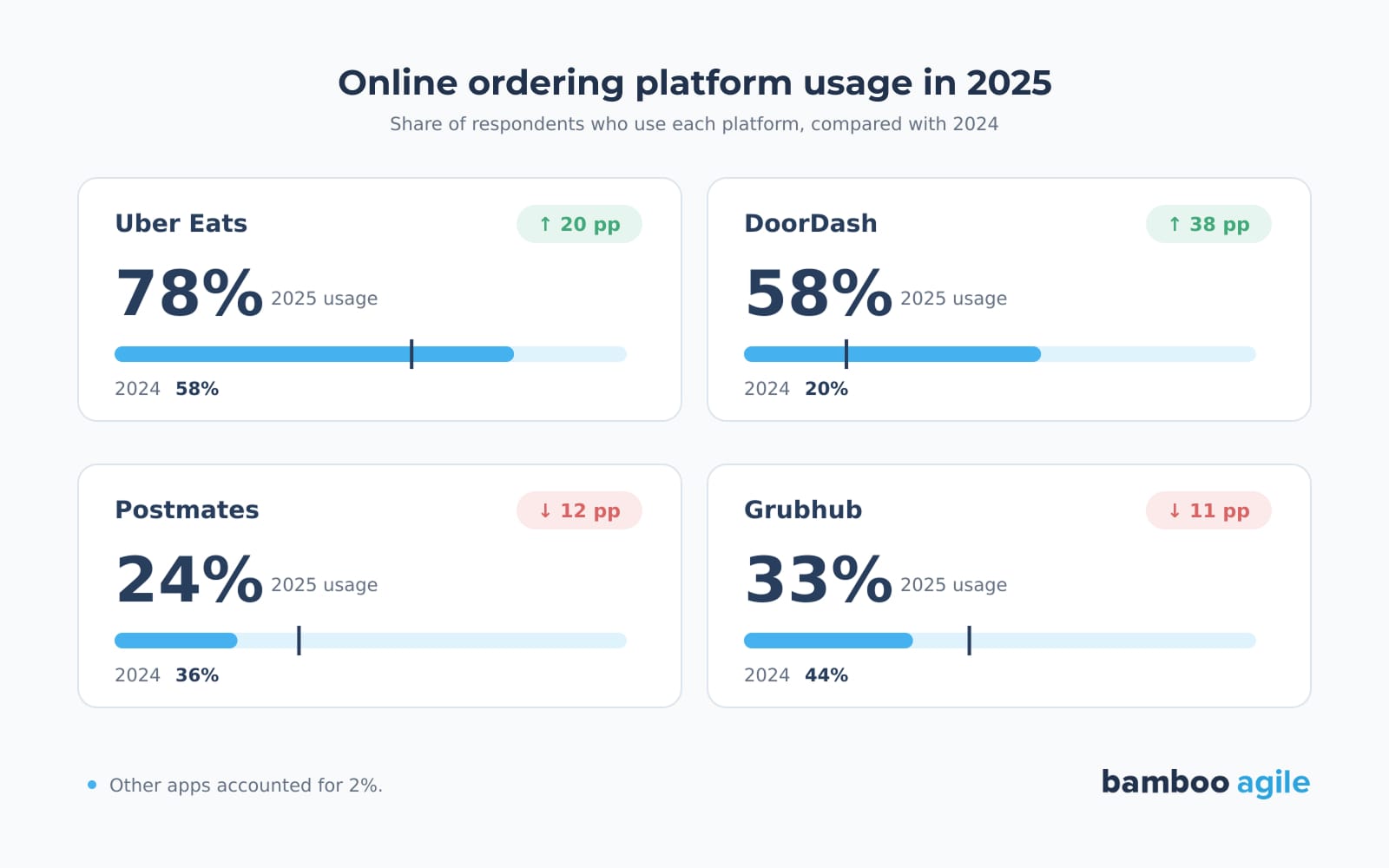
A market of that size draws a lot of competition. Naturally, a company with limited resources should think carefully about how it enters, and never treat the priciest option as the only default choice.
Should you build a custom food delivery app, or go white-label, low-code, or no-code?
The decision about the development approach shapes everything downstream, be it budget, timeline, or how much control the business retains. It’s also more than the usual two-way “build vs. buy” question.
No-code platforms like Bubble or Glide let a single restaurant or small delivery operator get an app live within days or weeks, using visual, drag-and-drop tools with no handwritten code at all. The tradeoff is a ceiling: as order volume grows or the business wants features the builder doesn’t support, migrating off the platform later can mean starting over. Still, this path suits validation stages well.
One rung up from that, low-code solutions like OutSystems, Mendix, Microsoft Power Apps, or Retool trade some of that simplicity for more flexibility. They’re still primarily visual, but they let a technical team drop into custom code for advanced logic, integrations, or a payment flow a generic builder can’t handle.
Alternatively, you can start with white-label platforms – Yo!Yumm, Deliverect, Flipdish, or Oyelabs – pre-built systems, where customer apps, restaurant dashboards, delivery apps are licensed and rebranded under a business’s own name. They allow you to launch quickly and are affordable, even though you should be ready for ongoing licensing fees or commission-sharing.
And at the far end of all three, custom food delivery application development gives full ownership of the code, complete control over features and user experience, and the ability to scale without platform limits. It also takes the longest and costs the most, and it pays off best once the business already has enough orders to justify the investment.
| Business stage | Budget / Cost | Timeline | Recommended path |
| Single restaurant or small chain testing food delivery demand | <$10,000 | Needs to launch in weeks | White-label platform or no-code app builder |
| Regional chain or multi-location brand | $10,000–$80,000 | Weeks to a few of months | White-label platform or no/low-code platform with custom logic layered on top |
| Multi-vendor marketplace, aggregator, or funded startup building for scale | $80,000+ | Multiple months | Fully custom development |
Each path fits a different stage of a business’s growth. A provider that picks custom development before validating demand often ends up with an expensive, even though a feature-rich app and very few users to justify it. A company that outgrows a no-code or low-code platform without planning for migration ends up rebuilding from scratch later.
Business models
The next question is what kind of business you wish to have, since that shapes which features matter and how the app makes money.
| Model | Control level | Capital needed | Revenue source | Example |
| Aggregator | Low to moderate | Low | Restaurant commissions, delivery fees | Multi-restaurant marketplace app |
| Delivery-service (logistics-owned) | High | Moderate to high | Delivery fees, commissions, surge pricing | Platform with its own driver fleet |
| Cloud kitchen | High over food, none over dine-in | Moderate | Direct food sales | Delivery-only virtual restaurant brands |
| Direct-to-consumer (D2C) | Full | Low to moderate | Direct sales, loyalty programs | Restaurant chain’s own branded app |
An aggregator (think a mini Uber Eats) connects many restaurants to many customers and takes a cut. It’s usually the easiest door in for a first-timer, since restaurants still often handle delivery too.
A delivery-service model owns the logistics itself, trading higher operating complexity for more control over speed and consistency.
A cloud kitchen setup skips the dining room entirely, running delivery-only brands out of a shared kitchen.
Direct-to-consumer apps belong to a single restaurant or chain, cutting out aggregator commissions and keeping the full customer relationship.
Monetization strategies
Choosing a business model answers who the app serves. Now, let’s take a look at how a food delivery business can make money:
- Commission per order is a percentage fee charged to restaurants; this is the most common baseline revenue source for an app owner.
- Delivery fees are charged to customers, often varying by distance or demand during certain hours.
- Subscription or membership plans trade a recurring fee for perks like free delivery. Most apps like Wolt or Bold Food offer to subscribe to a “Plus” or similar tariff to avoid delivery fees from many places, but not all.
- Featured listings and sponsored placement let restaurants pay for visibility in search results or on promotional banners.
- In-app advertising sells space to complementary brands, such as beverage or dessert companies, within the ordering flow.
- Cross-selling partnerships add grocery or convenience items to the platform, generating additional order value.
/
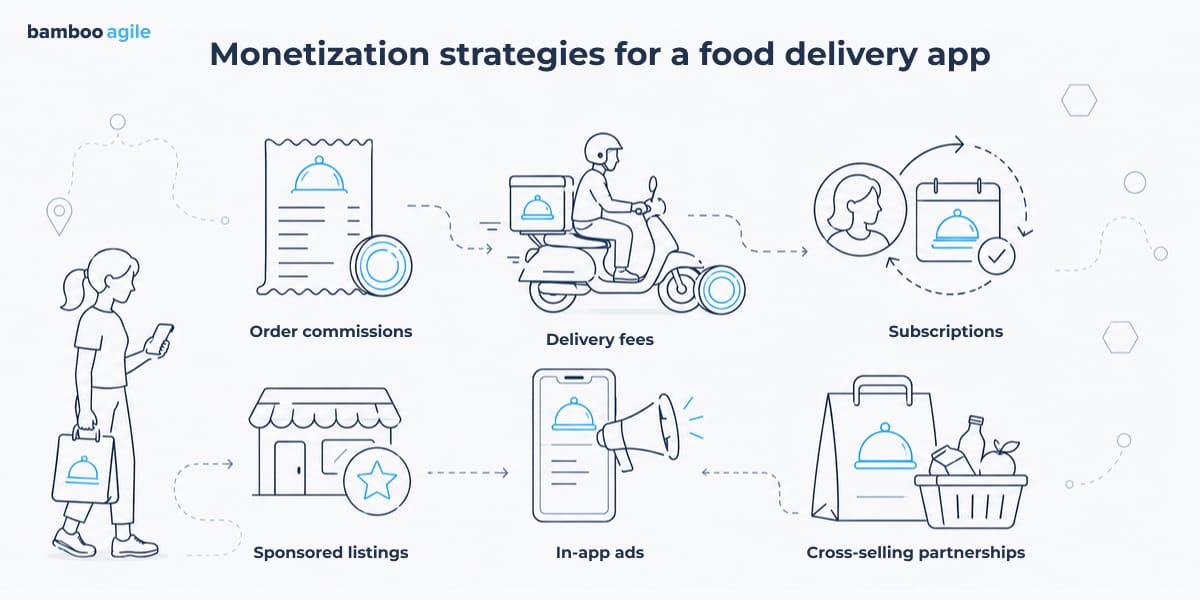
Most platforms combine two or three of these, since commission alone tends to annoy restaurants, and delivery fees alone can make people order less often.
Still, stacking revenue streams isn’t automatically painless, though. A 2025 academic case study on Zomato’s push toward profitability found that adding new business lines, like its Blinkit quick-commerce arm and District events business, on top of the core delivery business created real friction with the restaurants and delivery workers.
How to make a food delivery app compliant with legal regulatory requirements
Food safety disclosure
Depending on where the app operates, both the platform and the restaurants-partners may need to disclose things like food handling practices, allergen information, or licensing status. This varies by country and even by city – oftentimes can be met in the EU and the UK, so local legal counsel is worth consulting during the discovery phase.
Driver classification
If delivery drivers count as employees or independent contractors, the business may have real legal and financial consequences, and such rules keep changing in many regions. A platform’s business model, particularly whether it operates its own delivery fleet, affects this classification.
That classification question feeds directly into a related one: how drivers get paid.
Pay and tip transparency
DoorDash has paid out settlements over exactly this: $2.5 million to the District of Columbia in 2020, then $16.75 million to New York in 2025 over a similar practice used in Illinois in 2024. A driver would be promised a set minimum for a delivery, and if the customer’s tip fell short of that minimum, DoorDash covered the gap, but if the tip covered it or exceeded it, DoorDash contributed less of its own money. The tip was quietly propping up DoorDash’s payout. Any platform building its own pay logic should keep tips and guaranteed pay fully separate and disclose the breakdown clearly.
Dynamic and personalized pricing
Charging different customers different prices for the same order has drawn direct regulatory attention. Instacart halted its AI-driven price-testing tools in December 2025 after the FTC issued a civil investigative demand, following a Consumer Reports investigation that found identical grocery items priced up to 23% apart depending on which customer was buying. Regulators appear to be responding to the lack of transparency as much as the pricing itself.
Data privacy specifics
Food delivery apps collect location data constantly, well beyond the moment of checkout, so that data needs to be stored and shared with more care than a typical app requires. Platforms serving alcohol delivery also need age-verification mechanisms built in from the start.
Core food delivery application features across user groups
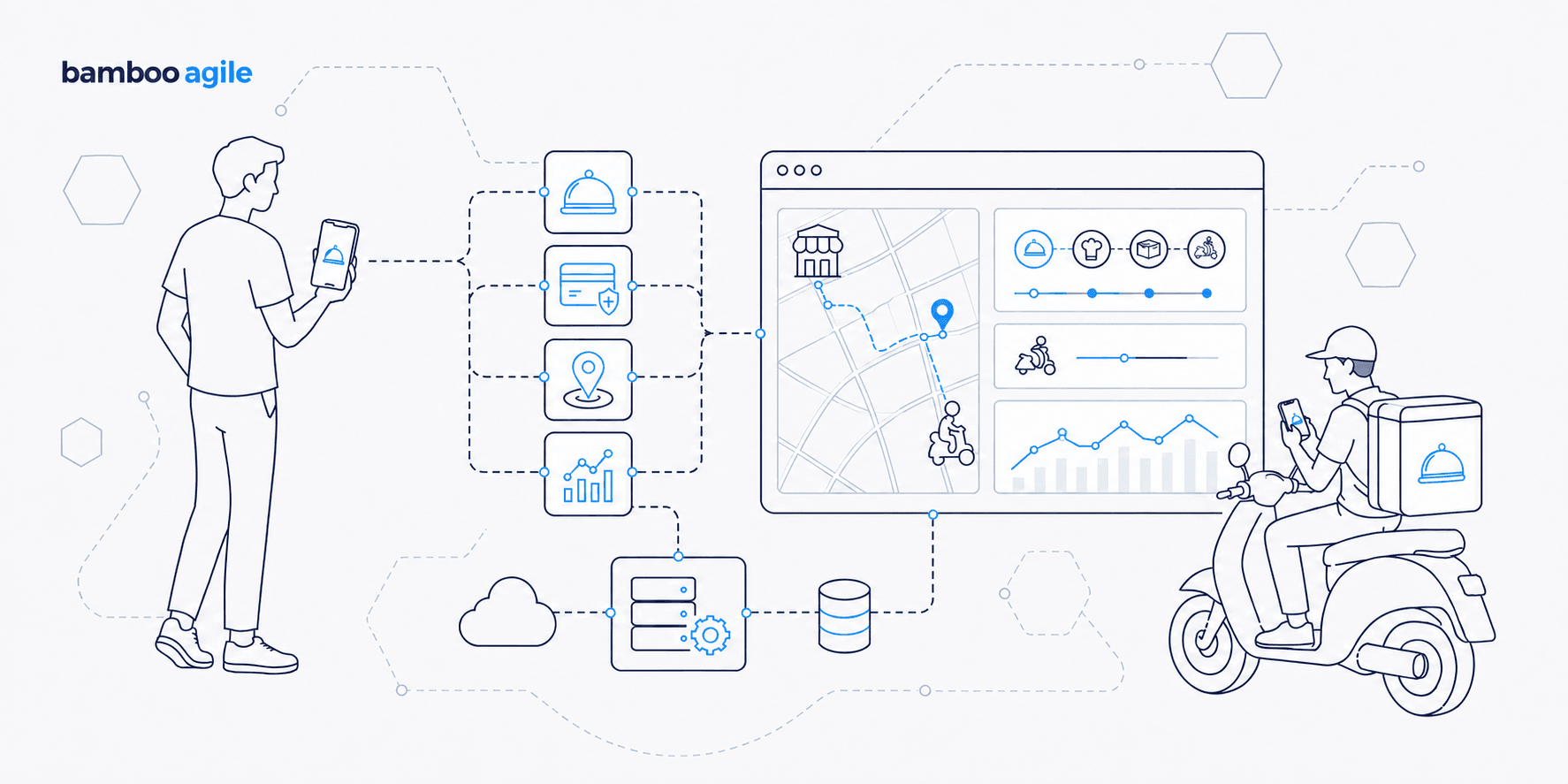
With the build path, business model, monetization approach, and legal groundwork settled, you might think about the app’s future capabilities. A working food delivery app is in reality three or four connected apps: one for customers (end-users), one for restaurants, one for delivery drivers, and one for the platform’s owner (probably you).
Customer app
Ask people who use these apps regularly why they bother, and surprisingly, it’s not only about laziness. Recently, a Reddit thread on r/NoStupidQuestions raised exactly that question and got comments about disability, chronic illness, recovery from surgery, rural areas with no public transit, chemo patients who need food right after treatment, and parents working from home with a torn-up kitchen and zero spare time. One user described grocery delivery as removing “such a burden” after losing the ability to drive.
Design for that full range of need, and the feature list starts to matter: reliable ETAs, real allergen filters, support that doesn’t assume the customer can just leave the house.
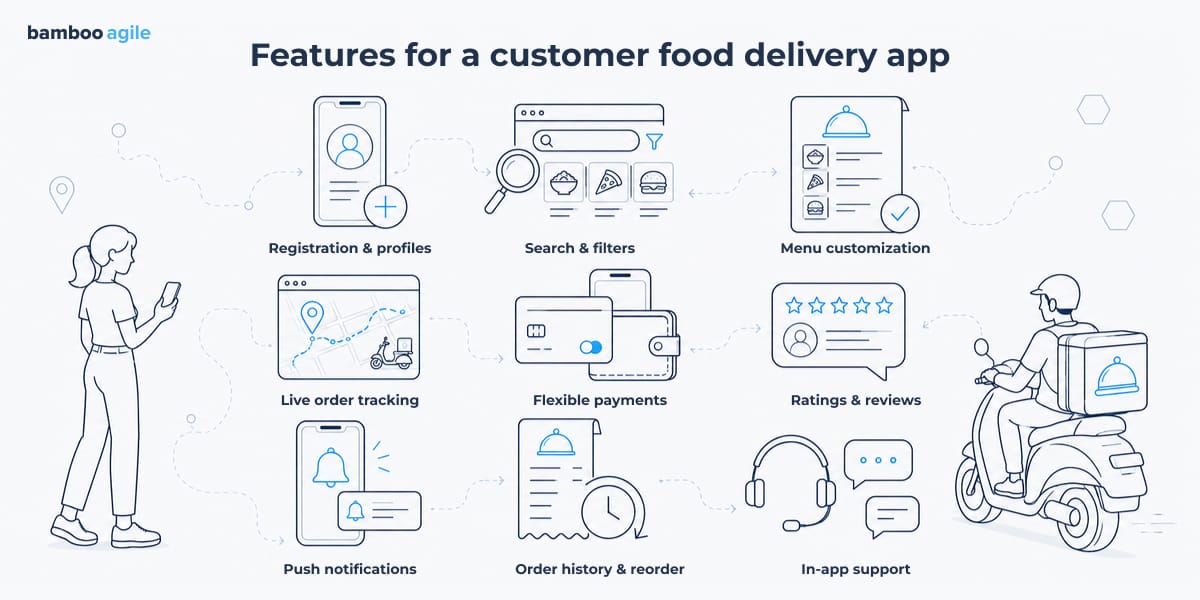
Still, most customer-facing food delivery apps include the following features:
- Registration and profiles, where people sign up via email, phone, or social login, with saved preferences for faster reordering.
- Search and filters covering cuisine, price, dietary restrictions, or restaurant/store rating.
- Menu browsing and customization that relies on clear photos, item options, and add-ons to reduce ordering mistakes.
- Real-time order tracking with GPS-based updates from confirmation to delivery.
- Multiple payment options – cards, digital wallets, and cash on delivery where relevant.
- Ratings and reviews for both restaurants and the delivery experience.
- Push notifications about order status, promotions, and offers.
- Order history and reorder helping with one-tap repeat for frequent items.
- In-app support or chat that gives a direct line to customer service or the driver.
Restaurant app
On the other side of every one of those orders is a restaurant or grocery, which is where the second platform comes in with the following features:
- Menu and inventory management for adding, editing, or marking items as unavailable in real time.
- Order status updates cover accepting, preparing, and marking orders as ready.
- An analytics dashboard allows tracking order volume, peak hours, and top-selling items.
- Promotions management lets a restaurant create discounts or featured placements.
- POS integration syncs with existing point-of-sale systems to avoid duplicate data entry.
App for couriers
A courier app should support every stage of the delivery workflow, from accepting an order to tracking earnings and resolving delivery issues. Its main features include:
- Order assignment that happens automatically or manually, based on driver location and availability.
- GPS navigation and route optimization to calculate the shortest path and reduce delivery time.
- An earnings dashboard for tracking daily and weekly income.
- An availability toggle letting drivers set their own working hours.
- In-app communication for direct contact with customers or support about delivery issues.
Working couriers have opinions most agencies never think to ask for. In a Reddit thread on r/JustEatUK, a driver asked fellow couriers what the perfect app would include, and the answers were very practical:
- Job filtering by distance and minimum pay for acceptable offers, so low-payout orders get screened out automatically.
- Order stacking control, so drivers could choose how to sequence multiple pickups from the same restaurant, since they often know the fastest route better than a dispatch algorithm.
- Return-trip awareness factors in how far an accepted order pulls a driver from home base, alongside the distance to the restaurant and customer.
- A detailed personal history and stats view shows full addresses, prep-wait time, delivery time, and a running average to compare against.
- A readable map with a night mode, a zoom-out option, and orientation that rotates with the direction of travel.
- Lock-screen order previews letting a driver accept a job without needing to unlock the phone first.
It’s worth noting that none of it is hard engineering, so you may consider these tips when working on your courier app.
Admin panel
The admin panel gives operators central control over the business, covering both day-to-day administration and platform-wide oversight.
- User, restaurant, and driver management covers onboarding, verification, and account control.
- Commission and payout configuration allows flexible fee structures per restaurant or region.
- Promo code and banner management rounds out the platform-level marketing tools.
- Platform-wide analytics track order volume, revenue, and performance trends across the network.
- Fraud detection flags unusual transaction patterns.
Advanced and future-ready features
Once you’ve planned the functionality for all the platforms, you may want to later enhance your food delivery app with so-called ‘killer features’ to stand out. For example, you can add:
- AI-driven recommendations based on order history and browsing behavior.
- Machine-learning route optimization that accounts for real-time traffic and order density.
- Voice ordering through smart speaker integrations.
- In-app chatbots for instant answers to common support questions.
- Geofenced notifications that surface nearby restaurants or deals when a user enters a specific area.
- Multi-language and multi-currency support for platforms operating across regions.
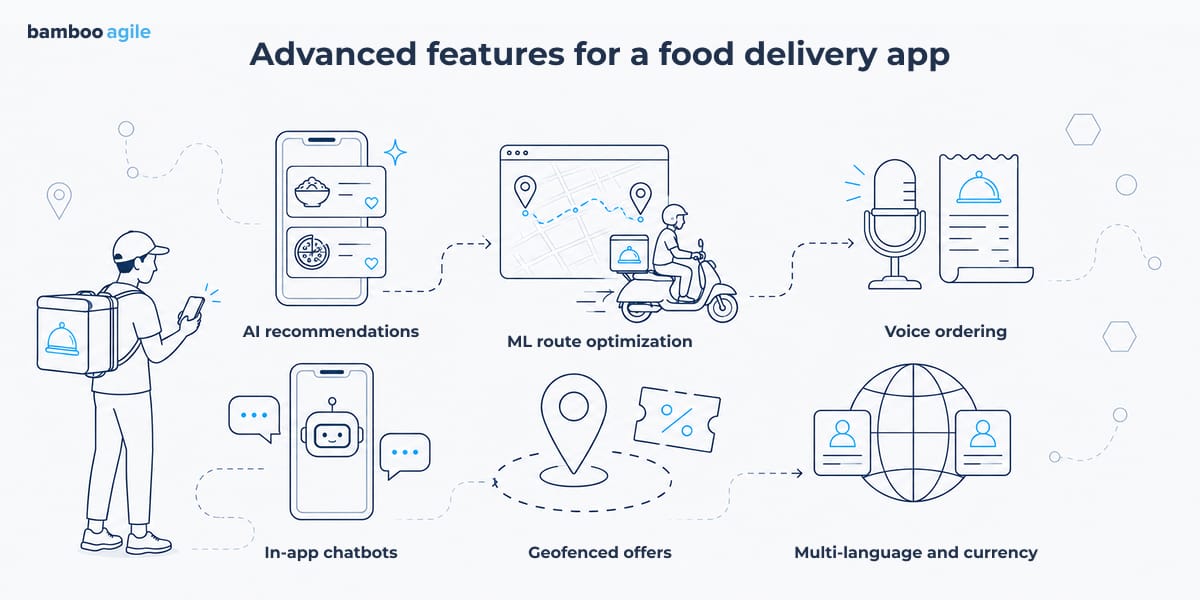
These truly add engineering complexity and cost, so they’re generally worth putting off until the core app has proven demand.
On automation specifically, DoorDash’s co-founder and CEO, Tony Xu, put it plainly when discussing the company’s early robot-delivery trials: he said he sees “a world where technology and humans coexist to help each other”.
Loyalty features, for example, deserve the same scrutiny, since how well they’re built matters more than the idea itself. Chipotle relaunched its rewards program in spring 2026, and Gartner analyst Brad Jashinsky told CX Dive that the update made it far easier for the “vast majority” of members to actually track what they’d earned.
What stood out in the same coverage: comparable relaunches of similar programs at Dunkin’ and Starbucks brought real improvements too, but ended up quietly shrinking the value of their points programs in the process, while Chipotle’s changes were purely additive.
Technology stack and a note about architecture
The right stack depends on the team and the scale the app needs to support, but a few choices show up consistently across successful platforms:
| Layer | Common technology choices |
| Mobile frontend | Swift, Kotlin, React Native, Flutter |
| Web admin frontend | React.js, Next.js, Vue.js |
| Backend | Node.js, Python (Django/Flask), Java Spring Boot |
| Database | PostgreSQL, MySQL, MongoDB, Firebase |
| Real-time updates | WebSockets, Socket.io |
| Cloud hosting | AWS, Google Cloud, Microsoft Azure |
| Payments | Stripe, PayPal, Razorpay |
| Maps and location | Google Maps API, Mapbox |
| Security | OAuth 2.0, JWT, AES encryption |
Microservices architecture is deserves a word of caution. It’s the default advice for scaling a multi-sided platform, but an engineering leader at DoorDash was candid about the real tradeoffs in a 2025 interview. He described an early microservices split as its own form of technical debt, something teams create by adopting it before they truly need that scaling it offers. So, for an early-stage food delivery application project, a clean, well-organized monolith, one unified codebase, is often the more honest choice.
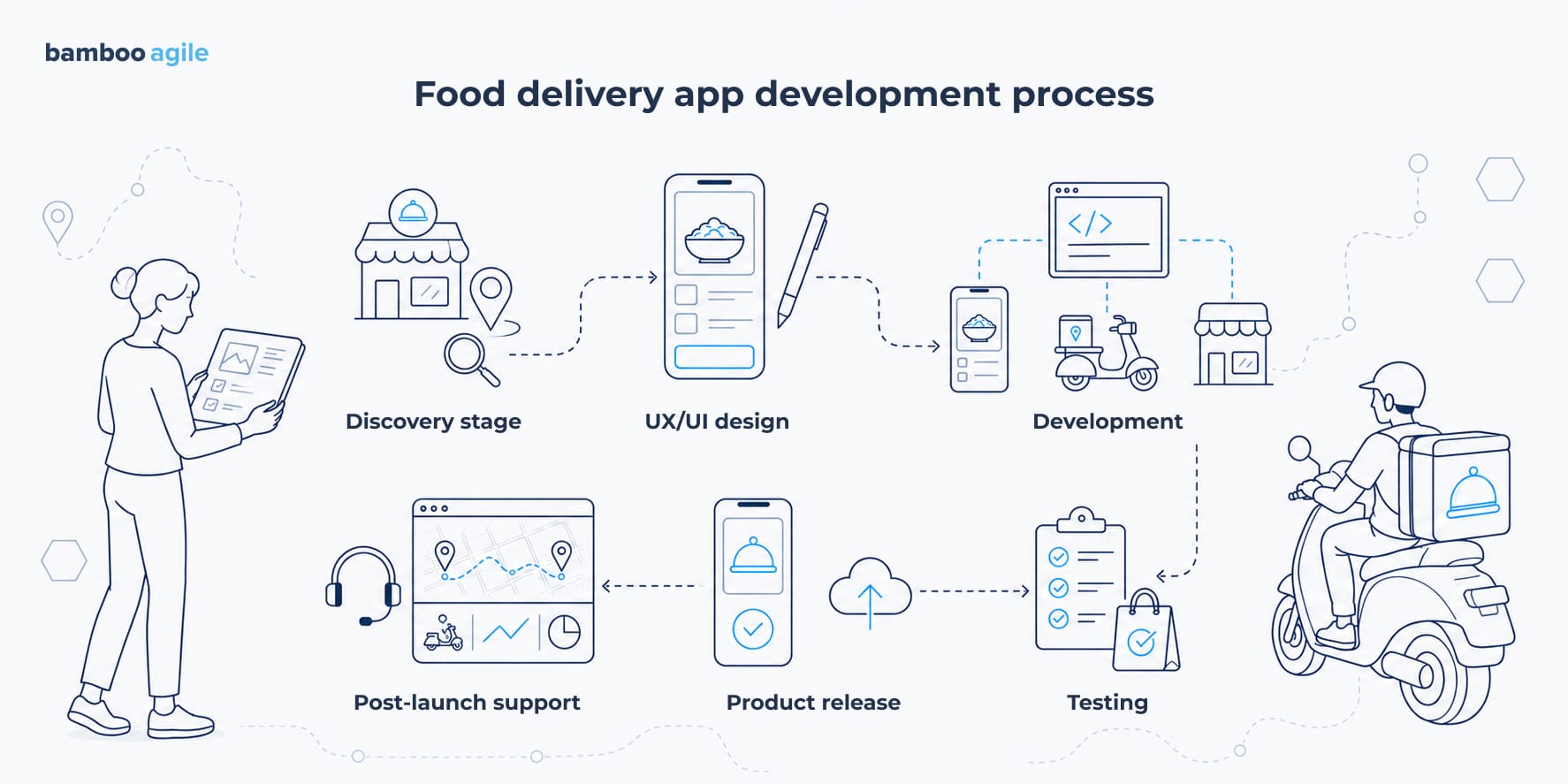
Food delivery app development process
Stack decided, the development itself tends to follow the same rhythm regardless of which team takes it on.
- Discovery stage covers the requirements elicitation, technology selection, studying the integrations needed, and rapid prototyping of the future product. Besides, it’s the stage for scoping MVP features and prioritizing the rest.
- UI/UX design produces wireframes and prototypes for all four platforms.
- Development involves works on the frontend, backend, and integrations in iterative cycles.
- Quality assurance runs functional, security, performance, and usability testing across devices.
- Launch covers app store submission or deployment.
- Post-launch support handles bug fixes, feature updates, and scaling infrastructure as usage grows. It typically runs 15–20% of the initial development cost per year.
How to choose a development partner to hire
Whoever ends up building this, custom food delivery app development company or white-label vendor, deserves the same care as any other major hire.
Check for relevant portfolio experience
A development house that’s built e-Commerce sites or general-purpose mobile apps can still be unprepared for what this category actually demands. Food delivery application development services represent a different kind of engineering: several parties moving at once, live location data threading through every order, and payment flows that split money across restaurants, drivers, and the platform simultaneously.
Therefore, look for direct, named experience in areas like:
- Real-time order and dispatch systems that coordinate customers, restaurants, and drivers at once.
- Live GPS tracking and route optimization under load.
- Multi-party payment splitting across commissions, driver payouts, and platform fees.
- Marketplace architecture.
- Integrations with POS systems, delivery APIs, or third-party logistics providers.
Ask direct technical questions
Beyond the CVs, the conversation itself reveals plenty. How does the team plan to handle scaling once order volume climbs? What actually happens, step by step, when something fails in production? Have they worked with the specific payment gateways or mapping APIs this particular build will need? A vague or evasive answer to any of these says really a lot.
Get clarity on pricing structure
Fixed-bid pricing offers cost certainty and can create pressure to cut corners if scope creeps. Time & materials pricing offers flexibility and requires closer project management to avoid budget overruns. Both models work fine under the right conditions.
Beyond the contract terms, it’s worth testing the team itself with harder questions.
Common challenges and solutions
Even with the right team in place, a few recurring challenges show up across most food delivery platforms, and planning for them early makes them far easier to manage once they surface.
| Challenge | Practical solution |
| Standing out in a saturated market | Focus on an underserved niche: healthier options, local-only restaurants, or a specific delivery speed guarantee |
| Balancing supply and demand during peak hours | Use demand forecasting and driver incentives to smooth out coverage gaps |
| Payment security and fraud | PCI-DSS compliant gateways, encryption, and automated fraud detection on unusual transaction patterns |
| Scaling infrastructure under load | Cloud-based, microservices architecture that scales components independently, added once the app has clearly outgrown a simpler build |
| High customer acquisition cost | Loyalty programs and referral incentives to build organic growth over time |
| False or disputed delivery claims | Photo or geolocation proof of delivery, since even a small dispute rate compounds fast at volume |
DoorDash, which handles about 2 billion orders a year, has publicly described “never-delivered” issues as a steady drain on both revenue and trust, serious enough to need dedicated internal tooling. A newer platform won’t see that volume right away, but the same dispute pattern shows up at any scale, so proof-of-delivery mechanics are worth building into the MVP.
Post-launch: what to track
Launching marks the midpoint of the work, with the metrics worth tracking starting from day one:
- Order completion rate is the share of started orders that are completed, a strong signal of checkout friction.
- Actual versus promised delivery time shows the gap between quoted ETA and real delivery time, since consistent overpromising erodes trust quickly.
- Customer acquisition cost (CAC) is what it costs to acquire a new user, tracked against their lifetime value.
- Repeat-order rate at 30, 60, and 90 days is the clearest indicator of whether the app is building habitual use.
- Driver utilization rate shows how efficiently available drivers are being matched to orders, which affects both delivery speed and driver retention.
These figures matter more in the first three months, since they reveal if the core product is working before further investment.
Getting started
All in all, it’s easy to see why food delivery apps are some of the most profitable niches in today’s food trading industry. While some detractors may call it a mere passing trend, everything points to this being a fresh development that’s here to stay. And with the integral role that these applications have come to play in our society, there’s no better time to give this blossoming venture a shot.
Bamboo Agile has years of experience in developing online shopping applications, so if you are interested in building a highly intuitive and functional food ordering app, but simply do not know where to start, then look no further: we are ready to provide you with quality software dev consultations and are eager to share our expertise. What’s more, our staff can smoothly guide you through the entire development process, keeping it flexible, efficient, and fully transparent.
Want to know how much your food delivery application development costs? Our team will gladly help you estimate the price based on a careful analysis of your business needs – just fill out the form.