Introduction
Spring Framework has become noticeably more complex over time. The gradual build-up of extra functionality is to thank for that. Now, starting a new project requires a long setup process.
But not all is lost. Spring Boot was designed specifically to combat this problem – and it does so with flying colours. Today, we will talk all about this tool and how it compares to the raw Spring Framework.
What is the Spring Framework?
Spring is a popular open-source framework for developing enterprise applications. It was created to simplify app development on the popular Java EE technology stack from Oracle, which was very complex and difficult to use at the time.
The framework has a robust programming and configuration model. Unlike many other frameworks, it focuses on several areas of application functionality and provides a wide range of additional functions for them.
One of the main advantages of the Spring Framework is its use of the Dependency Injection pattern. DI makes it much easier to implement the functionality that applications need, and allows to develop loosely coupled, more general classes.
Advantages of Spring Framework
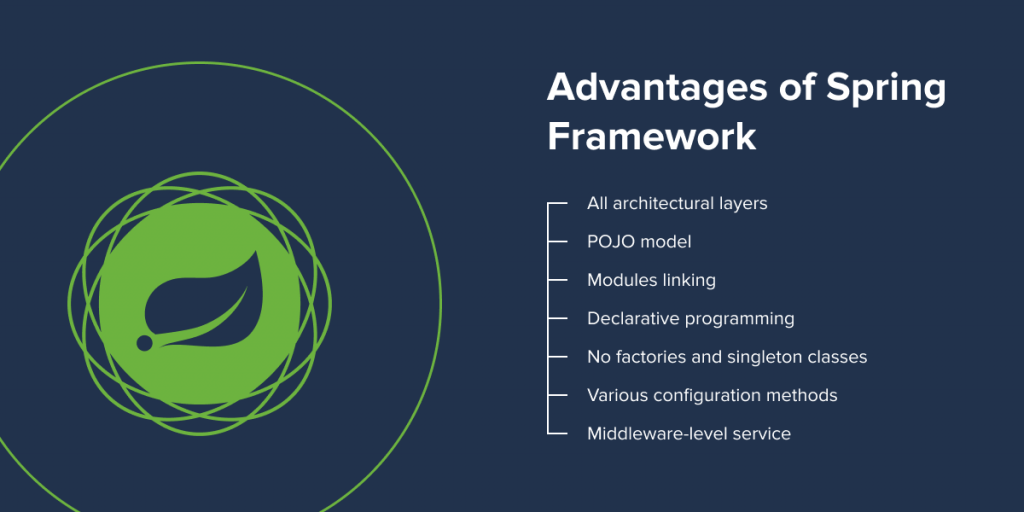
Let’s look at some advantages of Spring Framework:
- Can be employed on all architectural layers of web applications;
- Uses the very lightweight POJO model when writing classes;
- Allows you to freely link modules and easily test them;
- Supports declarative programming;
- Eliminates the need to independently create factory and singleton classes;
- Supports various configuration methods;
- Provides middleware-level service;
- Portability – the same business logic can run client-side (e.g. in a Swing app) and server-side (web or EJB apps) without rewriting it;
- Frequent security updates through its tight integration with Spring Security.
In short, the framework offers a lot of benefits. But it does have the downside of a lengthy configuration process. This has contributed to the creation of Java Spring Boot.
What is Spring Boot?
Spring Boot is an open-source framework designed to help with Spring development. It automates configuration and speeds up the process of creating and deploying Spring applications.
While its parent framework focuses on providing flexibility, Spring Boot seeks to reduce code length and simplify web application development. By leveraging annotation and boilerplate configuration, the tool reduces the time it takes to develop apps. This helps you make standalone applications with less or almost no configuration overhead.
Is Spring Boot popular?
Yes. According to JetBrains’ State of Java 2025 report, based on the 2025 Developer Ecosystem Survey of more than 24,500 developers, Spring remains the most-used framework among Java developers at 65%. Stack Overflow’s 2025 Developer Survey backs this up at the Spring Boot level specifically: it’s used by 14.7% of all respondents and 15.6% of professional developers, so it’s placed among the ten most-used web frameworks tracked, ahead of established names like Flask and ASP.NET.
Read this article to learn all about microservices architecture and how it compares to monolith.
Newer alternatives such as Quarkus and Micronaut have carved out real niches, particularly for fast-startup, cloud-native, and serverless workloads. But the data doesn’t support a narrative of decline: Spring Boot’s usage share has stayed remarkably stable, and it remains the default choice for most enterprise Java teams in 2026.
When to use Spring Boot?
Spring Boot is optimal for building scalable microservices. But it can also be used for developing a broad variety of applications:
- Microservices;
- Utilities;
- MVC web apps;
- Reactive web apps;
- Serverless applications;
- Asynchronous applications;
- Mobile backends;
- And more.
In general, the framework makes it easy to create different types of apps with minimal effort. Let’s have a closer look at its unique feature set.
Spring Boot features
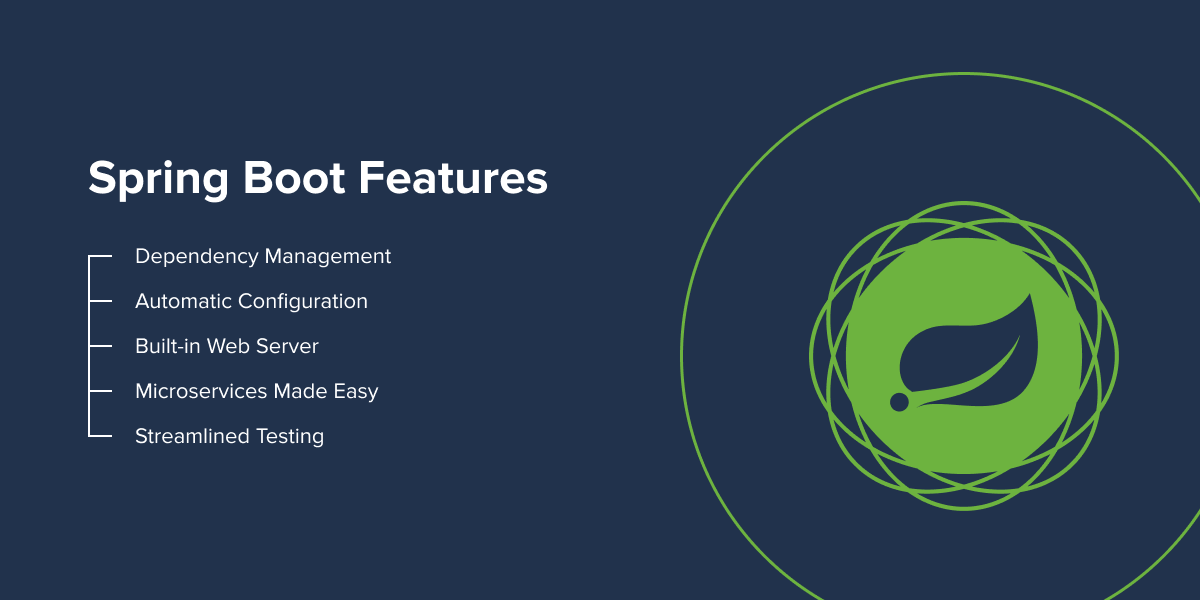
Dependency management
Managing dependencies is easy with Spring Boot. The framework implicitly packages the required third-party dependencies for each type of application. It then provides them through so-called starter packages (spring-boot-starter-web, spring-boot-starter-data-jpa, etc.).
Starter packages are collections of handy dependency descriptors that you can include in your application. They allow you to get a universal solution for all Spring-related technologies. So you don’t even need to search for code examples or compatible drivers and libraries online.
For instance:
- If you want to start using Spring Data JPA to access your database, just include the spring-boot-starter-data-jpa dependency in your project. That’s it, you’re done.
- If you want to create a web application, just add the spring-boot-starter-web dependency. It will pull all the libraries you need to develop MVC applications into your project, such as spring-webmvc, jackson-json, validation-api, and Tomcat.
Basically, it collects all common dependencies and defines them in one place. As a result, the pom.xml file will contain much fewer lines when used in Spring Boot than in regular Spring.
Automatic configuration
Another notable feature of the technology is automatic configuration. After choosing a suitable starter package, the software will try to automatically configure your application based on the jar dependencies you added.
For example:
- If you add Spring-boot-starter-web, the system will automatically configure registered beans such as DispatcherServlet, ResourceHandlers, and MessageSource.
- If you are using spring-boot-starter-jdbc, it automatically registers the DataSource, EntityManagerFactory, and TransactionManager beans. It also auto-reads the database connection information from the application.properties file.
But let’s say you’re not going to use a database. Let’s say you don’t provide any details about connecting manually. In that case, the framework will automatically configure the database in the memory without any additional configuration on your part (if you have H2 or HSQL libraries).
And you’re not forced to roll with it. Auto configuration can be completely overridden at any time with user preferences.
Built-in web server
Every Spring Boot application includes an embedded web server. This means you no longer have to worry about setting up a servlet container. Instead, the app can run itself as an executable .jar file using the built-in server. And if you need to use a separate HTTP server, simply exclude the default dependencies. The framework provides various starter packages for different HTTP servers.
Microservices made easy
You can package an app into a separate .jar file with a full Tomcat container embedded. This feature was borrowed from the Play framework’s application deployment model (though, Spring Boot can also create traditional .war files). Basically, you can quickly package an entire service (e.g. user authentication) into a standalone and fully deployable artefact with an API. This makes installing and deploying software much easier.
Streamlined testing
You can speed up the QA process by using intuitive default settings for unit and integration tests. Microservices testing is particularly easy with the help of the JUnit testing framework and the @Test annotation. To test only certain parts of the functionality, developers can use the @SpringBootTest annotation followed by the list of components that need to be tested.
Want to make your testing more efficient? Check out our complete tutorial on backend testing.
Spring Boot 4: what’s new since 3.0
Spring Boot 3.0, released in November 2022, set the baseline that later versions build on: a move to Java 17, Jakarta EE 9’s jakarta.* packages instead of javax.*, and initial support for GraalVM native images that compile applications ahead of time for faster startup and lower memory use. That baseline held through the whole 3.x line, but 3.x is no longer the current generation. Spring Boot 3.5, its final minor version, reached open-source end of life on June 30, 2026. Spring Boot 4.0 has been the actively developed line since November 2025, with 4.1 following in June 2026.
Spring Boot 4.0 (November 2025)
Built on Spring Framework 7, Spring Boot 4.0 marks the first major generational shift since 3.0. Its most notable changes:
- Modularized JARs. The codebase was split into smaller, more focused JARs, directly addressing one of the framework’s oldest complaints about bloated deployment artifacts.
- Jakarta EE 11 and Servlet 6.1. This baseline shift means Undertow is no longer supported, since it hasn’t yet been updated for Servlet 6.1. Tomcat and Jetty remain fully supported.
- Null safety with JSpecify. Annotations across the portfolio now flag nullability at compile time.
- Java 17 through 25. The Java 17 baseline from 3.x carries over, with first-class support added for Java 25.
- API Versioning and HTTP Service Clients. Built-in support for versioning REST APIs and declarative HTTP clients cuts down boilerplate for service-to-service calls.
- Jackson 3. The JSON library dependency moved to its next major version.
Spring Boot 4.1 (June 2026)
4.1 is an incremental release on the 4.0 foundation, but it adds two capabilities worth flagging for teams building AI-integrated backends:
- MCP support. New @McpTool, @McpResource, and @McpPrompt annotations expose Spring services directly to AI agents over the Model Context Protocol, alongside unified tool-calling support for agentic applications.
- Spring gRPC auto-configuration for both server and client sides, out of the box.
- SSRF mitigations and Kotlin 2.3 support round out the release, alongside the usual dependency and security updates.
If you’re weighing whether to build AI-driven features on top of an existing Spring Boot backend, that’s exactly the kind of upgrade our AI integration services team can help you plan.
Advantages of Spring Boot
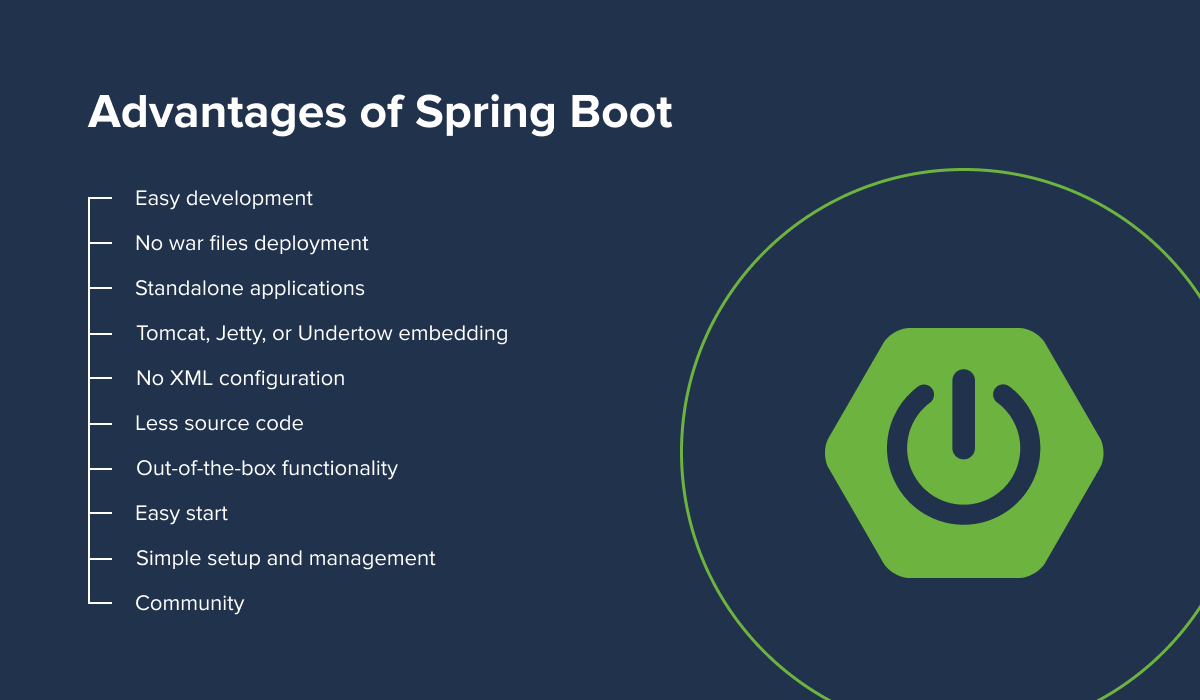
Spring Boot helps developers keep things simple when working with Spring. Let’s have a more in-depth look at how it achieves that:
- Easy development. All the framework’s features aim to make development faster and easier;
- No .war files deployment. There’s no need for the deployment of .war files, since you can package apps as .jar executables;
- Standalone applications. You can package services as standalone applications;
- Tomcat or Jetty embedding. You can directly embed Tomcat or Jetty into an application (Undertow support was dropped in Spring Boot 4.0);
- No XML configuration. Automatic configuration removes the need for XML configuration;
- Less source code. The technology reduces the amount of code necessary to write a Spring app;
- Out-of-the-box functionality. The framework comes with a lot of useful features for testing, Maven and Gradle support, an embedded web server for every app, etc.;
- Easy start. It’s is very beginner friendly and sets up a lot of the things you need automatically;
- Simple setup and management. Automated configuration, as well as simple database and dependency management make setup extremely fast;
- Community. Large community and many training programs to facilitate the familiarisation period.
The development team is also very responsive. Josh Long says, “We pay special attention to StackOverflow tags and do our best to respond to them, but if a bug is discovered there, it ultimately lands in GitHub. GitHub is a great way to impact the projects. We try to make it easy, like having labels for newcomers who want to contribute to start somewhere where we could mentor them.”
All in all, the framework does an incredible job of simplifying Spring development. It streamlines dependencies and allows users to run applications directly from the command line. It also doesn’t require an external application container and greatly reduces the amount of code necessary for configuration.
Disadvantages of Spring Boot
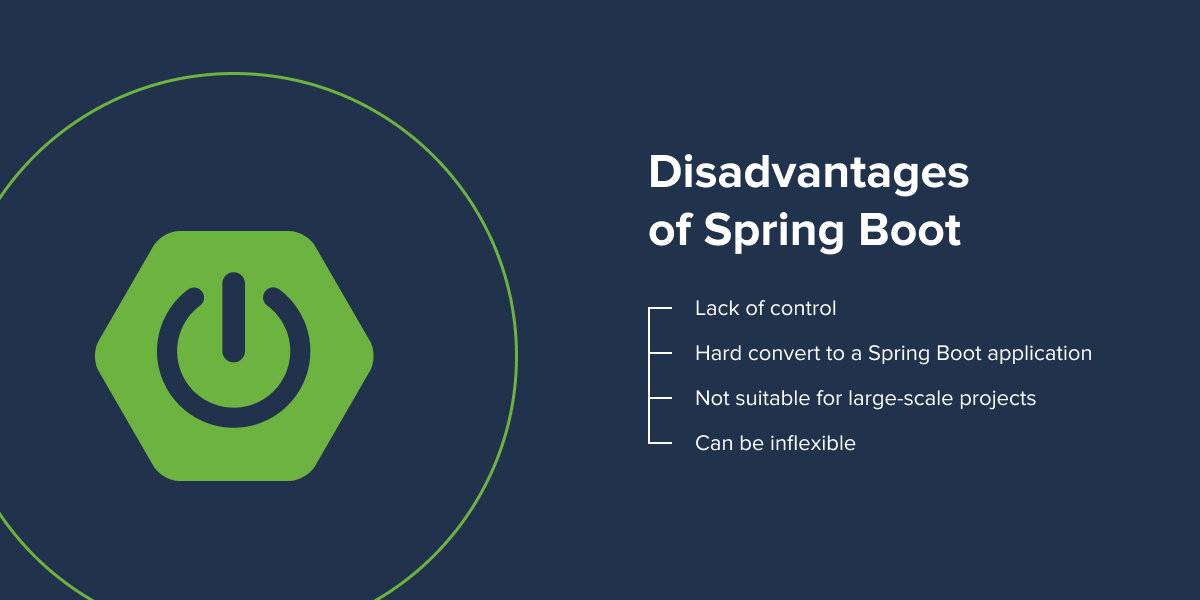 In spite of the many advantages of Spring Boot, it still has a couple of drawbacks that you should keep in mind:
- Lack of control. The opinionated, auto-configured approach has historically pulled in a lot of unused dependencies, resulting in a large deployment file. Spring Boot 4.0’s modularized JARs ease this, though teams still running the 3.x line feel it fully;
- Hard to convert to. The process of converting a legacy or an existing Spring project to a Spring Boot application can be complex and time-consuming;
- Not suitable for large-scale projects. Many developers claim the tool is not suitable for building big monolithic applications. Though some argue that it can handle large projects just fine, it’s far from a common consensus;
- Can be inflexible. Spring Boot uses an opinionated approach. This means it gravitates towards a single solution to any given issue. It reduces decision making in the coding process, but also makes it less flexible than that of the parent framework;
- Learning curve. Getting comfortable with Spring’s conventions and auto-configuration “magic” takes real time, especially for developers new to the ecosystem;
- Logging customization is awkward. Overriding the default logging setup takes more configuration than most other frameworks;
- Concurrency can be tricky. Handling many simultaneous operations well often needs extra tuning beyond the defaults.
Spring Framework vs. Spring Boot
Now that we know all about the Spring Framework and Spring Boot, let’s compare the two.
| Spring Framework | Spring Boot | |
| Technology | Open-source Java framework | Spring Framework extension |
| Purpose | Provides a flexible environment with libraries and tools for building web apps | Provides similar features, but uses less code and lets apps run without annotations or XML configuration |
| Key feature | Dependency injection | Autoconfiguration |
| Embedded servers | No | Yes (Tomcat, Jetty) |
| Configuration | Manual | Automatic |
| XML knowledge | Required | Not required |
| CLI tools | No | Yes |
| Approach | Unopinionated | Opinionated |
| Use cases | Enterprise solutions, apps with unique configurations, apps that require lots of flexibility, etc. | Microservices, REST APIs, small applications, serverless apps, etc. |
All in all, the choice depends on your preferred coding style and the type of application you wish to create.
Conclusion
Spring Boot is an integral part of the Java ecosystem, and its move to Spring Boot 4 keeps it firmly relevant heading into the next stretch of Java development. It offers an efficient and scalable toolbox for building Spring applications with a microservices architecture. Carefully review how its pros and cons align with your business goals, including where your team sits on the 3.x-to-4.x migration path, to know if this framework is right for you.
Alternatively, consult a reliable software vendor on which technology would be best for your project. Bamboo Agile has years of experience with Java and can become your trusted partner on this journey.
Sign up for a free consultation now.