Bamboo Agile | Bespoke software development company
Bamboo Agile is an Estonia-based custom software development company that crafts bespoke solutions for telecom, education, healthcare, finances, other sectors.
Bespoke software up close – definition and real examples
When organizations are shaping a product and deciding how it should be built, the question of software strategy becomes one of great importance. Teams are trying to move forward without locking themselves into choices that later may turn into expensive architectural mistakes. They understand the stakes, but the path isn’t always obvious.
Bespoke development used to sound like a heavy, expensive commitment, something reserved for large enterprises with substantial resources. Yet, by 2026 the situation looks far more lightweight. Cloud-native tooling, modular architectures, and mature development ecosystems have broadened the range of viable approaches. Now fully bespoke software development is simply one more option among many worth examining.
The definition of bespoke software
Let’s approach the question academically for a moment, and start with the textbook definition since this one is fairly concise: bespoke software is developed from scratch to meet the needs of a single client or organization.
This distinguishes it from off-the-shelf products, which are produced for broad audiences and standardized use cases. Bespoke systems, by contrast, are intentionally narrow in focus. They are shaped by the context in which they will be used.
In healthcare, for example, customized software is common exactly because the environment demands it. Systems frequently need to accommodate specialized clinical workflows, privacy obligations, equipment integration, and coordination between staff roles and patient needs. Even within the same field, processes vary across departments or institutions. Which makes tailored solutions a pragmatic choice rather than an indulgence.
Let’s take a look at some well-known examples of bespoke solutions in other industries that most of us have likely used.
Examples of bespoke software across industries
It was said that bespoke software applications appear across industries where performance, scale, or differentiation demand solutions built around specific operational models. The following examples illustrate how organizations rely on custom systems to support their core services.
Digital media and streaming
We see the power of bespoke software every time we open Netflix or Spotify.Systems like recommendation engines, experimentation tools, and catalogue handling are built in-house around how each platform works. YouTube goes even further, running its own encoding and moderation infrastructure for global video delivery. At this scale, off-the-shelf tools simply can’t keep up with the demands of personalization and performance needed.
Transportation and mobility
Since timing and optimization define their value, Uber and Bolt build their own ride-matching and routing algorithms to reflect demand patterns and market strategies. Tesla embeds custom telemetry and updated systems directly into vehicles. These solutions exist because coordination, safety, and efficiency depend on organization-specific logic.
Finance and banking
Payment providers such as PayPal build and maintain their own bespoke platforms with transaction processing, fraud detection, and settlement systems because off-the-shelf solutions cannot guarantee the speed, security, and regulatory compliance required at their scale. These systems are built to handle massive transaction volumes, adapt to evolving fraud patterns, and meet the specific legal frameworks of multiple countries.
Education
Universities often customize systems like Moodle or Canvas to reflect governance structures and assessment frameworks unique to their programs. Digital learning apps like Duolingo invest in proprietary personalization engines aligned with their pedagogical approach.
Logistics and supply chain
Companies such as DHL, FedEx, and UPS use their own routing and tracking platforms developed based on their operational models. In this case bespoke app development creates efficiency advantages that directly affect the cost and quality of service.
Overall, if there’s a common thread across these industries, it’s that bespoke software isn’t chosen just for the sake of it. In these cases control, differentiation, or operational fit matter enough to justify building technology around the organization.
How the business environment is reshaping software decisions
If we zoom out from technology and look at the market context, we will discover that startups’ operational environments are different from those of a few years ago.
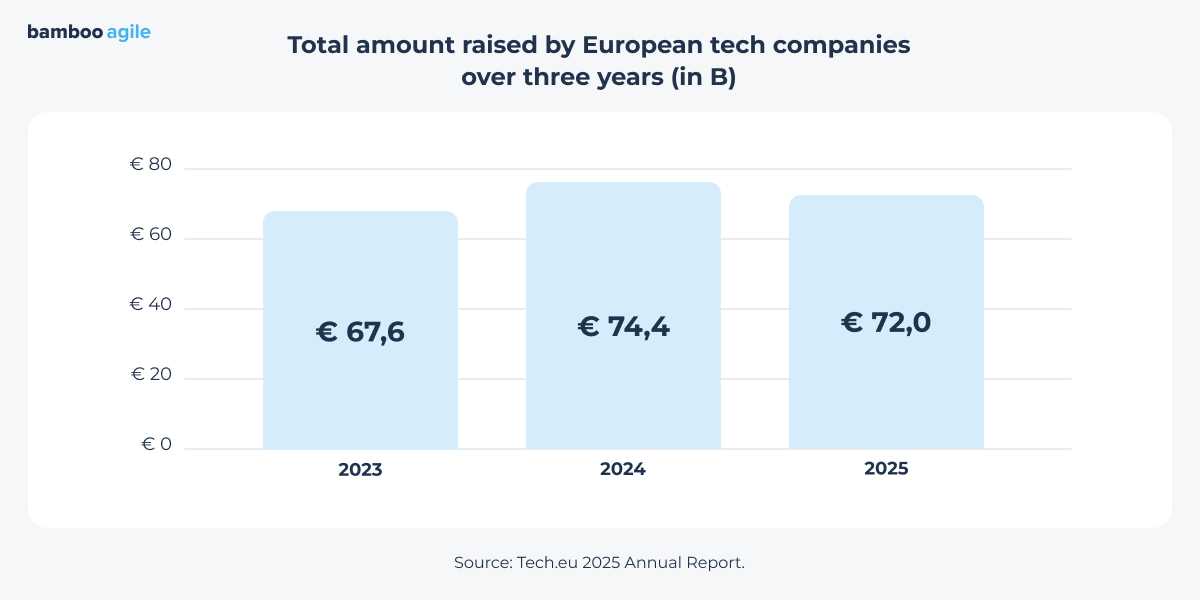
To start with the obvious: capital is tighter. According to Tech.eu’s annual report, in 2025 total investment across Europe reached €72 billion, a 3.2% decline year-on-year and below the peak quarters of 2023–2024.
At the same time, deal dynamics reveal a growing imbalance between activity and conviction. Apparently, there is a preference for scale and validated business models over exploratory product bets.
Still, early-stage activity remains present in deal count, yet capital access is structurally tighter. According to the same report, the transition from seed to Series A now averages around two years, and only about 20% of startups reach Series A within 24 months. Progressing without demonstrable traction seems to be rather difficult.
In that environment, fully bespoke development carries different implications than it did during more expansionary cycles. Bespoke solutions require time, upfront capital, and organizational stability. These characteristics conflict with conditions where iteration speed and cost discipline dominate. As a result, early-stage teams more frequently rely on modular stacks, third-party platforms, or composable tooling to reach market validation before committing to deeper customization.
In that sense, bespoke software development today functions not as a default foundation, but as a deliberate escalation aligned with maturity and competitive differentiation. So the question should be where customization will create competitive leverage – and where it will not justify the cost of complexity.
A significant share of modern product functionality doesn’t have to be written from scratch. Payments, authentication, messaging, search, analytics, storage, and compliance tooling are already mature ecosystems with reliable vendors and open-source frameworks.
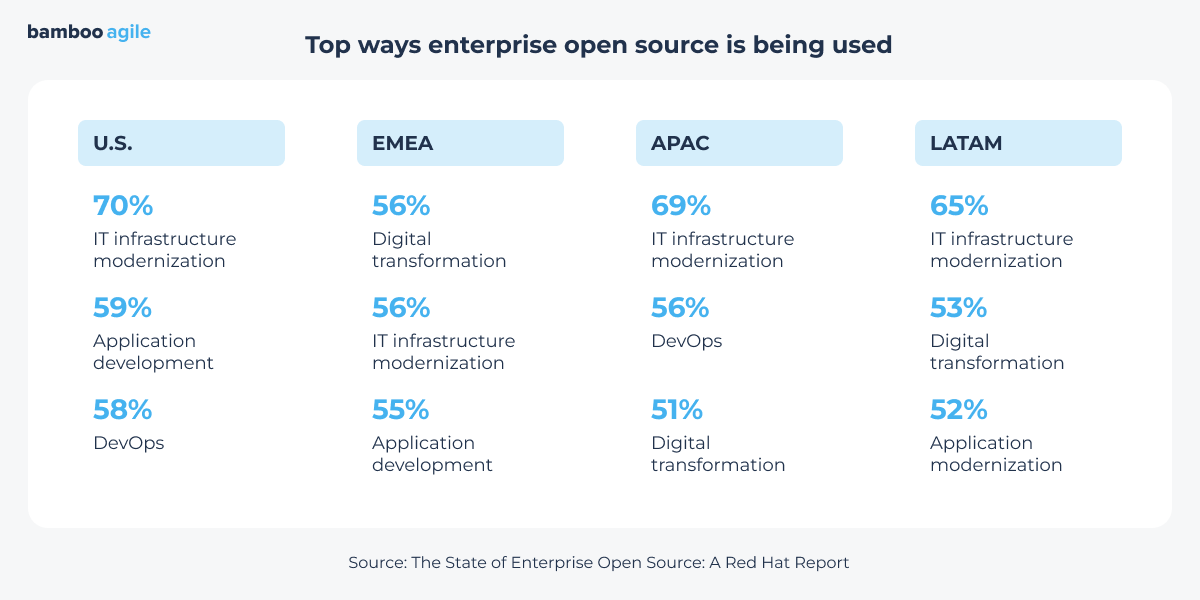
Industry data shows how dominant reuse has become. Surveys of enterprise technology leaders indicate that approximately 90% of organizations use enterprise open-source solutions, particularly for infrastructure modernization, application development, and digital transformation, reflecting their central role in production environments.
The same report highlights that around 95% of respondents consider enterprise open source important to their overall infrastructure, and 80% expect to increase its use in emerging technology areas.
API consumption follows the same pattern. Surveys report that at the organizational level, 65% of companies rely on APIs to collaborate with partners, 53% consume third-party APIs, and 60% share internal APIs to accelerate product delivery, highlighting their strategic operational role.
Besides outsourcing commoditized capabilities to APIs or libraries, engineering teams reduce maintenance surface area, infrastructure liability, and compliance burden. That often means smaller backend teams, faster iteration cycles, and lower total cost of ownership during the first years of operation. And these are the factors that investors consider when evaluating runway performance.
That is why using these tools in your software can be a justified economic response to funding pressure and time-to-market constraints. Since capital is selective and traction must be demonstrated early, time-consuming building of expensive core infrastructure from scratch rarely makes sense.
Modular and flexible architecture
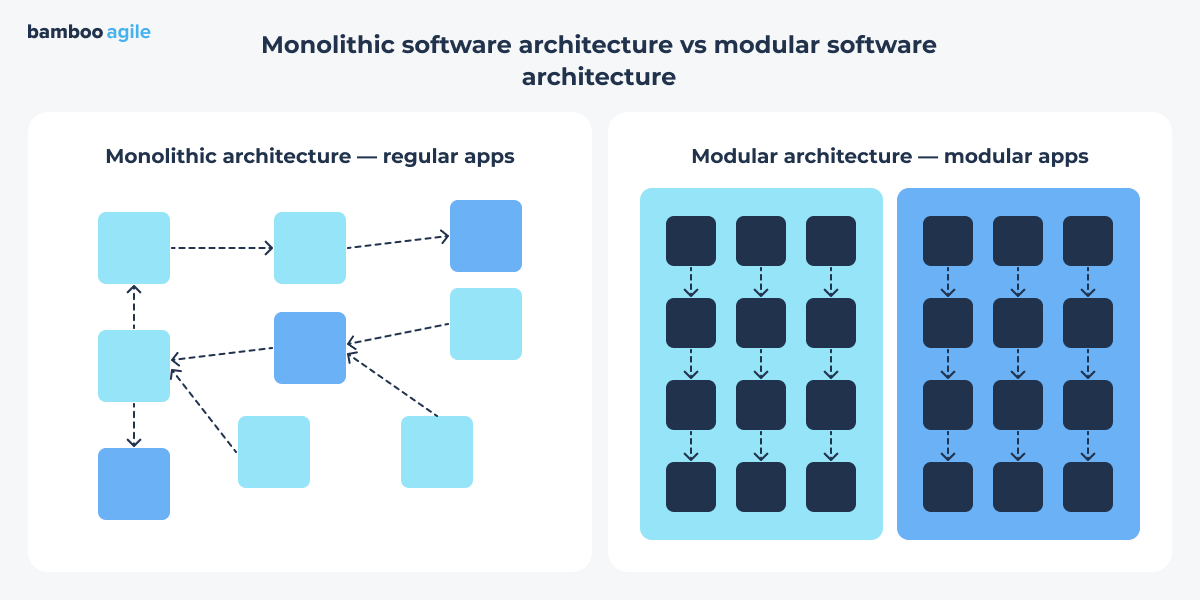
Modular software simply means building a system as a set of independent parts rather than as one tightly connected whole. Each module handles a specific responsibility, for example, payments, user management, search, and reporting. Moreover, it can be developed, replaced, or scaled without rewriting the entire application.
For example, let’s look at a payment module in an online platform. When a user makes a purchase, the main application sends transaction data to the payment module. That module processes the payment, communicates with external providers if needed, and returns the result. If the organization later decides to switch providers, improve fraud detection, or handle higher transaction volume, changes are made only within that module, and the rest of the application remains untouched. This way business can limit disruption and avoid system-wide redevelopment.
This approach has become common because modern software environments change too quickly for monolithic systems. In turn, microservices-based modular development reduces codebase size per component and allows different technologies to be used for each service, so processes can be more flexible. Moreover, industry data suggests that modular architectures can lead to around 50% faster time-to-market.
Read a detailed analysis of what modular architecture is and how we applied it in one of clients’ fintech projects.
Low-code/no-code tools for rapid prototyping and internal apps
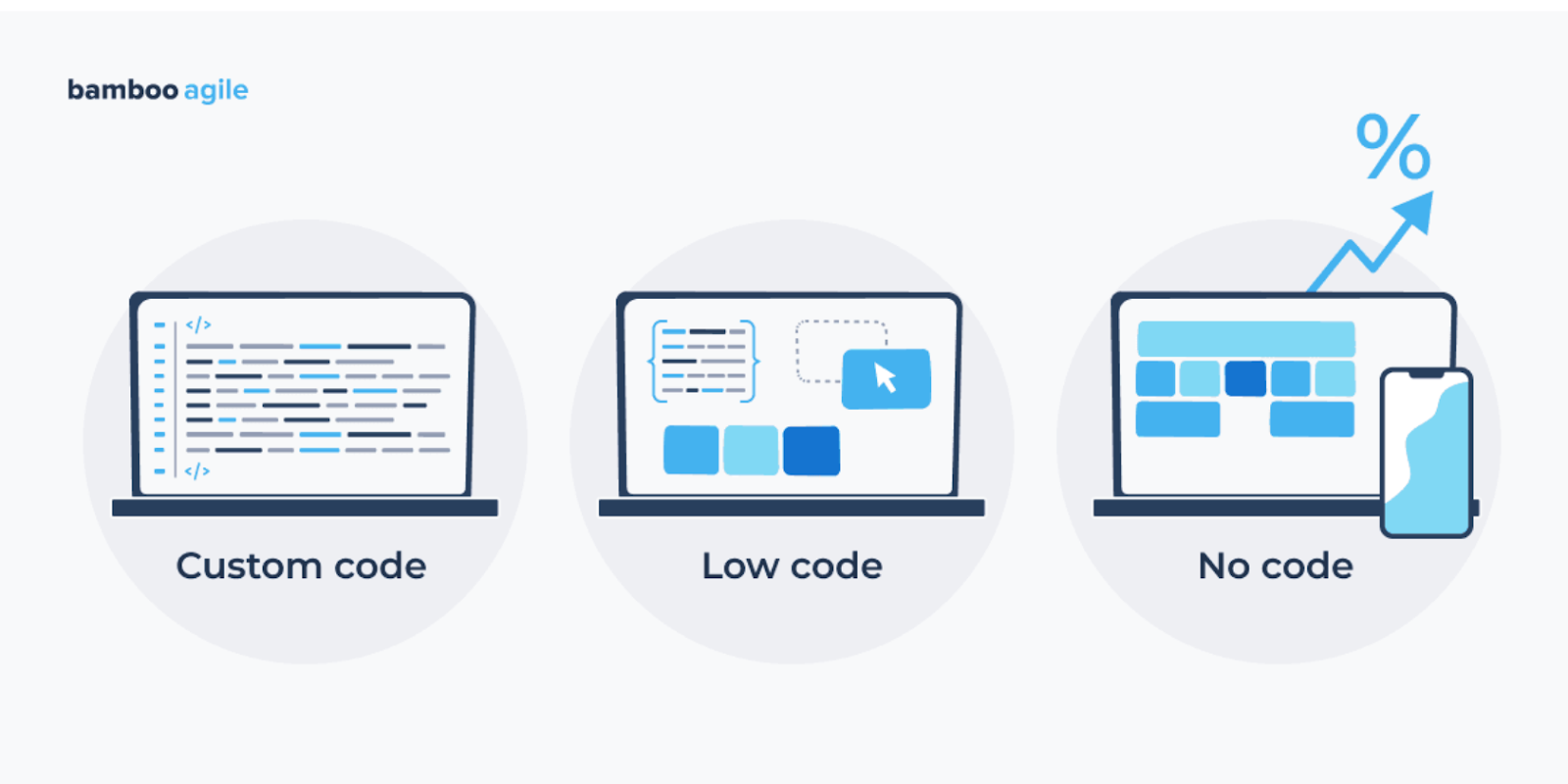
Low-code and no-code tools allow you to build software by just configuring components instead of writing everything from scratch. It is important to note that they are not a replacement for engineering. Instead, they can be a way to test ideas and automate internal work before committing real bespoke application development budgets.
Gartner estimated that in 2025 about 70% of new enterprise applications use low-code or no-code technologies, compared with under 25% in 2020. The same research direction shows why: faster delivery and lower dependence on scarce developers.
Low-code/no-code approaches mainly prioritize speed and accessibility over deep customization. They are therefore best suited to well-bounded solutions rather than complex core systems. Typical use cases may include internal dashboards, workflow automation and data collection tools. They can cover prototypes, onboarding flows, and early product experiments as well.
Separately, industry surveys indicate that organizations adopting these platforms report shorter development cycles and reduced backlog pressure on engineering teams, because non-technical staff can handle internal tooling themselves.
However, highly specialized functionality, performance-critical systems, or products requiring fine-grained control over architecture generally still require conventional engineering approaches.
AI-assisted coding and automated testing
AI-assisted development tools help generate code, suggest refactors, and automate parts of testing. The point here is not developer replacement but compressing the iteration cycle.
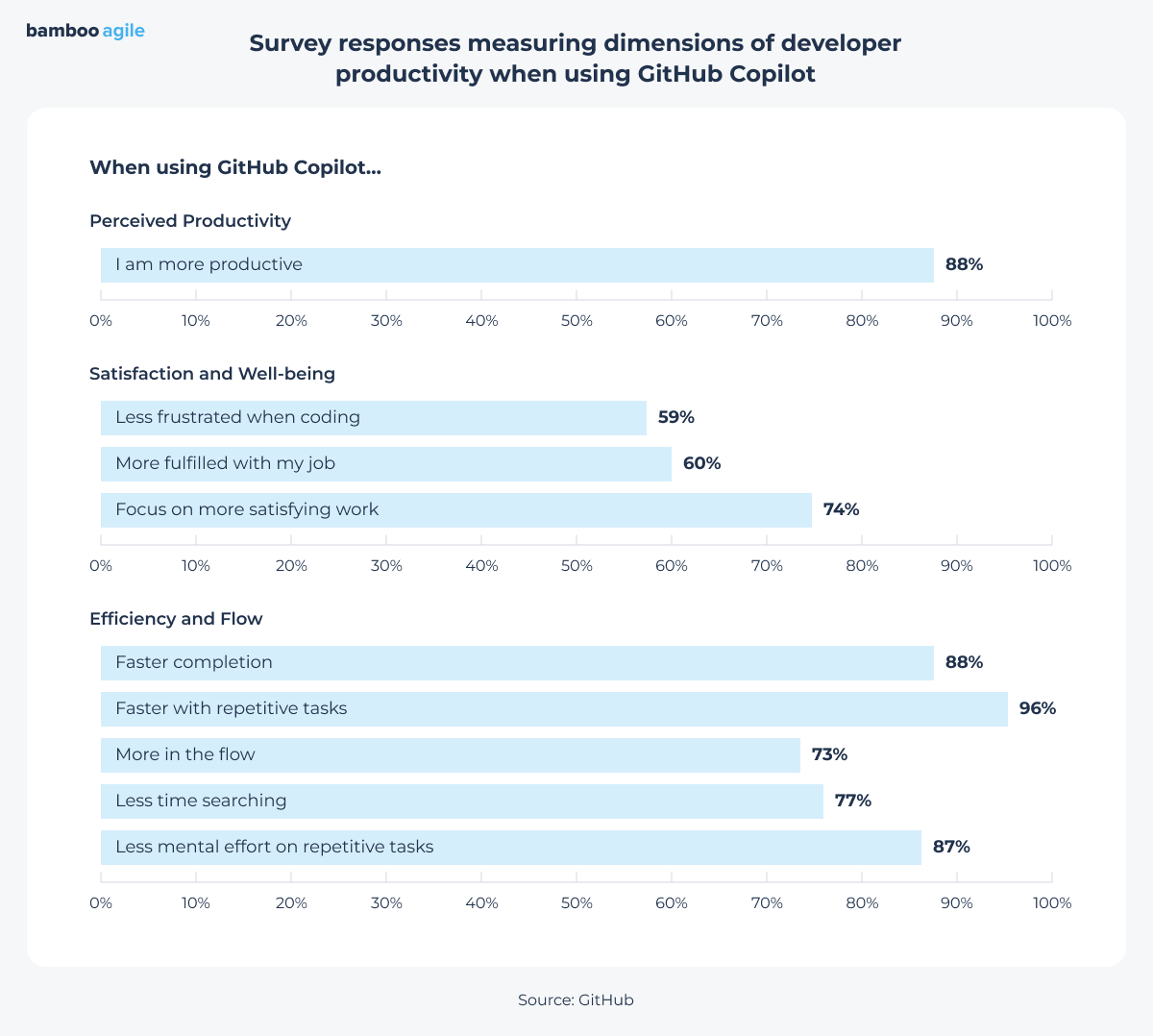
Experimental research conducted with developers using an AI coding assistant showed participants completed programming tasks significantly faster (up to about 55% quicker) compared to those without assistance.
Industry surveys similarly report perceived productivity improvements: developers using AI-assisted tools frequently report reduced time spent on boilerplate code, documentation, and debugging activities, contributing to shorter iteration cycles.
Some teams are also experimenting with “vibe coding” approaches. It is a relaxed, creative way of programming where developers work with an LLM-powered chatbot that helps generate code, allowing the chatbot to write parts of the program for them. The focus here is on exploring and prototyping rather than following strict rules or architecture. That is why it requires careful discipline to avoid messy code or architectural inconsistencies.
The testing side matters just as much. Automated testing is being augmented by AI as well, particularly for generating test cases. This addresses one of the most expensive failure points in software, as industry studies consistently show that defects discovered late in production can cost several times more to fix than those caught during development. Therefore, making earlier detection is just financially significant.
For startups operating under funding constraints, using AI capabilities in bespoke app development can directly improve runway efficiency and increase experimentation capacity without proportional headcount growth.
Critical skills behind modern bespoke software development
We’ve looked at different approaches shaping modern development, but using them requires a team that can make sound decisions and bring all the pieces together. In other words, the outcome depends not just on the technologies chosen, but on the people applying them.
From our perspective, there are several core capabilities worth looking for when evaluating a bespoke application development team.
System-level perspective
Teams need to understand how individual decisions affect the wider system. When deciding whether something should be custom-built or reused, they should be able to consider long-term scalability, maintenance effort, and integration impact. Seeing the full picture helps avoid overengineering on one hand and rigid dependency on external tools on the other.
AI-augmented engineering
The value here lies beyond simply using AI tools. The real skill here is to apply them responsibly. Strong teams understand how to leverage AI to increase delivery speed and experimentation and at the same time maintain architectural consistency, code quality, and security standards. This ability to combine human expertise with AI can become a key productivity advantage.
Product mindset
Inevitably, technical decisions carry business consequences. Modern development teams are expected not only to implement requirements but to understand why those requirements even exist. A product mindset allows engineers to align architecture and feature decisions with user value, market priorities, and long-term product evolution. This skill helps prevent overengineering, reduces wasted development effort, and ensures that bespoke solutions remain adaptable as business needs change.
Listen to the podcast episode with Maxim Leykin
On Agile Redemption, Maxim discusses how to grow a product engineering mindset in development teams, helping engineers take ownership and think beyond the code.
Once multiple services, APIs, and tools are involved, coordination becomes essential. Teams need to connect external platforms, internal modules, and automated workflows in ways that remain stable and observable. This capability is what turns separate tools into a functioning product ecosystem.
Bamboo Agile – building bespoke software in practice
At Bamboo Agile, these discussions are part of our everyday work. The solution is never universal, and finding it requires both engineering experience and practical realism.
To share how these decisions look from an architectural and technical perspective, we asked our CTO, Maxim Leykin, to explain how he and the engineering team approach bespoke software development in real projects, what trade-offs they consider, and why the “right” solution is not always the most obvious one. Here’s his perspective.
Maxim Leykin, Chief Technology Officer at Bamboo Agile
Nowadays the boundary between fully bespoke software and customized solutions can be blurry and non-obvious. It’s mostly the level of customization that makes a difference: sometimes deep and comprehensive customization of ready-made components or platforms can be comparable with bespoke development from an engineering perspective while remaining efficient in terms of time and money.
The main and unbeatable advantage of bespoke software is that we are free to create proper architecture for the particular case based on requirements and solid experience possessed by our solution architects and engineering managers. We always consider scalability, performance, and security factors and try to keep a modular design so as to be able to reuse code where possible. Other advantages are that we don’t need to keep any legacy tech stack, rely on somebody who should fix bugs in third-party libs, etc.
Being a CTO, I would probably vote for bespoke software in most cases (it’s a joke), but we work in the real world, and when evaluating and estimating new software projects, our approach is to consider all possible options to meet client requirements in the most effective way in terms of budget and timeline. Thus, we always compare full custom development vs. using some ready components/libraries if it can decrease time-to-market without quality trade-offs.
E.g., if clients come to us with the idea of developing a hotel booking platform or ERP system, there is a small chance we recommend going for development from scratch, as there are numerous open-source and commercial frameworks that can be customized per client needs quickly and efficiently.
At the same time, we need to be careful when evaluating third-party solutions as a foundation for our software. There are many factors and risks which need to be considered; among the most important of them are:
complexity of integration and customization
quality and maintainability of the source code
level of support
licensing model
In summary, when choosing an approach for a particular project, I would recommend identifying several possible ready-made components or frameworks and evaluating them thoroughly to choose the best match (AI tools can be of great help here, though we shouldn’t fully rely on them). If a suitable solution has been found, in the second step we can estimate customization cost and compare it with the cost of bespoke development.
Have a project in mind?
Reach out and we’ll help you evaluate the options and choose the development approach that fits you best.
Marketing specialist & content writer at Bamboo Agile.
Yana has worked in the information technology sector for about 5 years. During this time, she has authored articles, conducted interviews, and produced market reviews, development guides, and case studies.
She collaborates closely with engineers, product managers, and QA specialists to ground her writing in direct technical insight. Her content emphasizes data‑backed analysis, drawing on respected global publications and the company’s own domain knowledge.
Beyond Bamboo Agile’s blog, Yana’s work appears on Medium and Hackernoon.
We use cookies to analyze user behavior and improve the website for you. Check our Privacy Policy for more information.
Functional
Always active
The technical storage or access is strictly necessary for the legitimate purpose of enabling the use of a specific service explicitly requested by the subscriber or user, or for the sole purpose of carrying out the transmission of a communication over an electronic communications network.
Preferences
The technical storage or access is necessary for the legitimate purpose of storing preferences that are not requested by the subscriber or user.
Statistics
The technical storage or access that is used exclusively for statistical purposes.The technical storage or access that is used exclusively for anonymous statistical purposes. Without a subpoena, voluntary compliance on the part of your Internet Service Provider, or additional records from a third party, information stored or retrieved for this purpose alone cannot usually be used to identify you.
Marketing
The technical storage or access is required to create user profiles to send advertising, or to track the user on a website or across several websites for similar marketing purposes.