
Most growing companies eventually hit the same fork in the road: hire developers in-house or outsource software development to an experienced third-party vendor. That decision is getting harder to make on gut instinct alone. Not every company has the specialized skills or resources to build software itself, and closing that gap internally keeps getting tougher. Thus, 72% of employers worldwide now report difficulty finding the skilled talent they need, and for the first time, AI-related skills are the single hardest skill category to fill, ahead of traditional engineering roles (ManpowerGroup, 2026 Talent Shortage Survey).
That talent gap is a big part of why software development outsourcing remains a mainstream way to build products. According to Deloitte’s Global Outsourcing Survey, 80% of executives plan to maintain or increase their investment in it, and 83% are already using AI as part of how they deliver outsourced work. So, outsourcing and AI adoption are now moving together, not competing with each other.
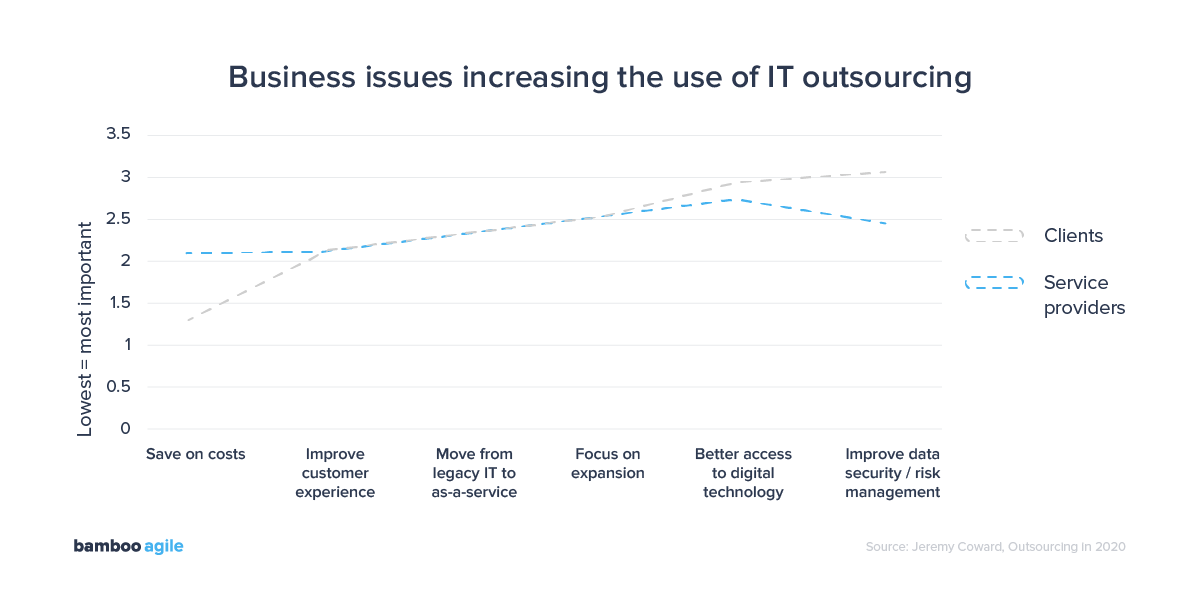
Besides, Deloitte’s survey found that 50% of executives used outsourced services specifically for front-office capabilities like sales, marketing, and R&D, and that 70% of organizations had selectively brought some previously outsourced work back in-house over the last five years. In practice, most companies are running a mix at the same time, rather than picking one model and sticking with it forever.
That mix exists because delegating work to a different company isn’t a guarantee of success. Software delivery in general has a mixed track record. Recent Standish Group CHAOS data suggests only around 30-34% of IT projects meet all their success criteria (on time, on budget, full scope), regardless of who’s doing the building. That’s exactly why the “tips for successfully outsourcing” section later in this guide matters as much as the pros and cons themselves. The difference between a good and bad outcome usually comes down to how the engagement is set up, not whether you outsourced at all.
With all that context in mind, let’s walk through an in-depth analysis of the pros and cons of outsourcing software development, so you can figure out what would work best for your business.
What is software development outsourcing?
Software development outsourcing is when a business approaches a third party to build their software or app for them instead of hiring a team of software engineers or app developers in-house.
In practice, this means handing off some or all of a project (e.g., planning, coding, testing, or ongoing maintenance) to an external vendor: a dedicated software house, a freelance team, or individual contractors. The vendor can be based anywhere in the world, working entirely remotely, or it can be located closer to your business.
Why do companies outsource software development?
The reasons have shifted noticeably in 2022–2026. Cost reduction is still cited often, but it’s no longer the dominant, near-universal driver it once was.
One of the most common reasons behind software development outsourcing is a lack of experts. For example, suppose the project you are working on keeps growing, but all your team members are fully booked. You will need to bring on additional people to complete it. Or maybe you’re starting a new project that happens to require more skilled professionals than you currently have. Hiring a single developer can take up to 4 months – sometimes the wait is just too long. In cases like that, application development outsourcing is a much faster and more convenient option.
Another popular reason is the lack of expertise within the company. Perhaps you’re starting a new project on an unfamiliar technology stack; maybe your old project has grown so much that it has become too much for your internal team to handle; maybe your website needs a redesign, but your programmers don’t have the relevant experience to pull it off. If you’re facing similar problems, then outsourcing product development can be a great way to achieve your goals without getting bogged down by risky experiments and amateur mistakes.
The third major reason is a certain type of software development not being part of a company’s core set of services. Let’s say your company offers transportation services. It would be much more cost-effective for you to outsource app development rather than hire and onboard a team of programmers in-house.
We have a blog article that compares in-house software development and outsourcing. Feel free to give it a look!
What’s typically outsourced in 2026 (and how AI and vibe coding are reshaping it)?
The rise of AI-assisted and “vibe coding” workflows has changed what companies actually send out the door. Buying raw developer headcount to write routine boilerplate code is losing value fast; the demand has shifted toward teams that can supervise AI tooling, validate its output, and own architecture and delivery decisions (Forbes Technology Council, 2026).
That shift shows up clearly in the data. McKinsey’s State of AI research found that while 62% of organizations were at least experimenting with AI agents, only 23% were actually scaling agent use in any single business function, and in no individual function do more than about 10% of organizations reported agents running at scale. In other words, most companies are still early in turning AI experimentation into dependable production capability.
Still, these R&D functions are most commonly outsourced in 2026 (compared to the state of the market in 2021):
- QA, testing, and validation of AI-generated code;
- Architecture and system-design oversight;
- DevOps/MLOps and AI infrastructure;
- Cybersecurity;
- Legacy system modernization;
- Project maintenance and support;
- Narrow AI/ML implementation.
Apparently, there’s a shift toward smaller, more senior outsourced teams doing higher-judgment work, with AI absorbing the repetitive layer underneath them. Practically, this means when you’re evaluating an outsourcing partner in 2026, “how many developers do you have” matters less than “what’s your AI toolchain, how do you validate AI-generated code, and who owns architecture decisions.”
Industries that tend to outsource less in 2026
Alongside the shift toward smaller outsourced software development teams, a related trend is reshaping the picture: some industries are pouring money into building software capability in-house rather than relying on external teams at all.
Automotive is the clearest example. Boston Consulting Group forecasts that software and electronics will make up 50% of a vehicle’s value by 2030, up from about 30% today. And automakers are racing to build that capability internally rather than buy it wholesale. Stellantis has built a dedicated Software & Services business unit staffed with 4,500 in-house engineers, while still working with external specialists for specific modules. Volkswagen went further, pouring more than €2.5 billion into CARIAD, its in-house software division, though the scale of that investment eventually forced VW to bring in outside partners (Rivian, Xpeng) to help finish the job. This is a useful reminder that pure insourcing has its own limits and costs.
Banking has been building this way for over a decade. JPMorgan Chase now employs more than 63,000 technologists globally and spends $17 billion a year on technology. They’ve been explicitly describing themselves as “one of the world’s biggest technology-driven companies” rather than just a bank. Most large banks now run this way: a large internal engineering organization for core systems, with outsourcing reserved for well-defined, lower-risk work around the edges.
Industrial equipment and agriculture is a less obvious but striking example. John Deere’s Chief Technology Officer told The Verge that the company by now employed more software engineers than mechanical engineers. Deere’s autonomous tractors, “See & Spray” systems, and cloud-based Operations Center are all built and maintained by a large internal tech organization.
Still, it’s not a hard rule – even in these sectors, outsourcing remains common for well-defined pieces of work. The deciding factor is less about the industry label itself and more about how sensitive the specific system or data is, and how much regulatory scrutiny it draws.
Pros and cons of outsourcing software development
There’s a long list of advantages and disadvantages of outsourcing software development to a third party. Let’s break them down to help you make better business decisions.
| Criteria | ✅ Pros | ⚠️ Cons |
| Cost | Pay for defined work, not a full-time salary. Avoid recruiting, benefits, and severance overhead | Can get more expensive than in-house if used constantly; hidden costs (calls, travel, scope creep) add up |
| Speed & scalability | Skip the months-long hiring cycle; scale a team up or down as demand changes | Time zone gaps can slow real-time collaboration and decision-making |
| Talent access | Reach a global pool of specialists | Skill level varies; quality depends heavily on how well you vet the vendor |
| Technology & AI readiness | Vendors often arrive with existing tooling, expertise, and cross-project experience | Code ownership isn’t always contractually clear |
| Management burden | A vendor’s own PM handles day-to-day tracking, freeing your team for strategic work | Losing daily visibility can feel like losing control, especially if tools and cadence don’t match |
| Code quality & continuity | Full lifecycle coverage – from analysis to maintenance – from one accountable partner | Quality can suffer if teams change mid-project; the vendor may end up holding most of the institutional knowledge. AI-generated code may ship without proper review |
| Security & compliance | Some vendors bring dedicated cybersecurity expertise your in-house team may lack | More parties touching sensitive data raises breach risk; cross-border data flow can violate GDPR/data-sovereignty rules |
| Business continuity | Vendor absorbs the legal and financial liability of direct employment | The vendor itself can go bankrupt, get acquired, or fold mid-project |
| Commitment & alignment | Reputation and contract performance keep a good vendor incentivized | A team split across multiple clients is rarely as invested as an in-house hire |
Key benefits of outsourcing software development
First up are some of the most worthwhile advantages of software outsourcing that you could enjoy as a business.
1. Cost efficiency and reduced employment risk
Hiring specialists is expensive, and an in-house team costs the same to keep staffed whether the workload is heavy or light. Outsourcing lets you pay for defined work instead of a full-time salary, scaling spend with actual demand rather than headcount you have to keep busy.
It also sidesteps the legal exposure of direct employment like severance obligations, misclassification risk, benefits liability, and labor law compliance in every country you hire in. The vendor is the employer of record for their own staff, so that liability sits with them, not you. That combination makes outsourcing especially valuable for short-term projects, one-off specialist needs, or expansion into a new market.
2. Speed, flexibility, and scalability
Assembling an in-house team takes months. Outsourcing compresses that timeline and lets you bring in the right specialist for whatever phase you’re in, whether that’s a security audit, a UI overhaul, or a one-off integration, without restructuring your internal team around a temporary need.
It scales in both directions, too. As your business grows, outsourcing lets you add a second team, a new specialty, or extra capacity for a busy quarter without a multi-month hiring cycle – and if a growth bet doesn’t pan out, scaling back down doesn’t mean layoffs.
The goals of expanding and growing with your product are also easily achievable with the assistance of third-party specialists. These professionals have years of expertise and can advise you on how to best reap the benefits of outsourced software development to build your business. This has a number of advantages and puts your company on an accelerated route to success. Such teams can not only help you steer your company and projects in directions you never considered before but also bring all those ambitious plans to fruition.

3. Access to specialized talent
As mentioned above, 72% of employers worldwide report difficulty finding the skilled talent they need, and for the first time, AI-related skills are the single hardest skill category to fill globally. Outsourcing opens up a global pool of vetted specialists, closing a gap your local hiring may not be able to close on its own.
4. Access to advanced technology, including AI
Outsourcing partners work across many clients and stacks, so they’re often further along the learning curve on a new framework, platform, or integration than an internal team building it for the first time.
Artificial intelligence, IoT, and virtual reality (VR) are only a few of the most commonly outsourced projects, and incorporating them into yours can potentially bring in more customers or improve operations.
However, you can’t rely on your in-house development team to stay up with current technology, let alone upskill in such a short period of time. Because software development evolves at such quick speeds, it is best to save internal resources for core business processes. In this case, you’d rather hire a partner for AI integration or IoT product development.
At the same time, you can be confident that you are working with seasoned professionals when you hire outsourced software development teams. They are continually up to speed on the most cutting-edge innovations in the market, providing you with a significant competitive advantage.
5. Less operational burden on your team
A good outsourcing partner covers the full lifecycle – from analysis, coding, and testing to maintenance and support. That means less day-to-day risk management on your end, and more room for your internal team to focus on strategic work instead of getting pulled into execution details, especially if they’re already stretched across other priorities.
6. Multiple payment options
One of the key advantages of outsourcing software development is the flexibility in payment. There are various pricing models offered by different service providers.
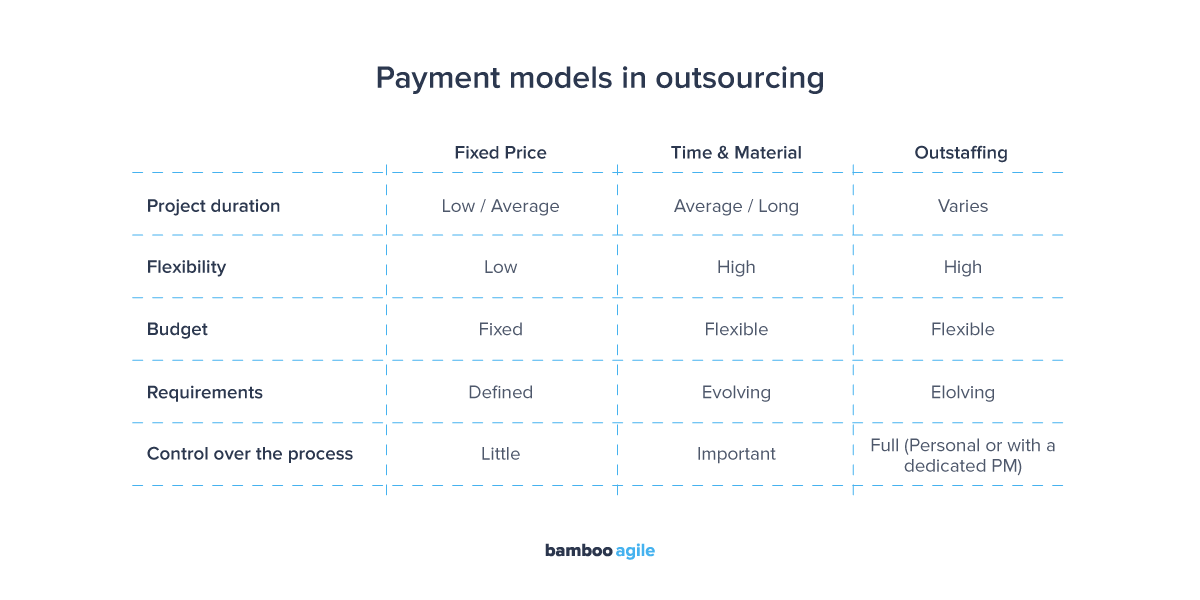
Fixed model
A fixed model is applicable when the project requires a fixed budget. If you want to outsource software development, the service provider will estimate its price before starting to work on it. The plus is that you find out the cost beforehand and know that it won’t change (not drastically, at least). As a rule, if the outsourced developer makes a mistake in pricing calculations, that’s not on you.
Bear in mind that the cost of development does not always include testing. It could be part of the hourly cost, included in only large-scale tasks, or paid separately. Or it might not be charged at all if the outsourced team does not have the right person for the job and the responsibility of exhaustive software testing falls on the client themself.
The disadvantage of the fixed approach is that the cost always accounts for risks, so it can be 10%-30% higher. Another detail that is worth mentioning is that you have to clearly understand the level of developer you want to hire. Any mistake could lead to further problems with hiring an additional specialist just to fix the problems not addressed by the previous developer. This is not an explicit disadvantage but a nuance since, in this case, it shouldn’t matter to you who performs the task – you just pay for the result.
Time-and-materials model
The time and materials (T&M) model, also known as the cost and materials (C&M) model, is common in long-term IT projects. It requires service providers to bid on a specific project and create a proposal based on the client’s specifications. This can also be seen in a build-operate-transfer (BOT) approach, in which the provider initially develops and controls the project’s development. The T&M model also requires the provider to operate in-house or under the supervision of the client.
Let’s take a closer look at this model using an example.
Suppose you are a software development company that needs to outsource a project to a third-party vendor. You have agreed to pay the vendor for the work they will do on an hourly basis, as well as for any materials or expenses they incur during the process. The vendor will provide you with a detailed estimate of the time and materials required to complete the project. This will include things like the number of hours each team member will need to work, as well as any hardware, software, or other materials they will need to purchase. Throughout the project, the vendor will track their time and expenses carefully and will provide you with regular updates on their progress. You will be billed periodically (usually weekly or monthly) based on the number of hours worked and the materials used.
Outstaffing
Outstaffing is a full buyout of specialists. For example, an outstaffing company supplies a programmer of a certain level (junior, middle, senior) to work as a staff unit in the client company. If the outstaffed employees get sick or decide to quit, the company is obliged to quickly find replacements for them – that is, in 1-5 days to avoid downtime.
A possible downside is the fact that you might hire a middle-level specialist, but some tasks turn out to require a senior expert. To tackle this, you have to make sure that your contract foresees the ability to change specialists to ones with a higher skill level. If not, then you’ll have to hire additional specialists. Also, you must properly understand all the different types of specialists you need to hire. Of course, you can hire additional professionals when your project is in progress, but then you might lose precious time while the new person(s) catches up on all the project details and is fully onboarded.
For outstaffers, the risks of this work format include the possible burnout of employees and problems with their professional development. For example, let’s say a company has a lot of specialists on its team. Those who are involved in client-side development can sometimes feel a bit left out – they might feel like they’re barely taking part in other projects or company life.

Cons of outsourcing software development
With that long list of benefits, you might be wondering why not to outsource software development. Well, there’s more than one potential issue, and we believe you should be prepared for all possible troubles you could run into. So, let’s discuss some likely disadvantages of IT outsourcing for app development projects.
1. Code quality risk
Code quality can suffer if a project passes through many hands, especially if you switch outsourced teams mid-project. In severe cases, that can mean a rewrite from scratch as part of project rescuing services.
AI-assisted “vibe coding” only adds a newer dimension to this risk: code generated from intent rather than a detailed spec can look correct while hiding subtle bugs, security gaps, or architectural inconsistencies that only surface in production. Ownership of AI-generated code, and any licensing questions upstream of it, isn’t always contractually clear either.
2. Business risks
Third-party companies are not immune to normal business risks: they can suddenly go bankrupt, lay off their employees, or even shut down altogether. Therefore, despite its obvious advantages, this type of delegation of tasks always presents a huge risk: there is a possibility of getting a raw, unfinished product due to unexpected business problems at the contractor’s end.
3. Time zone differences and communication challenges
Different time zone differences are a common risk for those working with offshore companies. The larger the time difference between you and the outsourcing provider you hired, the harder it might be to find a convenient time slot for both teams to communicate and resolve emerging problems.

4. Hidden costs
Usually, cost is a major differentiating factor when building software in-house vs outsourcing it – hiring a specialized development company is cheaper than setting up your own IT department. The employer saves on employee salaries, tax deductions, the need to create new workplaces, management, downsizing risks, etc. But if software development services are required constantly and especially full-time, maybe you’ve been underestimating your needs.
Besides, some businesses may even double-bill the client or provide a misleading overestimation. Phone calls, meetings, additional consultations, and even travel expenditures can all be considered hidden costs. It all adds up in the end, but while you’re in the middle of a project, there’s no turning back.
5. Information security concerns
Of course, there is typically an NDA that the service provider signs when you’re outsourcing software projects. The contract talks about specifics like data security, intellectual property rights, and consequences of breach. But even if you have the most sophisticated security measures in place, transferring important data to a third party increases the likelihood of it falling into the wrong hands.
6. Limited motivation
Outsourced teams may not have the same level of commitment or passion for your project as an in-house team would. Since they might be working on multiple clients’ projects, they might simply not be as invested in a single company’s (your!) long-term success. And as an outsider, you can’t really be going around giving pep talks.
Trends in outsourcing
The experience of outsourced teams can immediately and effectively impact your product; you can implement breakthrough technologies first and reap the benefits before anybody else. Here’s a basic list of innovations that are currently being employed in outsourced software development.
Cloud services
Businesses utilize cloud computing to outsource data management and storage as well as other IT functions. This allows them to collaborate effectively with teams all around the world and exchange and alter information in real time. As a result, costs are reduced, and efficiency is increased.
The most common cloud-based services are:
- SaaS (Software as a Service). Rather than installing software, a cloud provider hosts it and makes it available to end users through the internet.
- PaaS (Platform as a Service). Allows businesses to design, manage, and operate their own apps without having to construct or maintain the platform or infrastructure.
- IaaS (Infrastructure as a Service). This is another contemporary trend in IT infrastructure outsourcing. It is a pay-as-you-go service in which a third party provides you with cloud-based, internet-based infrastructure services like storage and virtualization as needed, but the operating system, any data, applications, and so on are your responsibility as the user.
Cybersecurity
As cyberattacks become more common, high-level data security will be one of the most critical problems in the coming years, and there will be an increasing need for cybersecurity outsourcing firms.
Although many cloud service providers offer security solutions, these are typically insufficient for creating enterprise-grade security. To ensure high-level security in cloud computing and fight against data breaches and targeted assaults, additional third-party solutions are frequently required.
AI and machine learning
AI, one of the top global IT outsourcing trends, refers to computers or systems that can perform tasks and improve themselves based on the data collected by emulating human intelligence. Machine learning involves a type of AI that uses data and algorithms to replicate how humans learn, enhancing its accuracy.
According to a recent report by MarketsandMarkets Research, the global AI market was valued at $214.6 billion in 2024 and is expected to grow to $1,339.1 billion by 2030, with a CAGR of 35.7%.
As these intelligent technologies grow more popular, the outsourcing market has taken note, and the number of organizations offering such services keeps growing.
AI and ML can manifest themselves in various ways. Here are a couple of examples.
- Recommendation engines can automatically propose TV shows to consumers based on their viewing habits.
- Chatbots employ artificial intelligence to better comprehend consumer needs and provide more effective solutions.
We can’t forget to mention the biggest and loudest trend of the past few years: ChatGPT. Microsoft became its biggest sponsor, investing $1 billion in 2019, including credits for processing power via Azure. In 2024, it was reported that the tech giant had committed to invest a total of $13 billion into the company over multiple years. The company behind ChatGPT, OpenAI, is valued at $157 billion according to reports from early 2025.
Alternatives to software outsourcing
If you are still unsure about the benefits of software outsourcing, don’t have many opportunities to try it out, or don’t fully believe in delegating all responsibilities to others, you can experiment with offshoring (outstaffing), onshoring, or nearshoring.
| Alternative | What you keep | What you trade off |
| Offshoring (outstaffing) | Full process control, fast hiring, lower cost than full outsourcing | Less local presence; still needs active oversight |
| Onshoring | Shared culture and work ethic with your team | Smaller, pricier talent pool; slower hiring |
| Nearshoring | No time-zone headaches, cultural alignment, cost-competitive | Limited talent in some countries; careful vendor selection needed |
Offshoring
If you’re not willing to give up complete control over your project, you can employ offshoring. This is a great alternative because you keep the simplicity and speed of hiring new employees, get valuable personnel from all over the world with economic benefits for yourself (this model is less expensive than outsourcing), have full control over your processes, and can personally check all the results.
Onshoring
If you’re seeking specialists only in your region who share your values, work ethic, or company culture, consider onshoring. But do note that the economic rewards from this will be minor, and the selection of acceptable employees may be limited due to low competitive skills. Also, keep in mind that the talent search procedure can be time-consuming!
Nearshoring
If you don’t want to deal with time zones and cultural differences but are still willing to venture outside your country, nearshoring is the way to go. Nearshoring presupposes that you can use the services of an agency that will fully implement your project on a turnkey basis, as well as an outstaffing firm that will find you the professional you need in the least amount of time.
If the project requires an experienced team of outstaffers, you can save time and money on hiring and still find a treasure of an employee. However, it is important to pay attention to the selection of human resources and their number. Talent is limited in some countries, and you may face problems you wouldn’t have to deal with if you expanded your options to more faraway nations.
Tips for successfully outsourcing software development
Now that you’ve assessed the pros and cons of outsourcing IT functions, particularly software development, you must be thinking of diving right in. When done correctly, software outsourcing can save you time and money while delivering high-quality results. However, if you’re not paying attention, there can be costly blunders.

Here are five tips for reaping the many benefits of software outsourcing.
Define business goals
Before you begin contacting possible offshore outsourcing partners, consider what you want to accomplish with your project. What problem are you attempting to solve? What characteristics are you looking for? What is your spending limit? Answering these questions will help you in finalizing the best vendor for your unique needs.
Check the outsourcing company’s profile
Once you’ve determined what you’re looking for, it’s time to begin your research. Check within your personal or corporate network to see if anyone has any recommendations. When you’ve clearly defined your requirements and flexibilities, spend some time reading online reviews and visiting your prospective vendor’s website and portfolio. This will give you an idea of their work style and whether they’re a good fit for your project.
Make a plan
Many business owners fail to develop a clear strategy for software development or business process outsourcing. Make sure you have a thorough project plan that describes your objectives, milestones, and deliverables before signing any contracts for outsourcing services. This will help you and your remote team get on the same page.
Follow every stage
Just because you’re outsourcing doesn’t mean you can ignore the project entirely – you still need to be involved to ensure that everything goes as planned. Set up meetings or virtual check-ins with your service provider to track progress and provide comments as necessary. Don’t be afraid to speak up if something isn’t going as you’d imagined – after all, it is your project!
Manage expectations
Last but not least, it is critical to manage expectations regarding both the benefits and drawbacks of outsourcing.
Make sure that your service provider understands what they’re getting themselves into and are realistic about what they can accomplish given your budget and schedule. Similarly, don’t expect any miracles – understand that there will always be some risk involved in software engineering outsourcing. Even when working with the most knowledgeable teams, sometimes certain delays are unavoidable. But everyone will be able to weather the bumps in the road (in case they do arise) if both parties enter the partnership with their eyes open.
Outsourcing experiences of big companies
Before we sign off, let’s talk about some real-world cases of companies that succeeded with software development outsourcing, and those who failed with it.
Software outsourcing success stories
GitHub
GitHub is a web-based platform for version control and collaborative software development. The company has used outsourcing to develop some of its key features, such as its mobile app and its desktop client. GitHub has worked with outsourcing partners from around the world, including in India, Romania, and Belarus, to develop new products and features quickly and efficiently.
Slack
Slack is a team communication platform that allows users to send messages, share files, and collaborate with colleagues. Slack has used outsourcing to develop its mobile app, which is available on both iOS and Android. The company worked with a team of developers in India to build the app, which has been downloaded millions of times and is a key part of Slack’s overall offering.
Liver Doctor
Sanofi, a worldwide healthcare organization, tasked Bamboo Agile with developing a mobile application to increase user participation in monitoring the state of their liver. Another goal was to enhance brand awareness for the Essentiale® Forte N product and offer consumers information on a variety of hepatological disorders and treatment options.
Based on the results of the patient’s tests, the software recommends the most appropriate type of therapy, with all medical suggestions validated by doctors. In most circumstances, a user does not need to consult a physician or a hospital; a proper diagnosis can be made using the app. As a result, the introduction of the Liver Doctor enabled patients to assess their symptoms and get advice on how to ease them, reducing the frequency of trips to local health centers.
Telefónica Germany
In May 2026, Telefónica Germany announced it had migrated its first 100,000 mobile customers to 4G/5G voice services running on outsourcing partner Mavenir’s cloud-native IMS platform, built on AWS. By doing this, the company has become the first mobile operator in Europe to run production subscribers on this kind of infrastructure in a public cloud. The migration is part of a multi-year transformation contract the two companies extended in February 2025, and they’re now jointly building an automation framework to speed up future feature rollouts.
It’s a good example of a telecom operator treating a specialized outsourcing partner as a long-term infrastructure co-owner rather than a short-term contractor.
AAA game publishers
Major game publishers routinely outsource significant portions of software development to specialized co-development studios rather than build every system in-house. Studios like Virtuos and Keywords Studios work across the industry’s biggest names like Ubisoft, Square Enix, 2K, Disney, and Tencent among them, handling everything from full co-development and porting to art production and QA.
Keywords Studios’ Sperasoft division, for instance, contributed to KRAFTON’s 2025 release PUBG: BLINDSPOT, continuing a track record that includes work on franchises like Halo, Battlefield, and Assassin’s Creed.
Failed software outsourcing attempts
Boeing
In 2019, Boeing faced significant issues with its 737 Max aircraft, which experienced two crashes that killed a total of 346 people. An investigation into the crashes found that one of the causes was a faulty software system that had been outsourced to a team of developers in India. The investigation found that the outsourced team had not been adequately trained or managed and that communication and coordination between the team and Boeing’s in-house developers had been poor.
Los Angeles Unified School District
In 2013, the Los Angeles Unified School District (LAUSD) launched a $1.3 billion project to provide all of its students with iPads. The project was outsourced to a vendor, which was responsible for providing the iPads and developing the necessary software. However, the project faced significant issues, including problems with the software that made it difficult for students to access educational materials. The project was eventually canceled, and the LAUSD was left with a significant financial loss.
Conclusion
Ever since the digital transformation of society, most companies have realized that to keep up with the latest trends, they’ll need to consider application development. And when it comes to choosing how to manage a project like that, the best option is to rely on experts.
Many companies are already outsourcing development to great success. You just need to organize, prepare, and take the big step!
But of course, this method can’t be suitable for everyone. In that case, it’s better to combine in-house and offshore development teams or not risk it at all and just hire your own professionals.
The responsibility of weighing the pros and cons of in-house software development vs outsourcing your projects lies on you, and the final decision is yours to make.
Bamboo Agile can be your helping hand in software development. We’ve got a team of professionals excelling in various domains ready to help you. If you’re considering outsourcing software development services to reputable Estonian companies with competitive rates, get a free consultation from us after filling out the form.