Introduction
It’s common knowledge that healthcare providers are notorious for being conservative when it comes to technology adoption. In an industry where one error can mean the difference between life and death, this kind of careful approach is easy to understand. That said, there are a variety of promising healthcare projects that have already proven their reliability and efficiency in the field – and more and more healthcare providers are starting to see the immense value in employing them.
According to Rock Health, U.S. digital health startups raised $14.2 billion in 2025, and that tendency has continued in 2026. The American Medical Association also found that 81% of physicians surveyed in 2026 reported awareness or professional use of AI in their own practice. The broader healthcare IT market demonstrates the same trajectory: it’s on track to grow from roughly $470 billion in 2025 to $550 billion in 2026, more than doubling again by 2031.
So, it’s pretty clear that smart technologies are infiltrating the field at a rapid rate. Let’s take a look at the most promising healthcare software projects the industry has in store.
7 most promising healthcare tech projects
1. Ambient AI clinical documentation
Clinicians spend a striking share of every appointment typing instead of treating, and it’s been one of the most persistent frustrations in healthcare.
Ambient AI scribes are changing that math. These tools listen to a patient encounter – whether it’s an in-person visit or a telemedicine consultation – and automatically turn the conversation into a structured clinical note in the electronic health record.
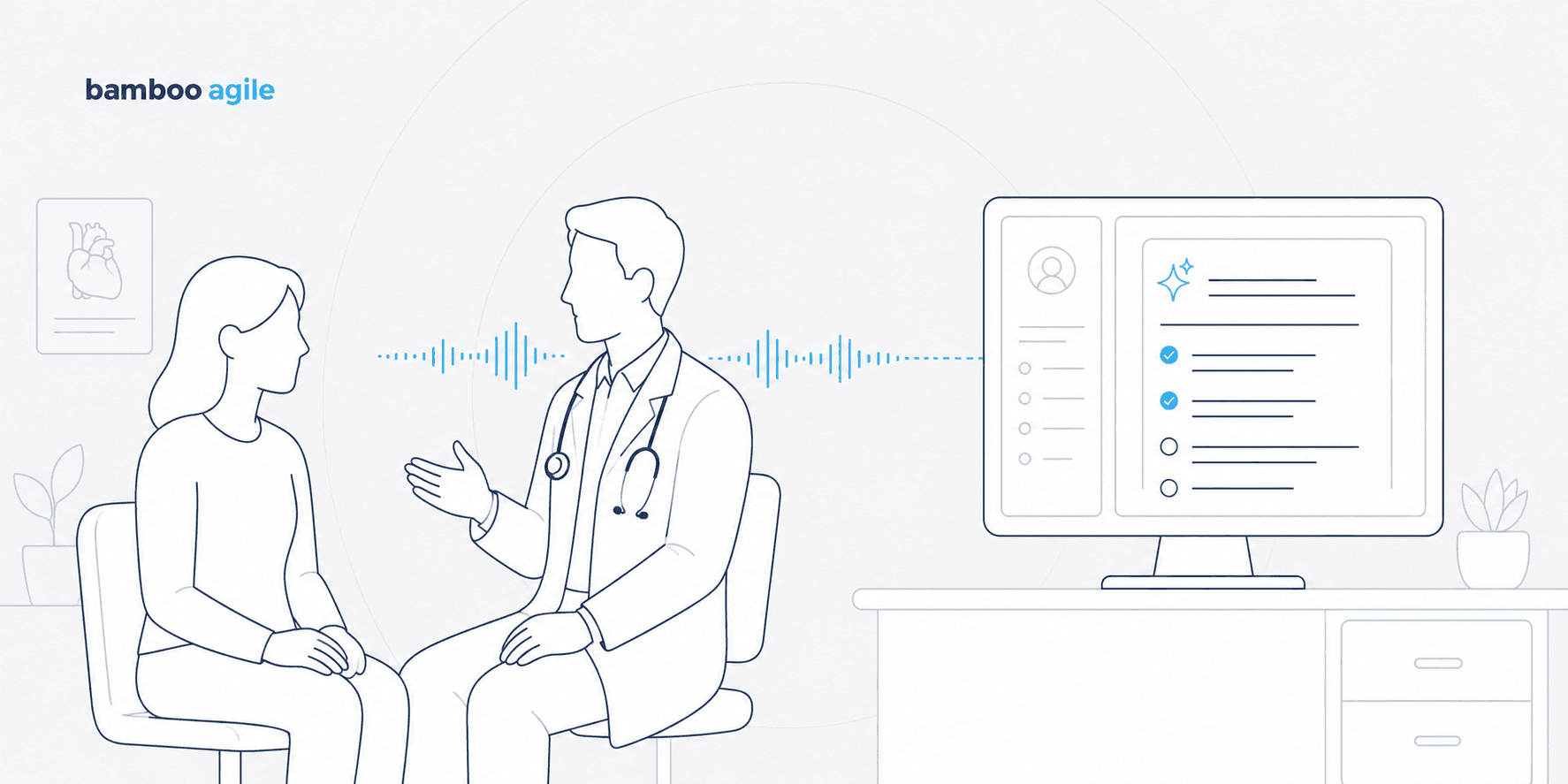
At UCSF, 70% of physicians were already using AI scribes in daily practice by 2026, and Kaiser Permanente logged more than 2.5 million AI-scribed patient encounters across 7,260 physicians in just over a year.
For a healthcare software development company, the most complex work here isn’t even the speech recognition, but building the integration that gets a generated note into the right EHR field, under the right compliance controls, without disrupting the clinician’s workflow.
2. Agentic AI for administrative automation
While ambient scribes handle the clinical side of documentation, a parallel shift is happening on the administrative side. Agentic AI systems represent software that can carry out a multi-step task on its own rather than simply answering a question. These systems are starting to take over prior authorization requests, claims processing, and eligibility checks: the paperwork-heavy processes that eat into staff time and delay patient care, and a recurring bottleneck across healthcare IT projects generally.
Despite this tech immaturity, real deployments are already running in 2026. For example, Cohere Health’s platform uses agentic AI to connect health plans’ prior authorization and payment-accuracy processes directly to provider workflows, while smaller practices like Michigan Orthopedic and 42 North Dental have adopted agentic scheduling tools specifically to cut down no-shows.
Developing this kind of system is a genuine AI integration challenge that requires careful guardrails, audit trails, and fallback paths to a human reviewer, since a wrongly denied claim or missed authorization has real consequences for a patient’s care.
3. Foundation models in medical imaging
Previously, diagnostic AI in radiology meant one model trained for one narrow task: a system that could flag a specific abnormality on a chest X-ray, say, and nothing else. These days, foundation models are replacing that approach with generalist systems trained on massive, diverse imaging datasets that can be adapted across many diagnostic tasks.
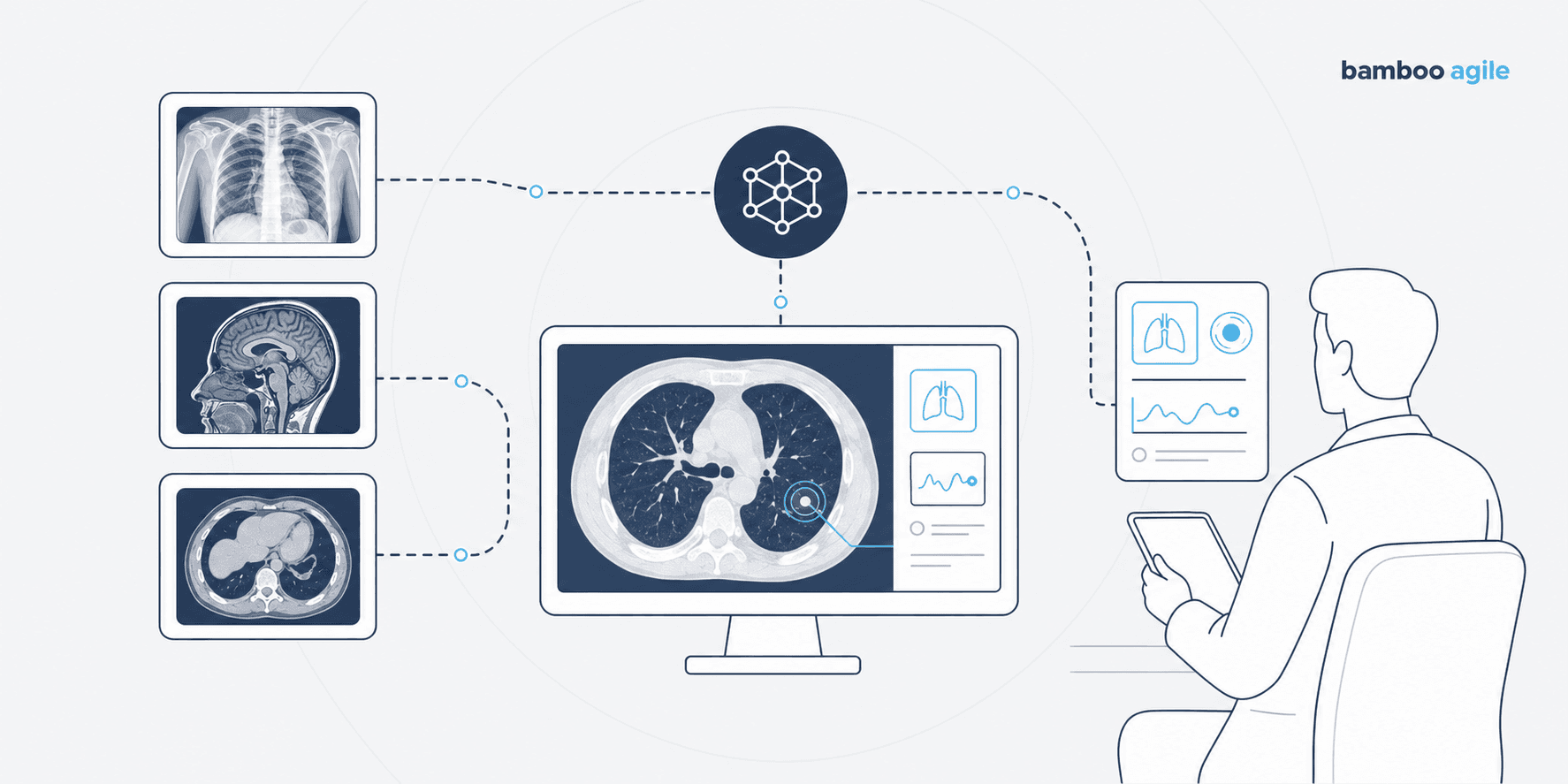
These models represent a shift toward general-purpose architectures powerful enough to draft a preliminary report, flag an anomaly, and support a radiologist’s read, all from the same underlying system. Named examples are already public: Google’s MedGemma and Stanford’s CheXagent generalize across multiple chest X-ray interpretation tasks.
For hospitals evaluating this technology, the harder problem usually also lies in integration with existing PACS and imaging infrastructure. Still, as we’ve noticed, this challenge keeps coming up across different medical software projects, regardless of how good the underlying model is.
4. Federated learning for multi-institutional AI
Training a healthcare AI model usually needs more patient data than any single hospital holds, but moving sensitive records between institutions raises exactly the privacy and compliance concerns healthcare software has to take seriously.
Today, federated learning solves this by training a shared model across multiple hospitals or research sites without the underlying data ever leaving its home institution – only model updates get shared, not patient records.
This is a genuine architectural change, and 2026 marks the shift away from the centralized data-pooling model that dominated healthcare AI through 2025, particularly for precision-medicine applications that need data spread across genomics biobanks, hospital records, and claims databases no single institution controls. NIH, NHS, and Genomics England already have deployments live, and it’s a natural fit for big data projects where the data itself can’t be centralized for regulatory reasons.
5. Generative AI-enabled digital therapeutics
Digital therapeutics – FDA-regulated software prescribed to treat a condition directly, not just monitor it – aren’t new on their own. What is new is generative AI integration moving into that category, turning a therapeutic app from a fixed, scripted program into something that adapts its approach based on how a patient is actually responding.
Regulators are actively working through what this should look like: the FDA’s Digital Health Advisory Committee met in late 2025 specifically to examine generative AI-enabled digital mental health devices, including scenarios for a prescription LLM-based therapy chatbot. Woebot – one of the original CBT-based mental health apps, launched back in 2017 – is now testing generative AI in its product, while newer entrants like Slingshot AI have raised capital specifically to build generative-AI-native mental health chatbots from the ground up.
6. Digital twins
A digital twin is a continuously updated virtual model of a real patient, department, or hospital, built from live data. It’s quickly becoming one of the more ambitious hospital IT projects a health system can take on.
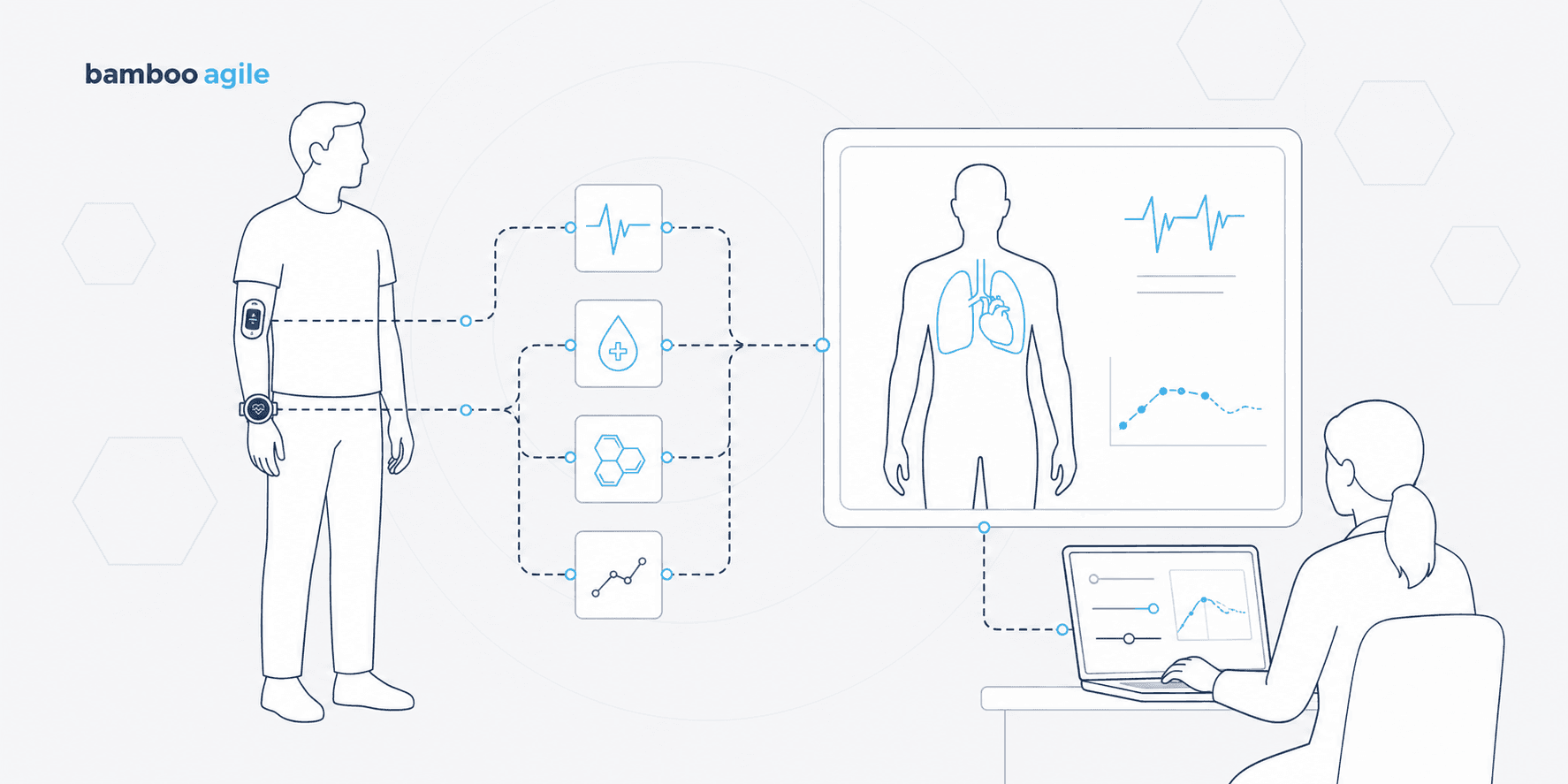
Applied to an individual patient, it means testing how their body might respond to a treatment before it’s given. Applied to a hospital, it means modeling patient flow and staffing before a schedule change goes live.
The technology has moved past the pilot stage. GE HealthCare’s digital twin platform for hospitals and health systems already simulates real-world patient flows, staffing demands, and resource utilization.
Building one from scratch means pulling together EHR data, imaging, wearables, and operational systems into a single, continuously updated model. This is a genuinely cross-disciplinary IoT development challenge as much as a software one.
7. Generative AI for drug and protein design
The most research-heavy entry on this list, but one with real momentum: generative AI models that design entirely new molecules and proteins, rather than screening through libraries of existing ones. Instead of searching for a compound that might bind to a disease target, these models generate novel candidates built specifically for that target’s 3D structure.
The field crossed a credibility threshold when three scientists won the 2024 Nobel Prize in Chemistry for techniques to decode and design novel proteins, and the pace has only picked up since – AI-fueled drug design pipelines are expanding by close to 40% a year.
The clearest real-world proof point is Insilico Medicine’s rentosertib, a generative-AI-designed drug for idiopathic pulmonary fibrosis that went from program start to an investigational new drug application in about 30 months against an industry norm of four to six years, and is now in Phase 2 trials.
This is squarely pharma software development territory rather than a hospital-facing project, but it’s one of the clearest examples of software directly accelerating the years-long, hundred-million-dollar process of getting a new drug to patients.
Conclusion
The healthcare industry is no longer what it used to be. Technology implementation rates are at an all-time high, and innovative solutions and decisions enter the market on a daily basis. Some automate the extra processes in clinics, some optimize the work of the software that’s already in place, some provide relevant data on global issues.
Whether it’s ambient documentation, agentic automation, or generative therapeutics, there are plenty of healthcare project solutions worth exploring when it comes to envelope-pushing healthcare tech. Now is the time to adapt, to upgrade your medical software with new and more effective applications – unless you want to lose the market competition, that is.
Want to help medical technology achieve new heights? Perhaps, you feel inspired to create a healthcare software project of your own? Then Bamboo Agile would be glad to help you make that idea a reality. Fill out this simple form for a free consultation.