Medical software doesn’t forgive shortcuts. A vendor can be great at building consumer apps and still stumble the first time they hit HIPAA, an EHR that refuses to cooperate, or an FDA validation requirement.
The market backdrop explains why having niche expertise matters more every year. The global healthcare IT market is on track to almost double by 2030, from about $480 billion in 2025 toward $961 billion. EHR adoption is essentially ubiquitous: more than 99% of non-federal acute care hospitals and 91% of office-based physicians are running a certified EHR.
That means most industry software projects today aren’t about first-time digitization. On the contrary, medical service providers care about technology replacement, modernization, and integrating AI into systems they already have. Additionally, AI in healthcare itself is moving fast: 81% of physicians surveyed by the American Medical Association in early 2026 say they use AI in a professional context, up from 38% just three years earlier.
Apparently, medical software development companies that understand both the compliance weight of healthcare and how to build AI into it responsibly are the ones worth paying attention to.
In this listing, we ranked ten companies using three most essential groups of factors:
- The presence of solid case studies in medical software, preferably with clients named.
- Compliance frameworks a company documents (HIPAA, GDPR, FDA device classes, ISO certifications, HL7/FHIR).
- Clutch rating and reviews back that rating up.
Bamboo Agile is scored unbiasedly on the same factors as everyone else here, using the same public sources.
Best medical software development companies
1. Itransition
Two decades in healthcare IT, delivery teams across 40 countries, and a headcount past 3,000: Itransition operates at a different scale than most of the companies on this list. Based in Decatur, Georgia, they carry a 4.9 on Clutch from over 40 reviews.
Their medical device-software work runs through FDA Class II and III territory, built to IEC 62304’s compliance classes, and one analytics platform they built now processes over 500 million patient records across several dozen petabytes of client data, illustrated in their unified care management platform case study. FDA device requirements or analytics at real scale are where this bench runs deepest.
2. Orangesoft
Headquartered in Warsaw, Poland, with a San Francisco office alongside it, Orangesoft runs a team of 70 to 100 people and holds a 4.9 Clutch rating.
The company’s medtech work is defined by hard numbers: a virtual hospital platform they built, with AI added to the pathology and radiology imaging pipeline, cut report turnaround time by 82% and infrastructure spending by 30%. They’ve also shipped an FDA- and HIPAA-compliant post-stroke remote monitoring platform for a U.S. hospital network.
3. Bamboo Agile
A mid-sized healthcare software development company from Tallinn, Estonia, Bamboo Agile holds ISO/IEC 27001 certification and is compliant with HIPAA, HL7, and GDPR.
Since 2002, their healthcare portfolio has included four distinct case studies:
- a HIPAA-compliant telehealth platform built for the Ministry of Health in an Arab state;
- an AI-powered app for assessing COVID-19 symptoms and book appointments through a chatbot;
- an iOS MVP for a teen health education platform;
- and a companion app for Sanofi.
Besides, they mention the Ministry of Health in Kenya among their clients. That’s a wider range than most companies this size manage, and it shows in both review volume and compliance breadth relative to their headcount.
4. Ralabs
Ralabs splits its footprint between a Tallinn, Estonia headquarters and an engineering team based in Ukraine. They count 80–100 people in total and hold a 4.9 Clutch rating from more than 40 reviews.
The company approaches projects as one continuous process, research, design, and development together, and keeps an ongoing client roster that includes Choosing Therapy, Eckerd, and Dental Referrals. Their telemedicine app case study describes shipping an MVP with real-time geolocation and doctor-patient communication in about a month, for a California clinic network that lost physicians to pandemic-era departures.
5. Uptech
With offices in Kyiv, Ukraine and Paphos, Cyprus, Uptech carries a Clutch rating around 4.9 and leans its healthcare work toward consumer-facing products.
MicroGenDX (at-home DNA testing) and Clearly (a teletherapy platform) both needed to feel effortless despite the sensitive data underneath. On the operational side, their AI-driven document processing system case study describes cutting analysis time by 34% for a private U.S. diagnostic clinic working to double its patient volume.
6. TechMagic
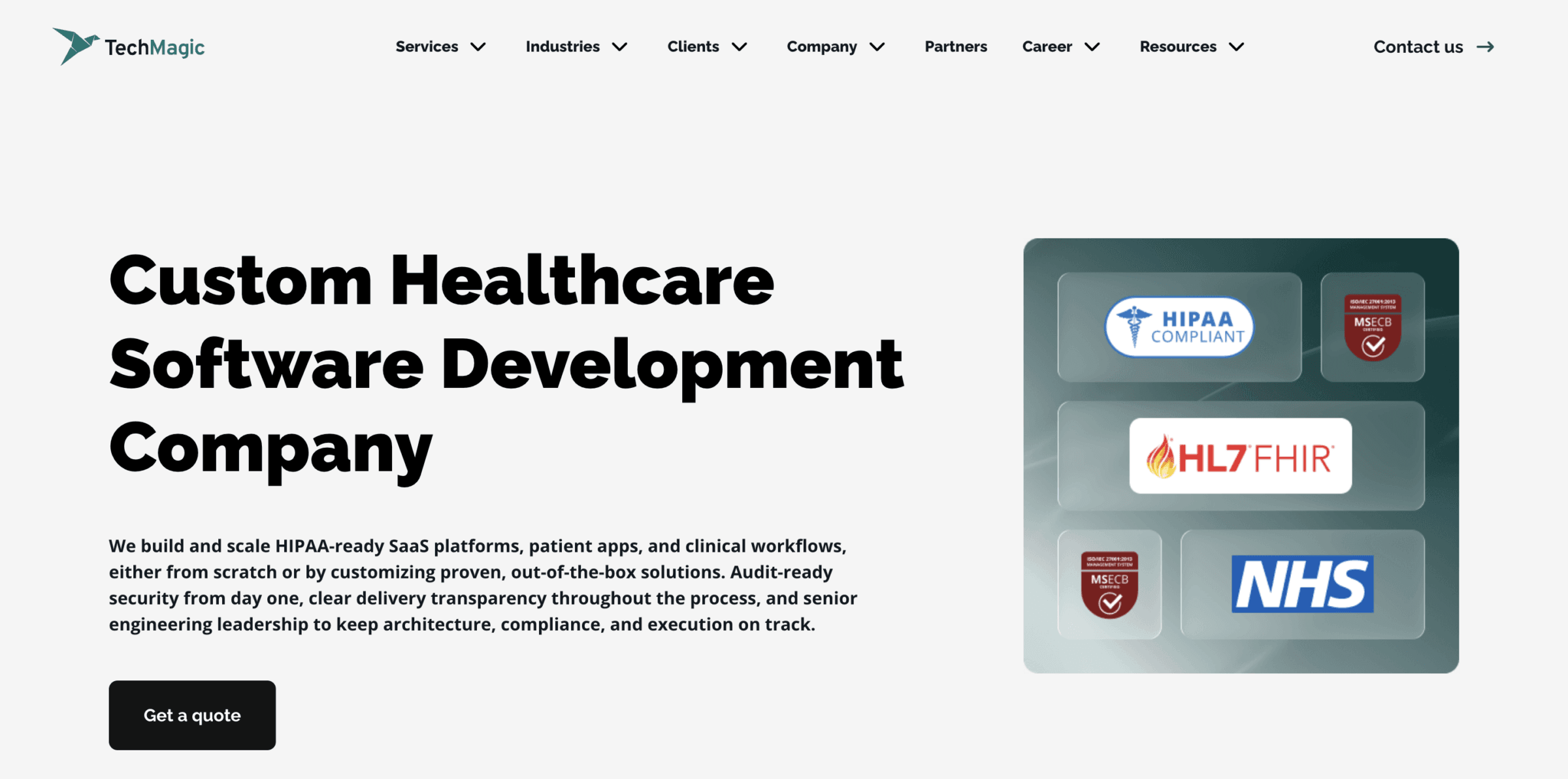
Around 400 people work across TechMagic’s offices in Lviv, Kraków, Kyiv, and London. Plus, the company holds the highest review count on this list, even though the rating is slightly lower – 4.8 out of 5.
Their healthcare reputation rests on two contrasting case studies. ClarisHealth brought them in to build Pareo, a payment-integrity platform for detecting fraud, waste, and abuse. Separately, hospital-management platform Unumed asked them to pressure-test their system before launch, and the penetration test came back with no critical or high-severity vulnerabilities.
7. Arkenea
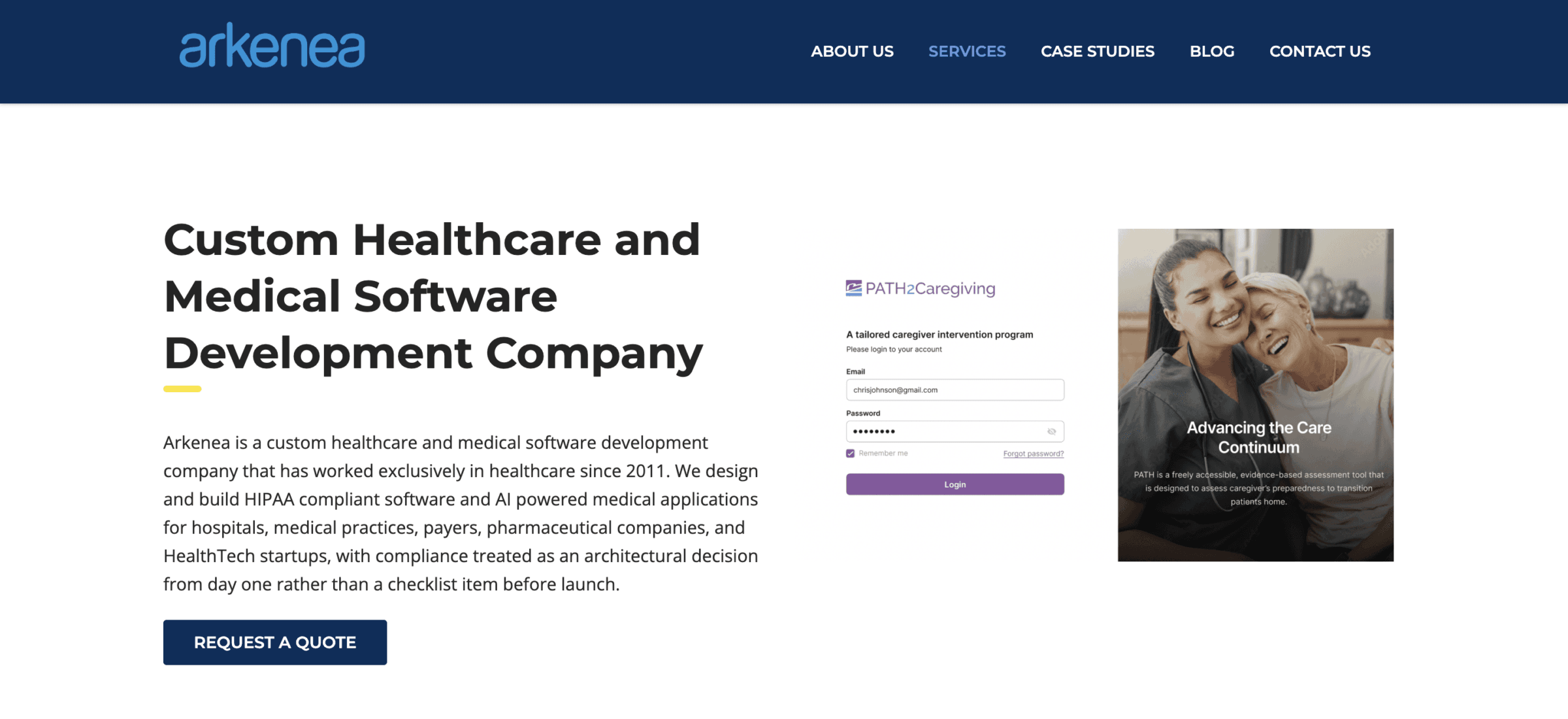
Arkenea keeps things deliberately small: about 50 people based in Cary, North Carolina, with development delivered out of India. A 4.9 Clutch rating comes from a smaller pool of 14 reviews.
No other industry vertical competes for the team’s attention. This focus has been maintained for more than 14 years, and it shows in their compliance list (HIPAA, HITECH, HITRUST, HL7, MDR), the broadest on this list, and in direct EHR integrations with Epic, Cerner, and PointClickCare.
Their NPHub case study, a nurse-recruitment platform built from scratch, reports it reaching $1.6 million in revenue within 18 months.
8. GloriumTech
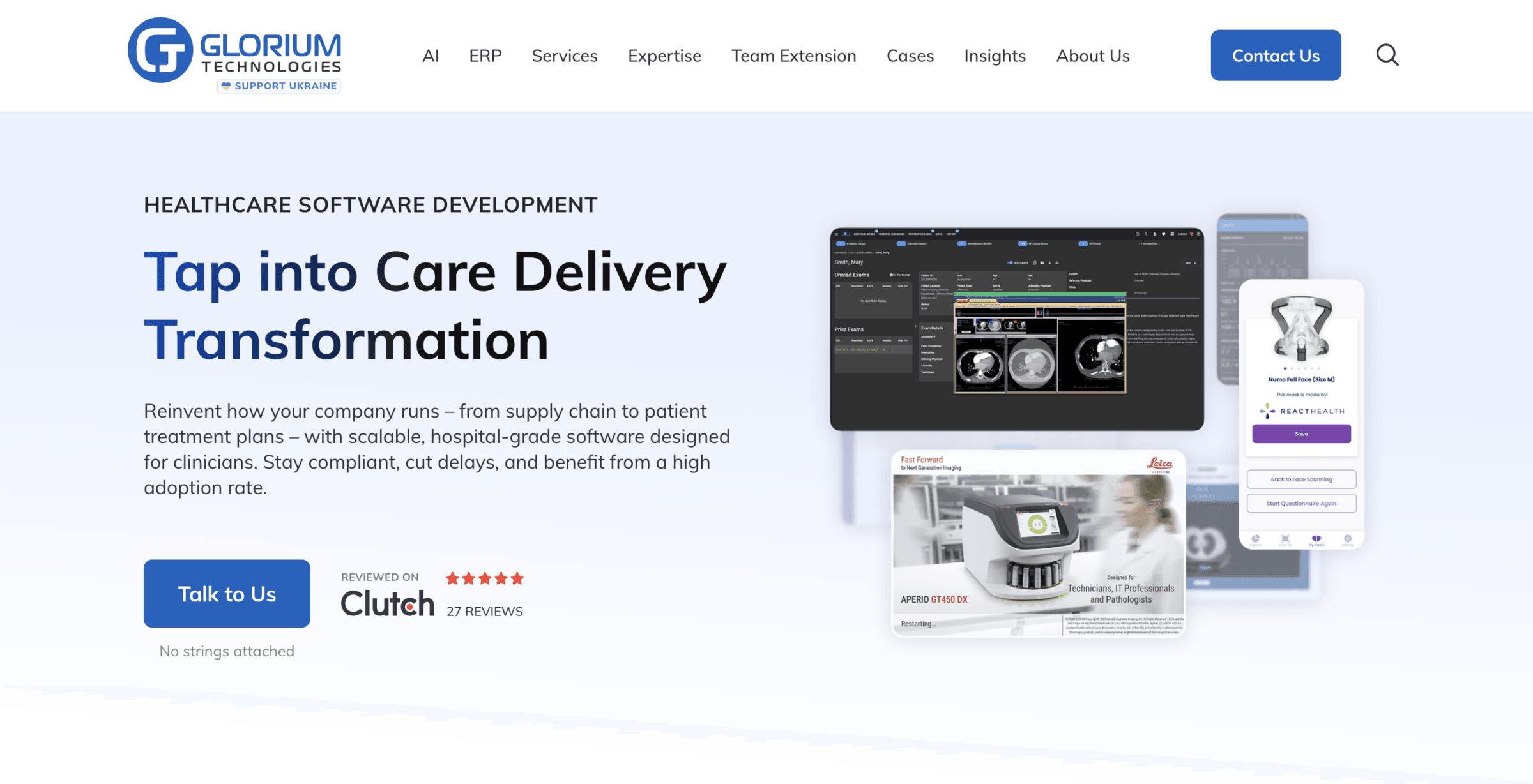
GloriumTech is headquartered in Houston, Texas, with delivery centers in Kyiv, Kraków, and Paphos. They employ around 150 people and hold ISO 9001, ISO 13485, and ISO 27001 certification. Clutch rates them 4.8 from 28 reviews.
Their Turtle Health case study describes taking over a women’s health platform after a previous outsourcing partner was unable to complete it, a rescue that only works with genuine healthcare-adjacent experience.
9. Pragmatic Coders
Since 2014, Pragmatic Coders has worked with more than 100 clients out of Kraków, Poland, where up to 75 people staff the headquarters. Most engagements start with a structured product-discovery workshop before the developer involvement.
Their WithHealth case study describes building a virtual care platform in six weeks during the early COVID-19 outbreak, cutting the client’s manual workload by an estimated 2,000 hours a year.
10. Leobit
Leobit operates out of a Lviv, Ukraine development center with representative offices in Austin, Tallinn, Kraków, and London. They have from 170 to 240 people in total and hold ISO 9001:2015 and ISO 27001:2022 certification alongside HIPAA, GDPR, CCPA, and OWASP compliance.
Their Clutch rating, 4.5, is the lowest on this list, but it’s drawn from more than 50 reviews. Their key healthcare practice-management platform case study describes rebuilding a scheduling system and cutting patient no-shows by up to 50%, and the platform was later acquired by Canada’s largest operator of outpatient health clinics for $4.75 million.
All companies at a glance
Size and rating alone won’t tell you much, so use this table to cross-reference against the compliance and case study detail in each write-up above.
| Rank | Company | Founded | HQ | Rating | Hourly rates |
| 1 | Itransition | 1998 | Decatur, GA (US) | 4.9/5 | $25-49/hr |
| 2 | Orangesoft | 2011 | Warsaw, Poland | 4.9/5 | $50-99/hr |
| 3 | Bamboo Agile | 2002 | Tallinn, Estonia | 4.9/5 | $25-49/hr |
| 4 | Ralabs | 2014 | Tallinn, Estonia | 4.9/5 | $50-99/hr |
| 5 | Uptech | 2016 | Kyiv, Ukraine | 4.9/5 | $25-49/hr |
| 6 | TechMagic | 2014 | Lviv, Ukraine | 4.8/5 | $50-99/hr |
| 7 | Arkenea | 2011 | Cary, NC (US) | 4.9/5 | $50-99/hr |
| 8 | GloriumTech | 2010 | Houston, TX (US) | 4.8/5 | $50-99/hr |
| 9 | Pragmatic Coders | 2014 | Kraków, Poland | 4.8/5 | $50-99/hr |
| 10 | Leobit | 2014 | Lviv, Ukraine | 4.5/5 | $25-49/hr |
A few things helping you make your final shortlist
Before signing with any medical software development agency on this list (or off it), ask these questions to make sure they fit your project:
- Who’s actually on the development team. Request the names and seniority of the engineers assigned to your project specifically, and whether that team stays consistent through the engagement or rotates.
- What happens if the relationship ends. Code ownership, documentation handover, and knowledge transfer if you switch vendors or bring development in-house later – all of this matter here. Some contracts make this smooth; others quietly make you dependent on the original team forever.
- Time zone overlap and communication cadence, in practice. A team eight hours ahead can still work well if they’ve built a rhythm around it (async handoffs, overlapping call windows), but clarify specifically how they’ve solved this for other clients, since medical software projects tend to need more real-time back-and-forth than typical software work.
- How they handle scope creep on compliance-driven changes. Healthcare requirements shift mid-project more than most software categories, whether from a new payer integration, a changed FDA guidance, or a security audit finding. Ask for an example of how they’ve absorbed one of these changes without blowing up timeline or budget.
- What a pilot engagement looks like before the full contract. Vendors confident in their process are usually willing to scope a small, contained first project (a discovery phase, a single feature) before you commit to a multi-month build. Reluctance here is itself informative.