
If there is something to be said about frontend development in 2026 – and about software development in general – it is how strongly it is influenced by the rise of artificial intelligence. The adoption moment came in November 2022, when ChatGPT put on-demand coding help in front of nearly every developer at once. And by 2026, AI has become as indispensable as the code editor itself.
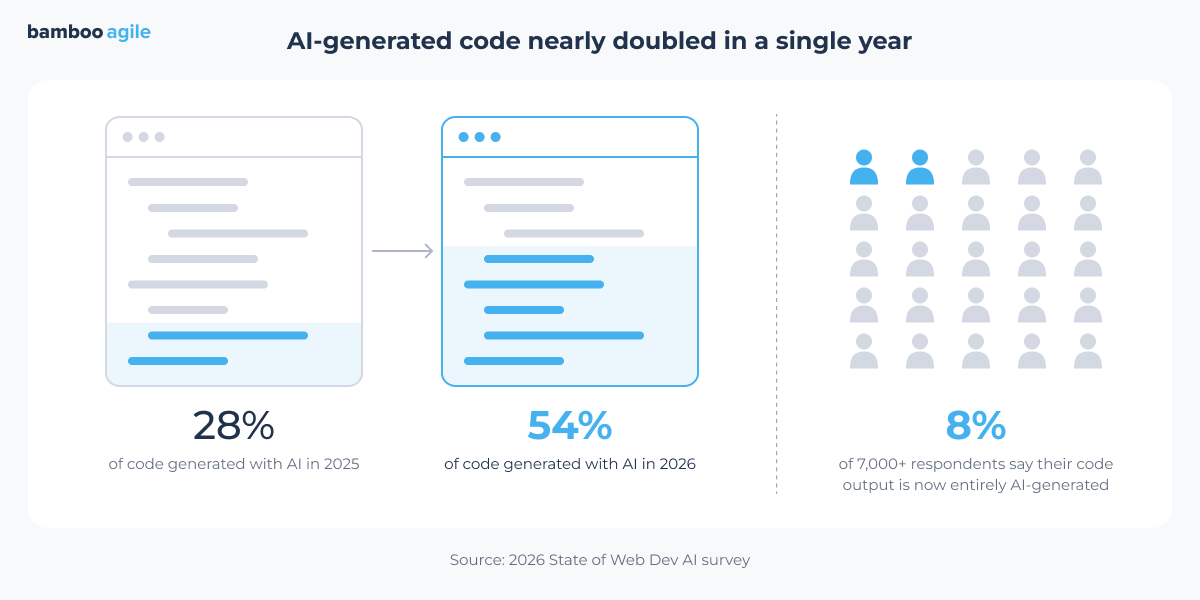
You can see this impact in numbers. According to the 2026 State of Web Dev AI survey, the share of code web developers generate with AI nearly doubled in a single year, from 28% to 54%. Out of more than 7,000 respondents, 8% stated their code output is now entirely AI-generated.
Opinions on AI in frontend development differ, though. Some openly say “AI sucks at frontend” (nerdy.dev):
“AI loves the boring stuff. It thrives on mediocrity. If you want some gloriously unoriginal UI, it has your back.”
Others admit you can no longer deny that AI has changed the economics of code generation (The Pragmatic Engineer podcast):
“In 2025, it was rational to be skeptical about AI, but in 2026 it’s clear that AI is changing all of the industry, and there’s less and less place for skepticism.”
At Bamboo Agile, we decided to study this paradox in detail and invited Mikalai Repin, our frontend developer (React/Angular), to share his own experience-based take on AI for daily tasks.

Our expert
Mikalai Repin is a frontend developer with more than five years of experience in JavaScript, TypeScript, Angular, React, Redux, RxJS, and Material UI. He holds certificates in Claude Code in Action from Anthropic and Building Professional AI Agents with Node.js & TypeScript from FreeAcademy.
How AI is changing frontend engineering
How has the frontend engineer role changed now that AI can write a significant part of the implementation? What does the market expect from a strong senior developer today that it did not five years ago?
A lot of tasks can go to AI now. The obvious ones are typical components, routine work, and validation. It has also gotten much easier to find your way around a project, because AI explains what each part of the application does, many times faster than reading the code yourself.
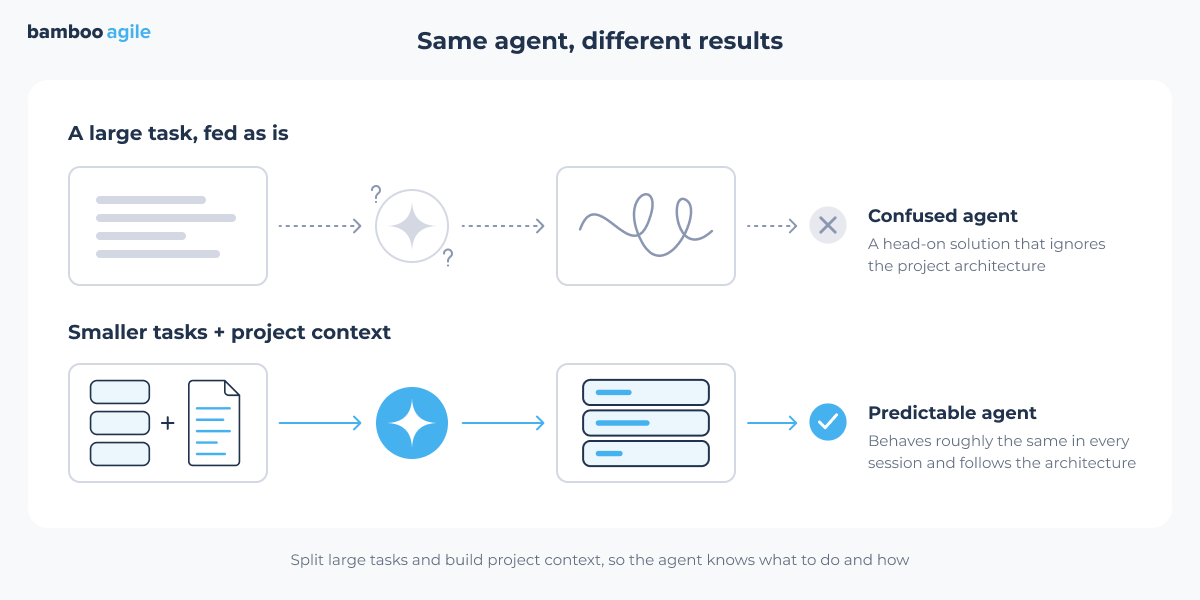
So, the roles have changed. These days, a developer works more like a reviewer and designer of code an agent writes. Usually, you split a task into smaller ones to give the agent an understanding of what to do. I think writing code now matters less than knowing what we are building inside the project and why. That means talking to analysts and other developers, and proposing changes that improve the product.
But strong fundamentals still matter. If you do not have them, you cannot tell whether the agent did the right thing.
You already mentioned that AI makes a developer’s job faster. From your experience, where does AI save you the most time in frontend development today – and where is the productivity gain mostly an illusion? Can you give us a recent example?
In my opinion, Storybook components and tests are where AI saves a frontend developer the most time. These used to eat up a big chunk of our time. Also, reading someone else’s code now can be done in twenty or so minutes.
But on complex tasks, the gain is almost an illusion. AI produces a plausible solution, and then fixing its bugs takes far longer than writing the code yourself. Often, the cause is that a large task gets fed to the agent as is, and the agent gets confused and does the wrong thing.
Context is the other half. You have to build it so the agent behaves roughly the same in every new session. Without context, agents solve tasks head-on and ignore the project architecture. AI can help with code review too, but I’d keep a human in that step.
As for an example from my personal experience, in a recent project, my team and I used AI across a fairly complex stack (React 17, TypeScript, MUI, XState + Redux). While indeed it made certain routine work faster, the agent ignored the project structure and often missed every place a fix could affect. As a result, the fix came out incomplete or broke the logic, so I still spent a lot of time fixing bugs by hand.
AI meets the modern frontend stack
You see AI as a good point for the first draft or base components. Let us dig a bit further. Modern frontend frameworks themselves are also becoming more automated – React Compiler can handle memoization, while Angular is moving toward Signals. Does a modern stack make AI-generated code noticeably better, or does AI simply introduce a different set of performance problems?
Even for those first-version components, the problem remains, because the models were trained on code written before these changes. Without explicit rules, agents memoize functions by hand even when the project uses React Compiler. In Angular, they reach for NgModule and Zone.js instead of standalone components and Signals. You end up with a mix of approaches in one codebase.
When working with LLMs, TypeScript is often considered a safety net. If we look at your resume, we can see that you have extensive experience with it. How much does strict typing help AI with complex state, API contracts, and refactoring – and what kinds of mistakes still slip through?
Mistakes do slip through, but TypeScript significantly reduces them. An agent changes a type, runs the check, sees the errors, and iterates until it passes.
The catch is that an agent tries to satisfy the compiler rather than the business logic, often by reaching for type casting (as). None of this works without a strict linter: ban any, @ts-ignore and non-null assertions, and restrict type assertions, so the agent is forced to fix the actual data flow instead of masking type errors.
Strict typing helps most with complex states. With discriminated unions and exhaustive checks, an agent cannot “forget” about the error state or the empty-data state, because the compiler will not allow it.
API contracts are trickier, because types disappear at runtime. If the backend returns something different, TypeScript will not notice, and the agent will happily write as User. That is why types are usually generated from the backend’s OpenAPI schema, and responses are validated at runtime, for example with Zod, so there is nothing left for the agent to cast.
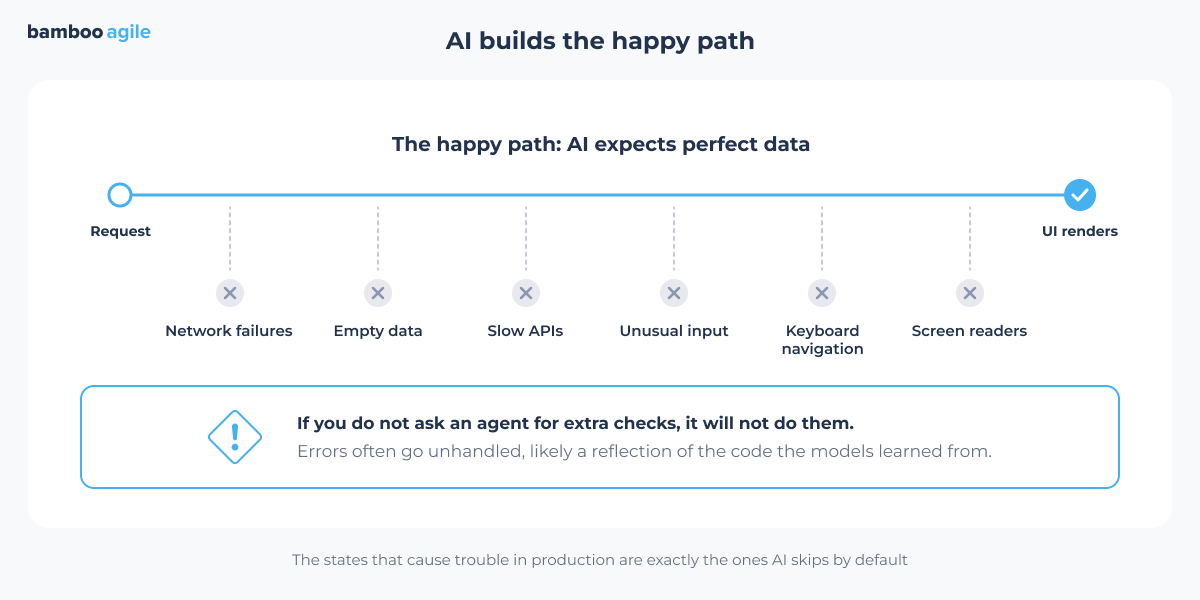
What we have gathered so far is that AI is good at producing the happy path. How well does it handle the states that usually cause trouble in production – network failures, empty data, slow APIs, unusual input, keyboard navigation, or screen readers? And what about accessibility?
If you do not ask an agent for extra checks, it will not do them. AI expects perfect data, and errors often go unhandled. That is probably a reflection of the code the models learned from.
Accessibility has the same cause. Agents wrap everything in div instead of using semantic tags. They build modals without focus traps, and their accessibility attributes are either decorative or missing. But it is not purely an AI problem – human developers do the same thing.
The agent simply replicates the average code it learned from, so non-happy-path states and accessibility requirements have to be explicit – ideally, in the project rules for the agent, not just in a one-off prompt – so it follows them in every session.
AI in real production codebases
Working on a clean new project is the easy case. Clients usually bring five or ten years of code written by different teams. How useful is AI when you need to understand, refactor, or modernize a legacy frontend without turning it into a rewrite?
This is where the quick code reading pays off most. AI can tell you:
- Where the data comes from
- How a module, function, or class works – as well as who calls it and what depends on it.
It can also do useful things like finding components and functions that nothing in the project uses or drawing a dependency diagram. And it writes tests that pin down current behavior, so you can check that a rewrite broke nothing.
For the modernization itself, I would write new code next to the old code and replace the old parts gradually, in small pieces. At the start, I would stay away from legacy components that look odd or inaccurate. First, I need to understand what they do and why. Often it is a workaround left by the previous developers.
Pinning down legacy behavior only works if the checks are trustworthy. AI can generate unit tests almost instantly now, which raises the question – has it changed how much you cover, and how do you avoid a test that passes from hiding broken component logic?
An agent can cover an application with tests quickly, but the tests are often there for show. Coverage goes up, and nothing guarantees that a broken component makes a test fail.
Our team ran into three problems:
- The agent reads the code and writes a test to match it. If the code has a bug, the test locks the bug in.
- toBeTruthy() and toBeDefined() check that a value exists, not that it is the right value.
- Hooks, services, and other dependencies get mocked up until the test means nothing.
To avoid this, you need to tighten your prompts. Mock only server data – never internals – and ban weak assertions. One more trick that helped: break a component’s logic by hand and see whether the tests fail.
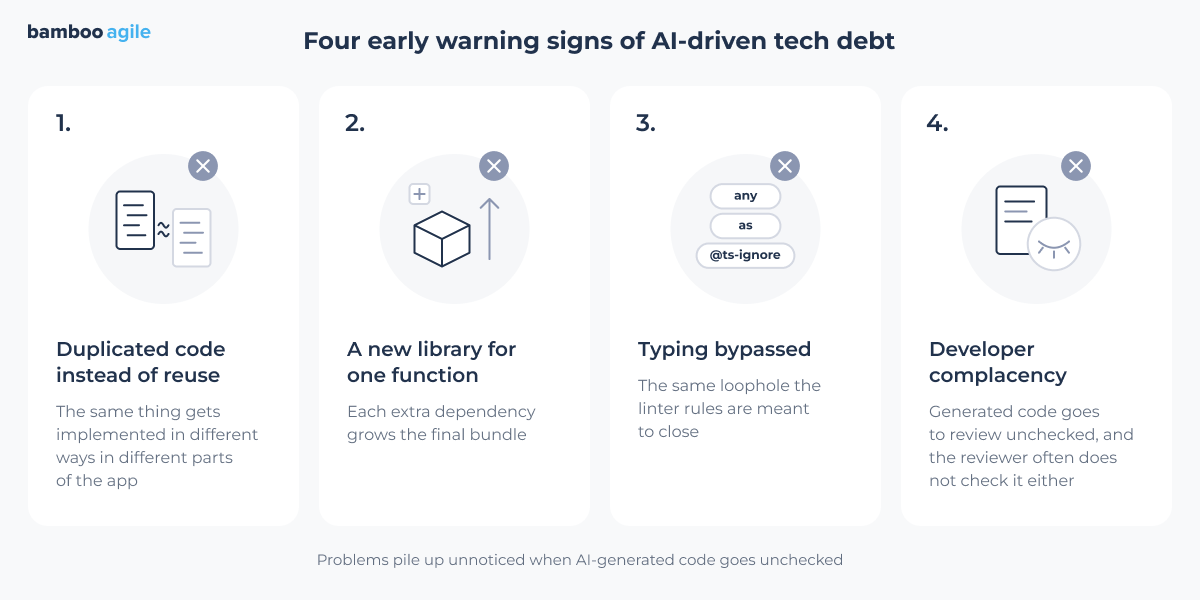
Tests that protect nothing are one way problems pile up unnoticed. What are the first warning signs that AI-generated frontend code is creating technical debt faster than the team realizes?
I see four such warnings:
- First, duplicated code instead of reuse. The same thing ends up implemented in different ways in different parts of the app.
- Second, an AI agent may add a new library just for one function, which grows the final bundle in size.
- Third, typing is bypassed with any, as, and @ts-ignore. That is the same loophole the linter rules are meant to close.
- And fourth, developer complacency. People get used to generating code and send it to review unchecked. But the reviewer often does not check it, either.
Bringing AI into a frontend team safely
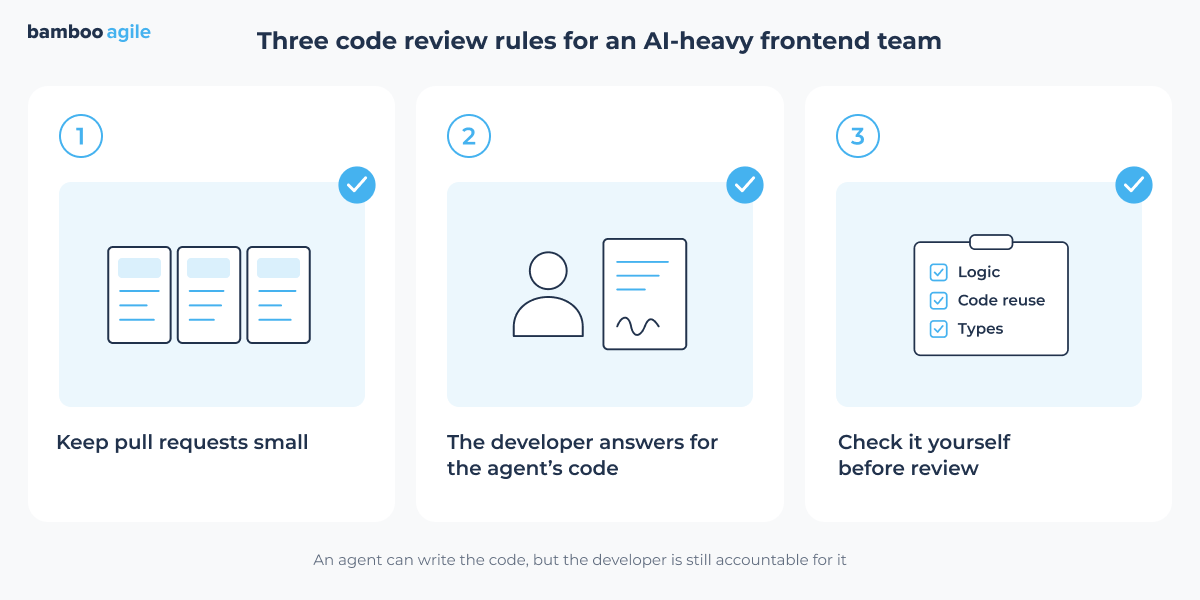
Based on your warnings, it looks like a frontend developer may get carried away and become too careless with AI by their side. If you set code review standards for an AI-heavy frontend team from scratch, what would the top three rules be?
I would suggest following the three rules below:
- Keep your pull requests small. An agent can generate 1,000+ lines in seconds, but no developer will properly review that volume. Splitting tasks into subtasks helps the reviewer catch AI hallucinations just as much as it helps the agent. Every PR needs a description of what was done and why.
- The developer answers for what the agent wrote – and has to understand it. Small PRs make that realistic, because a short change is easy to hold in your head.
- Before sending code to review, check the logic, code reuse, and types yourself. Do not trust the agent completely.
What this changes for the client
These rules put the responsibility on the developer, not the agent. For a founder or CTO, what is the single biggest difference they will notice when hiring an AI-native frontend developer instead of a traditional one?
You stop paying for typing and start paying for architectural judgment.
With a traditional developer, a large chunk of the budget goes into mechanical implementation: writing boilerplate, wiring form states, and scaffolding components. An AI-native developer compresses that execution time significantly. On well-scoped tasks, work that took weeks can shrink to days or even hours.
In practice, that translates into three concrete changes:
1. Much faster feedback loops. Ideas reach a working, testable prototype much sooner, which shortens the path to launch.
2. More ground covered by smaller teams. On new projects built from scratch, one experienced AI-native engineer can take on work that used to need more people. On large legacy codebases the gain is less clear, and AI can sometimes slow the work down.
3. The developer acts like a reviewer. The engineer spends more time on API contracts, performance, edge cases, and maintainability.
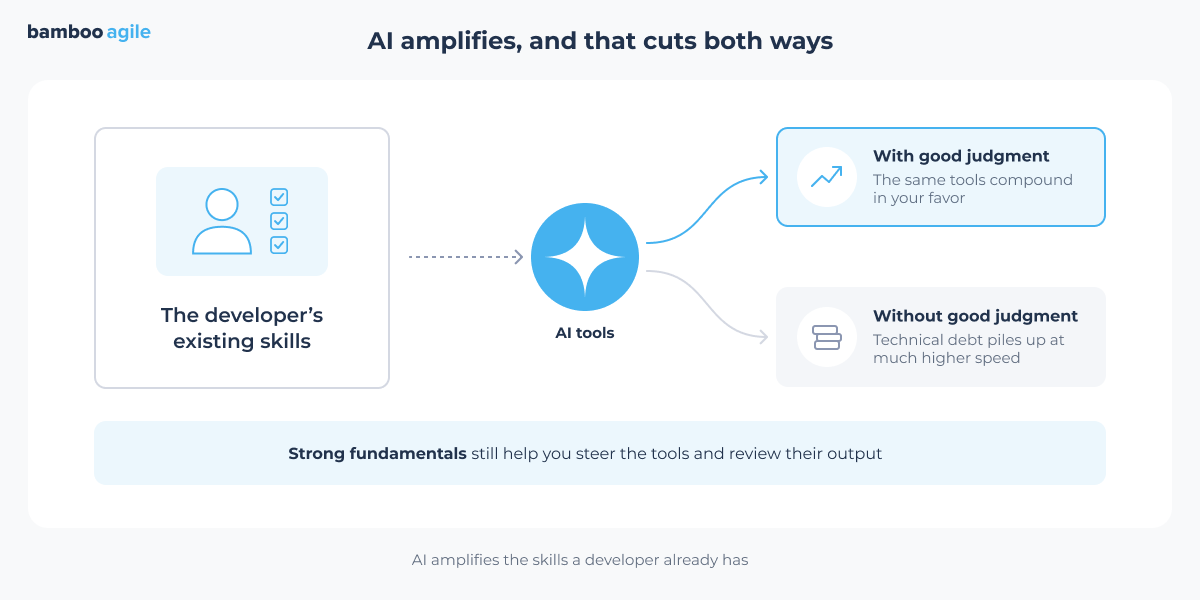
AI amplifies the skills a developer already has. That cuts both ways. Without good judgment, it is easy to generate technical debt at much higher speed. With it, the same tools compound in your favor. Strong fundamentals still help you steer the tools and review their output, even if how much they matter is changing as the tools improve.
Key takeaways
- The frontend developer’s job has moved from writing code to splitting tasks and reviewing what the agent produces. To make the review possible, one has to have strong fundamentals.
- In frontend development, AI saves the most time on Storybook components, tests, typical UI logic, and reading unfamiliar code. It is least reliable on large tasks and on projects where the agent has no context.
- Duplicated code, extra libraries, bypassed types, and unchecked generated code are the early signs of AI-driven debt.
- Safe review habits are small PRs with descriptions, full developer ownership of agent code, and a self-check before review.