A 2025 study from MIT’s Project NANDA analyzed more than 300 enterprise AI deployments and found that roughly 95% of enterprise GenAI pilots didn’t show any measurable return, while only about 5% created significant value. The same research found that projects delivered with an external partner reached production roughly two times as often as those built fully in-house. The finding proves what most procurement teams already suspect: the problem rarely lies in the AI model, but a partner choice here matters the most.
That is the gap this article is built to close. Below are ten generative AI integration companies having verifiable track records based on ratings and reviews pulled directly from Clutch, GoodFirms, and G2.
You can find other rankings mentioning Accenture, IBM, and TCS as “best AI integration companies”, but, apparently, it’s not much use if your budget sits under $100,000. This list is aimed to help small and mid-market buyers as well.
How generative AI actually gets integrated
Before comparing agencies, you should first clear it out what “integration” covers, since the term gets used loosely. Most projects combine two or three of the following:
| Method | What it does | Best for |
| API integration | Calls a model directly from your app or product | Simple, contained features like a chatbot or content generator |
| Middleware and connectors | Bridges an LLM to your CRM, ERP or legacy systems | Enterprise stacks you cannot rip out and replace |
| RAG pipelines | Feeds your own documents and data to the model | Answers grounded in company knowledge, not just general training data |
| Workflow automation | Adds AI steps inside tools you already use | Approvals, triage, document handling |
| Orchestration & agents | Coordinates several models or agents across multi-step tasks | Complex workflows that need reasoning across several steps |
Knowing which of these your project actually needs is the first filter for choosing a partner, since some of the agencies below specialize in only one or two of these methods.
What we looked at when compiling the list
Ratings alone do not tell you much, since most established agencies sit somewhere between 4.7 and 5.0 on Clutch. So alongside the scores, we checked:
- Verified client reviews on Clutch and GoodFirms, with review counts.
- Depth of generative AI services.
- Production case studies, meaning systems that shipped and are still running.
- Company scale and specialization, since a five-person boutique and a 650-person outsourcing firm are good at addressing different challenges.
Quick comparison
| Agency | Rating | Hourly rate | Employees | Headquarters | Best for |
| Dataforest | 5.0 Clutch / 5.0 GoodFirms | $50–$99/hr | 50–249 | Remote / EU-US | Fixing messy data before adding AI |
| Kanerika | 5.0 Clutch / 5.0 G2 | $100–$149/hr | 250–999 | US, India, Argentina, Singapore | Enterprise AI with compliance needs |
| Leanware | 5.0 Clutch | $25–$49/hr | 10–49 | Colombia / US | Startups wanting a small, senior team |
| Bamboo Agile | 4.9 Clutch / 4.9 GoodFirms | $25–$49/hr | 50–249 | Tallinn, Estonia | Full-cycle development services |
| Jellyfish Technologies | 5.0 Clutch / 5.0 GoodFirms | $25–$49/hr | 50–249 | Noida, Salt Lake City, Toronto | Augmenting an in-house team |
| Bitcot | 4.9 Clutch | $25–$49/hr | 50–249 | San Diego, US | US-based RAG and co-pilot projects |
| LeewayHertz | 4.7 Clutch | $50–$99/hr | 50–249 | San Francisco / Jaipur | Large enterprise AI programs |
| ValueCoders | 5.0 Clutch | <$25/hr | 250–999 | Gurugram, India | GenAI bundled with modernization |
| Sapphire Software Solutions | 4.9 Clutch / 4.9 GoodFirms | <$25/hr | 250–999 | Ahmedabad, India | Adding AI to an existing system |
| Netset Software Solutions | 5.0 Clutch | $25–$49/hr | 50–249 | Mohali, India / San Francisco / Mississauga | Fixed-budget entry into GenAI |
Top generative AI integration companies
1. Dataforest
Clutch: 5.0/5 (27 reviews) · GoodFirms: 5.0/5 · Employees: 50–249
Data engineering, ETL pipelines, and BI platforms came first for Dataforest, when GenAI got layered on top only once that foundation was solid, and the ordering still shows in the work.
One client case documents an LLM-powered contract review engine that cut processing time by 70% and lifted accuracy by 90% across legal and construction documents. Another hire Dataforest for building ongoing AI features into an HR platform’s reporting and third-party integrations.
Because the team treats data quality as the foundation rather than an afterthought, they suit companies whose generative AI plans keep stalling on messy or disconnected data.
2. Kanerika
Clutch: 5.0/5 (18 reviews) · G2: 5.0/5 (37 reviews) · Employees: 250–999
Kanerika is a global AI and data consultancy having offices in the US, India, Argentina, and Singapore, and a client list that includes Sony, Volkswagen, Kroger, and HDFC.
Their FLIP platform offers low-code data operations with embedded generative AI, letting organizations automate reporting and workflow tasks hassle-free. ISO 27001, ISO 27701, SOC II, and GDPR compliance, plus Microsoft and Databricks partner status, make Kanerika a natural fit for regulated, enterprise clients who need AI paired with serious data governance.
3. Leanware
Clutch: 5.0/5 (24 reviews) · Employees: 10–49
Leanware calls itself an AI-first development shop, and the structure backs that up: a US entity handles contracts while the engineering team works out of Colombia.
The team has worked with large language models since their early days and structures its generative AI consulting around strategy, model selection across GPT, Claude, and Gemini or open-source alternatives, and a stated goal of production value within 90 days.
Client feedback consistently praises thoroughness and honesty over flashiness. Leanware works best for startups that want close, senior-level collaboration. Still, a team of around 40 people may introduce limited capacity for very large, multi-workstream enterprise programs running in parallel.
4. Bamboo Agile
Clutch: 4.9/5 (35 reviews) · GoodFirms: 4.9/5 (98%) · Employees: 50–249
Bamboo Agile is a software development company based in Tallinn, Estonia, with close to two decades in business and ISO 27001 certification. Their client roster spans telecommunications names such as A1 Group, Orange, and MTS, alongside education, healthcare, fintech, and e-Commerce work. Reviewers regularly highlight transparent pricing and full-cycle delivery, from requirements and architecture through to QA and maintenance.
On the AI side, their dedicated GenAI integration services cover GPT, Claude, Gemini, and Llama integration, RAG pipelines, LLM fine-tuning, and workflow automation. They work on the basis of any of these three engagement models (fixed price, dedicated team, or time and materials) depending on how defined the scope is.
They delivered various AI-integrated software solutions, including an AI chatbot for COVID-19 self-diagnosis and appointment booking for a French healthcare organization, and a context-aware in-vehicle conversational AI system for an automotive client.
For mid-size projects where you want one accountable team from concept to production, Bamboo Agile is a solid shortlist candidate.
5. Jellyfish Technologies
Clutch: 5.0/5 (27 reviews) · GoodFirms: 5.0/5 · Employees: 50–249
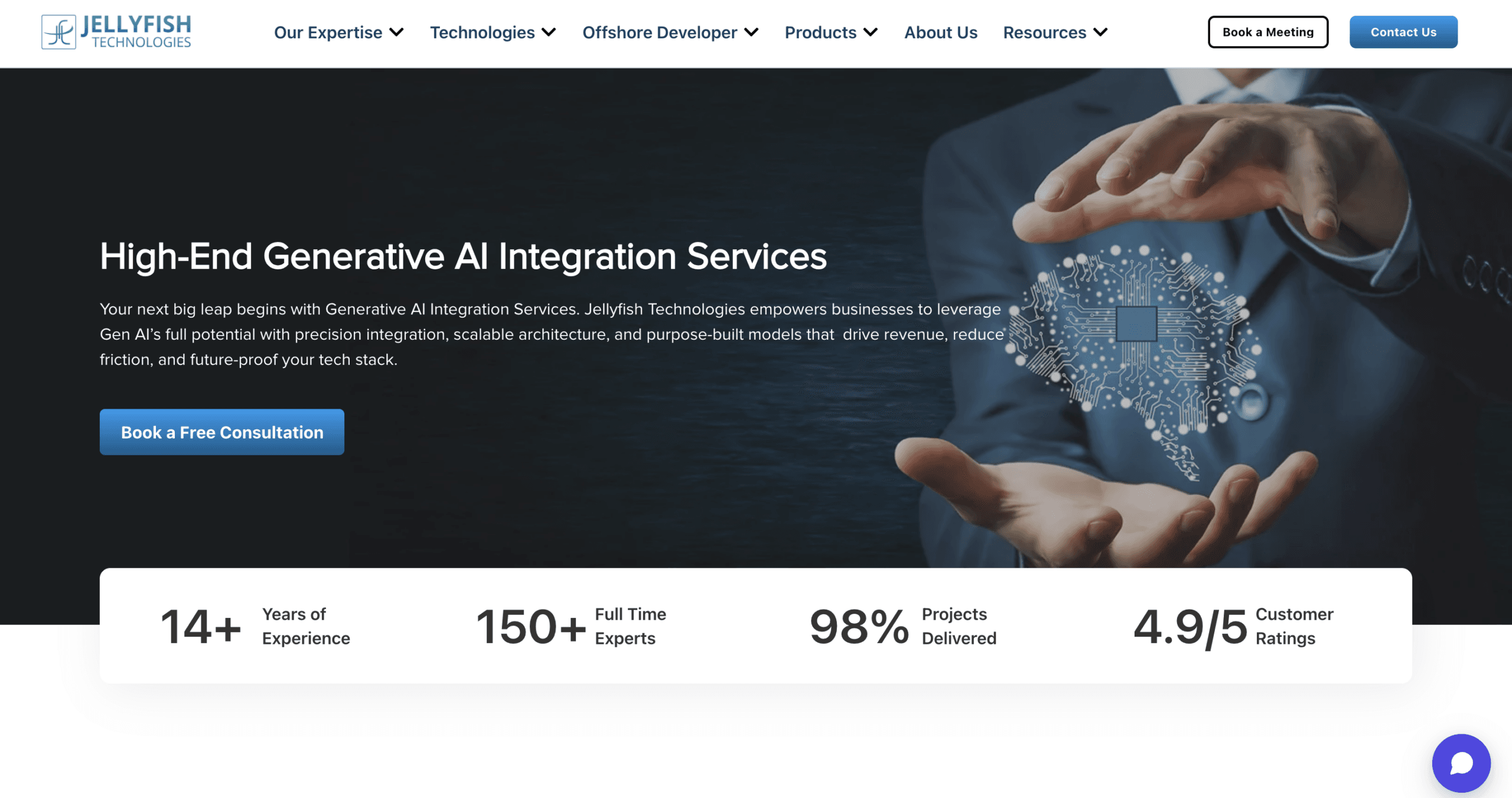
Founded in 2011 and now running offices in Noida, Salt Lake City, and Toronto, Jellyfish Technologies has delivered 250+ projects over 14 years.
What sets it apart on the generative AI side is flexibility of engagement: alongside full project delivery, it offers dedicated hiring of AI engineers and LLM specialists, so you can plug expertise straight into an existing team instead of outsourcing the whole development.
That makes it a strong option for companies that already have engineering capacity and just need specialists to fill a gap. Nevertheless, the staff-augmentation model works best when you already have someone in-house setting technical direction. But if you want the agency to own strategy end to end, confirm that scope upfront.
6. Bitcot
Clutch: 4.9/5 · Employees: 50–249
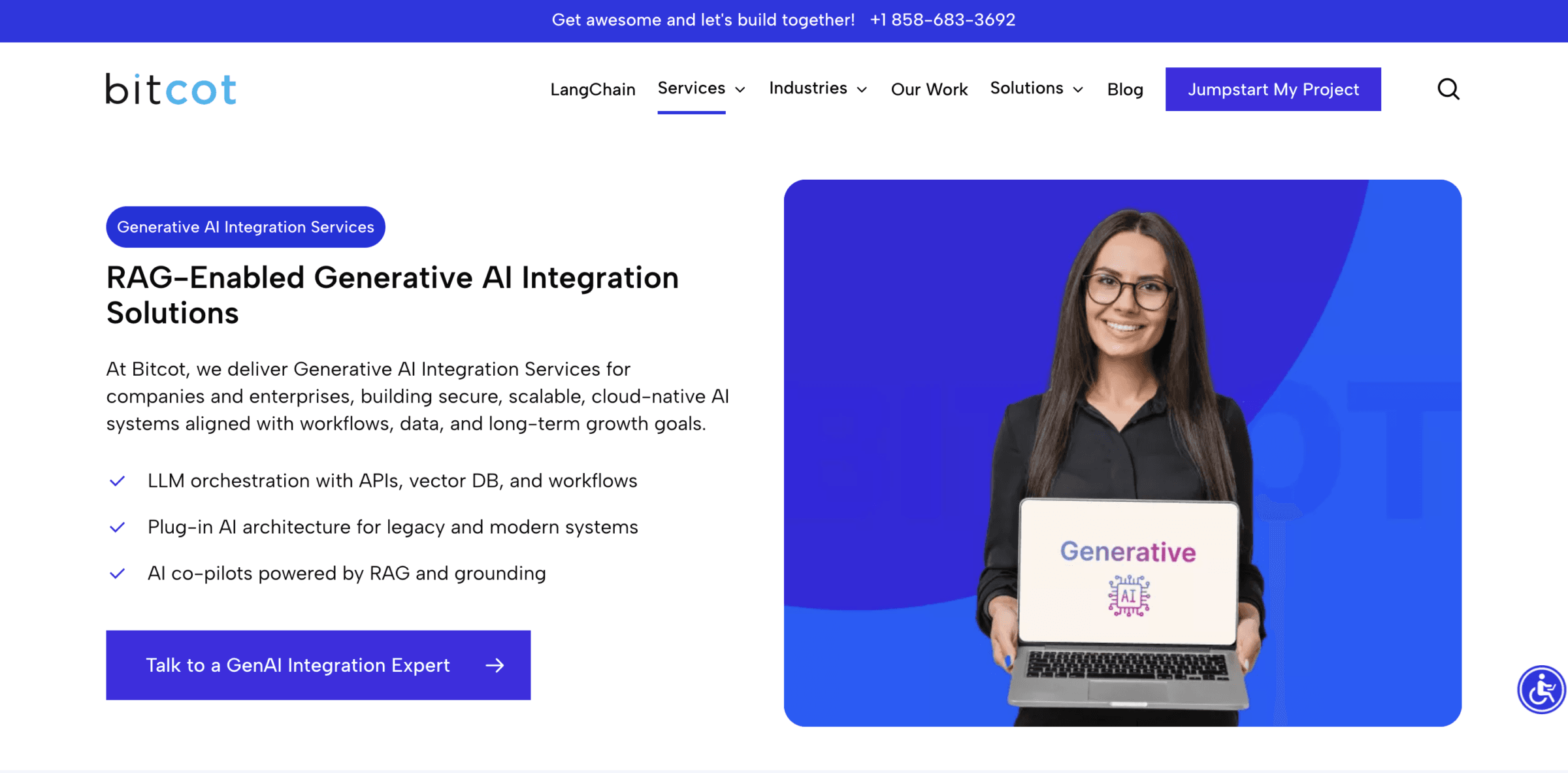
Bitcot is a company San Diego that runs a packaged GenAI Accelerator built around retrieval-augmented generation, LLM orchestration through APIs and vector databases, and a plug-in architecture designed to sit on top of legacy systems.
Their client base runs from startups through to established names like ResMed. Because the team is US-based with English-first communication, Bitcot suits companies that want a nearby partner and a packaged RAG or AI co-pilot offering.
7. LeewayHertz
Clutch: 4.7/5 (9 reviews) · Employees: 50–249
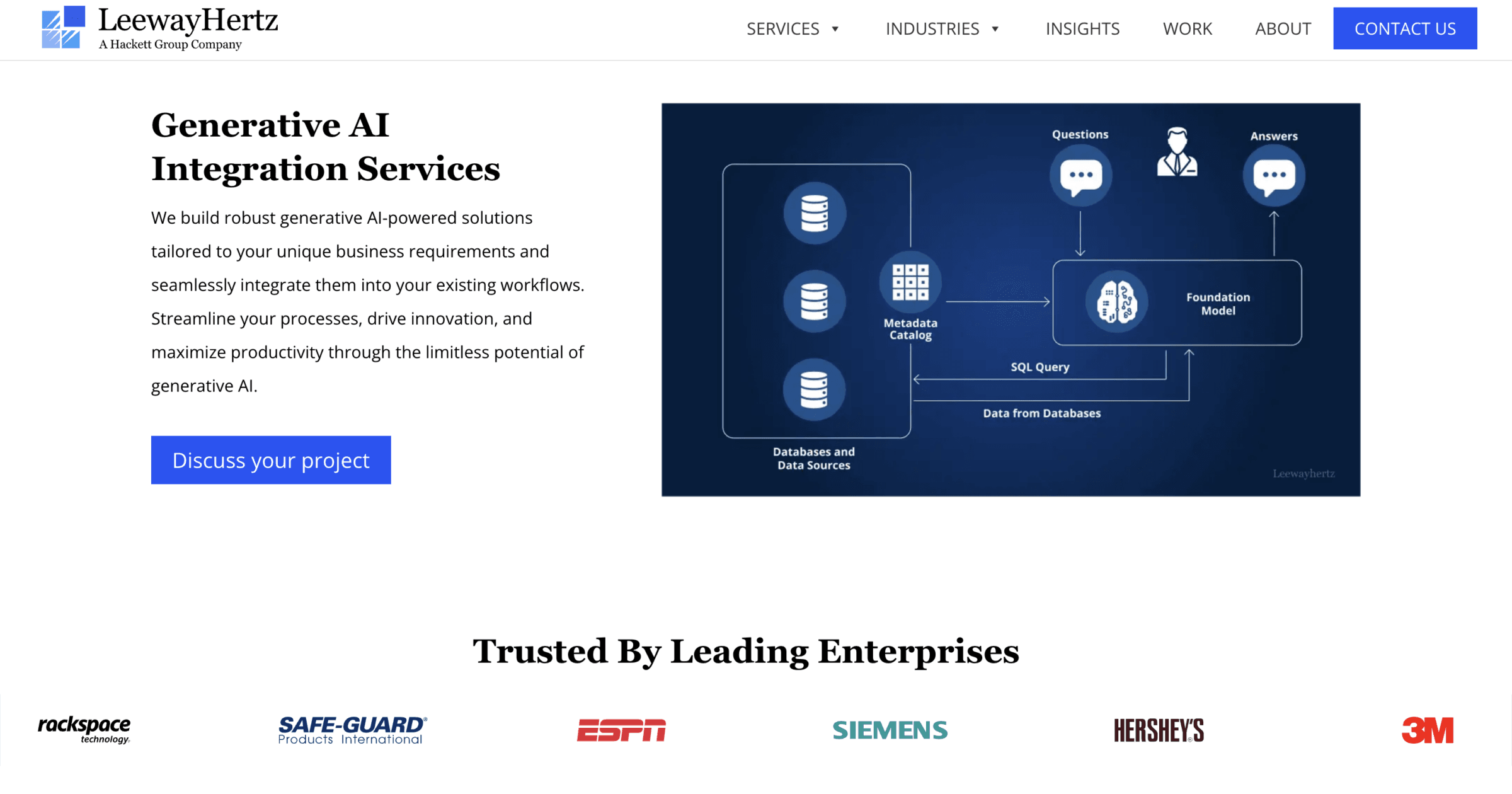
Founded in 2007 and now part of The Hackett Group following a recent acquisition, LeewayHertz says it runs a 250+-engineer team based mainly out of Jaipur, India, with a San Francisco headquarters.
Their ZBrain platform is a proprietary GenAI orchestration layer built to ground LLMs in enterprise data, and the company is reported to have earned a spot in Gartner’s 2024 Hype Cycle for Generative AI, plus, a Forbes ranking among the top ten AI consulting firms.
For sure, this is enterprise-grade AI consulting with the respective pricing, so it suits larger organizations better than early-stage startups on a tight budget.
8. ValueCoders
Clutch: 5.0/5 (7 reviews) · Employees: 250–999
ValueCoders has been running out of Gurugram, India since 2004, and their own site cites roughly 675-plus staff across 4,200+ delivered solutions with a reported 97% client retention rate.
Their Clutch profile carries far fewer reviews despite its scale, so weigh the volume claim against the thinner independent review count. ISO certifications and Great Place to Work recognition back up the company’s positioning.
Generative AI and LLM work sits inside a broader AI and automation practice that also covers legacy modernization and staff augmentation, which makes ValueCoders a sensible choice for organizations that want GenAI together with wider software modernization from a single outsourcing partner.
9. Sapphire Software Solutions
Clutch: 4.9/5 (331 reviews) · GoodFirms: 4.9/5 (201 reviews) · Employees: 250–999
Sapphire is one of the most reviewed software development vendors on Clutch. They were founded in Ahmedabad, India in 2002.
The company’s portfolio is broad, not specifically AI-first: education ERPs, healthcare documentation systems, government solutions, and e-Commerce sit alongside AI integration as one service line among several. Sapphire suits organizations, including schools, public sector bodies, and SMEs, that want to fold GenAI features into an existing system.
10. Netset Software Solutions
Clutch: 5.0/5 (101 reviews) · Employees: 50–249
Netset has run out of Mohali, India since 2011, with additional offices in San Francisco and Mississauga, Canada. The company positions its AI work alongside blockchain and Web3 development, and publishes fixed generative AI packages starting from $2,999, which gives smaller businesses a defined entry point.
One related reviewed project represented a full RAG pipeline for an advertising agency’s internal chatbot, using OpenAI embeddings, Pinecone, and LangChain, and the client reported it resolved 85-90% of internal queries without escalation. A separate documented project built an LLM-integrated CAD and PDF-reading tool for a Canadian millwork company.
How to choose between them
A high rating tells you clients were happy, not that a company is the right fit for your project. Before you commit, it is worth checking:
- Do they own the AI stack, or just wrap an API? Ask how they handle retrieval, orchestration, monitoring, and fallback behavior, not just which model they call.
- Staff augmentation or full delivery? Some agencies on this list, like Jellyfish Technologies, specialize in dropping specialists into your existing team; others, like Dataforest, Bamboo Agile, or Leanware, usually run the whole process.
- What happens after launch? Generative AI systems drift as models and usage patterns change, so ask about ongoing monitoring and retraining, not just the initial handover.
- Data governance. If you are in a regulated industry, certifications such as ISO 27001 or SOC II, and where client data is actually processed, matter more than the AI headline features.
Final thought
In 2026, the list of generative AI integration companies has been only extended over time, but, to find the best fit, you need to decide, what you are building, how regulated your industry is. and how much you want to own in-house versus outsourcing entirely.
FAQ
What does GenAI integration typically costs?
These are indicative market ranges based on project types described across the agencies above and the wider market, not a quote from any single company. Get an actual scoped quote before budgeting against these.
| Project type | Typical cost | Typical timeline |
| Single feature (chatbot, content generator, simple API call) | $5,000–$30,000 | 2–6 weeks |
| RAG system grounded in your own data | $30,000–$100,000 | 6–12 weeks |
| Multi-system integration (CRM/ERP + AI + monitoring) | $75,000–$250,000 | 3–6 months |
| Enterprise-wide rollout across teams or regions | $200,000+ | 6+ months |
Two costs catch people out after signing: data preparation, since real business data is almost always messier than assumed, and the ongoing running cost of tokens and retrieval calls once actual usage starts.
What is the difference between building an AI model and integrating one?
If you need to build a model, you need to train or fine-tune something new. But AI integration supposes connecting an existing model to your CRM, document stores, support desk or other tools, and keeping that connection secure, fast, and affordable once real users hit it.
Do I need to replace my existing systems to add GenAI?
Usually not. Most of the agencies above build middleware or connectors that sit alongside your CRM, ERP, or legacy platform without requiring re-engineering. The AI layer typically augments an existing workflow instead of forcing a migration.
Why do so many generative AI integrations fail?
This happens mostly due to a “learning gap”: most failed pilots used tools that could not retain feedback or adapt to how a specific team actually works, and were built and championed by an internal team without a clear business owner or success metric attached.
To avoid failure for your project, consider hiring a generative AI integration company that is highly experienced in your particular case.