Introduction
Organizations using legacy systems for years follow a simple rule. If it ain’t broke don’t fix it. Or if it works it works. They believe that applying a new solution or simply upgrading the existing one is not worth it. At least, that’s the case with many companies.
Modernization of legacy systems doesn’t come cheap, to be fair. Of course, it’s more cost-effective than building a new app from scratch. However, there are a bunch of factors that affect the app modernization price.
Let’s consider why legacy systems modernization is a worthy investment and reveal the aspects affecting the total cost of such a venue.
What is a legacy system?
A legacy system is an application, platform, or technology environment that remains in operational use despite being based on older architecture, outdated components, or superseded design standards. However, it can still support critical business processes.
Criteria used to classify a system as legacy commonly include the following:
- Unsupported technology
- Outdated architecture
- High maintenance cost
- Security limitations
- Poor documentation
- Operational fragility
- Limited scalability
- Integration constraints
- Skills scarcity
- Business misalignment
Legacy status is typically based on risk, maintainability, and fit for purpose, but not age alone.
What’s the state of the application modernization industry?
Many companies don’t want to invest in upgrading their software. However, industry numbers show that legacy systems modernization is increasingly common. Look no further than the research report by MRFR for proof. According to it, the global application modernization services market will reach the size of $61.28 billion by 2035, with a CAGR of 16.52%.
It’s a highly competitive field with numerous well-known IT businesses on board. For instance, the modernization industry’s key players include IBM, Oracle, Accenture, Dell Technologies, Fujitsu, and many others.
What are some legacy software examples?
Banks, governments, and retail companies are the most common victims of legacy software. Even background investigation systems and commercial organizations aren’t safe. Their systems have been in place for a very long time. And as populations and userbases grew, so did the data loads.
Modern platforms are already built to scale. Thus they are ready to tackle such issues. But consider this: COBOL is still the most popular programming language among federal governments. A language that was first developed in 1959. Of course, it’s not built to handle modern loads. And of course, it can’t overcome modern software security issues.
Other common examples of outdated tech include SAP, SharePoint, Oracle, .NET, and Lotus Notes. While not as old, they simply can’t stand to newer platforms. Because of that companies are often stuck with limited functionality.
SAP customizations are hard to make as per today standards. Similarly, adding new features to Oracle or .NET is slow and awkward.
SharePoint was very innovative on release. But it has long become inefficient in terms of costs, scaling, and governance. It’s even worse for Lotus Notes. The system architecture is 30+ years old. Performance and security aside, it lacks cloud functionality. The latter is an integral part of modern tech ecosystems.
The U.S. Government Accountability Office has documented plenty of mission-critical systems that are decades old, such as tax processing, benefits administration, and defense logistics platforms. Some of these systems are more than 40–50 years old and still process millions of transactions daily. For example, the IRS Individual Master File system, originally developed in the 1960s, still remains central to tax processing.
What are the costs of maintaining legacy systems?
Cutting company spendings on software renewal may seem like a sound strategy in the short term. After all, why change stuff when the old systems are functioning just fine? But that decision may backfire in the long run thanks to the accumulation of many little expenditures needed to upkeep an outdated app.
The US Government Accountability Office states that ten of their legacy systems cost around $337 million a year to operate and maintain.
Enterprise data shows a similar pattern. Research from ServiceNow finds that:
- Legacy systems cost ~$40,000 per year on average to maintain
- IT teams spend ~17 hours per week per system on maintenance
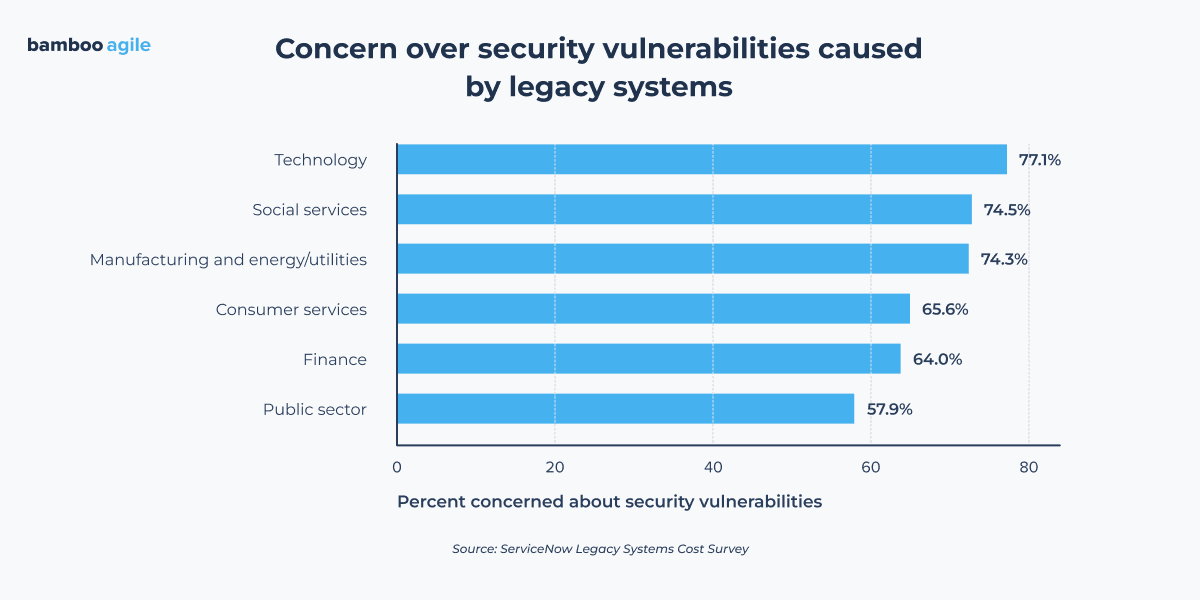
- Over 75% of IT professionals report security concerns related to legacy environments
How come it’s so expensive? The answer is simple: a combination of main and hidden costs.
Main costs
These are the surface-level operational costs of legacy systems. They are fairly easy to account for. First, there are the management resources that are required for regular maintenance: man-hours, third-party tools, etc.
Of course, even the newest, most cutting-edge systems need regular maintenance. But maintaining an old software solution is notably more difficult. Over time it becomes harder and harder to find skilled tech support specialists that know the application and its components well enough to reliably update it. This adds to the expenses.
Finally, there’s the issue of special licensing. Some legacy applications require licenses or paid subscriptions, adding up to their overall maintenance cost. Though, there’s also the problem of these licenses or subscriptions possibly getting discontinued. This may complicate or completely block access to the software.
Overall, the main costs of legacy systems include:
- Ongoing maintenance and operational support costs
- High dependency on scarce or aging technical expertise
- Licensing and subscription fees for outdated or proprietary software
- Integration costs with modern systems and platforms
- Security patching and risk mitigation expenses
- Downtime and incident recovery costs
- Infrastructure inefficiencies (higher compute or hardware usage)
- Future modernization or migration to microservices costs due to accumulated technical debt
Hidden costs
Now these aren’t as easy to calculate. These are various performance issues that arise as a result of using outdated solutions, which affect multiple business areas. They are not immediately obvious, but can become devastating if left unaddressed for long periods of time. Let’s look at each of these individually.
Lower productivity
The act of maintaining outdated systems can by itself put considerable strain on your IT department. Appian’s 2025 UK Public Sector Efficiency Survey revealed that employees lose around 5 hours per week due to inefficient or legacy systems, contributing to significant productivity losses across organizations at scale.
Instead of focusing on more important or exciting tasks, the employees will have to deal with constant bugfixes, compatibility issues, performance problems, and so on.
This doesn’t just reduce the amount of time and resources the team spends on doing mission-oriented projects. It also demoralizes the staff. Of course, the latter will serve to further decrease your programmers’ performance levels.
Compatibility issues
Integrations with third-party systems require just as much maintenance as the solution itself. If a legacy application is integrated with a service or system that receives consistent updates, there is a high probability that at some point the two will become incompatible.
This can deprive the software of not just some extra functionality, but of some of its core features. That means the business will have to waste its resources on finding new compatible integrations. It may even resort to buying brand new software.
Hindered data flow
A seamless data flow is integral to ensuring that the business meets all of its customer demands on time. Here, success is all about the program’s ability to quickly access and process up-to-date information.
Centralized data processing modules fulfill that purpose with flying colors. Sadly, they are absent in legacy software. The closest things it has to them are database management systems. Albeit easy to set up, they are far more disorganized and prone to significant loss of data if configured poorly.
Weaker security
Perhaps, the most pressing issue of all. Nobody trusts a business that doesn’t keep its own and its customers’ sensitive data safe. Your software may have been top-of-the-line in terms of security when it was first released, but those standards and protocols change very fast.
According to a ServiceNow survey, security is a top issue for IT workers across industries. They also report this as the highest cost of continuing to utilize legacy systems, even bigger an issue than maintenance costs.
Over time, avoiding data breaches and fixing vulnerabilities will become a very arduous task. And if you don’t live up to the challenge, a single incident like that can paralyze the workflow of the entire company. That’s far less of a risk with newer technology that operates using microservices and cloud storage.
Poor customer experience
Making a good impression on the customers is a priority for any modern company. But unstable legacy software can become a huge detriment to it.
A good example is a case of July 2024 global IT outage, when a faulty update affecting Microsoft Windows environments disrupted airline and airport operations worldwide. Major carriers and airport systems were forced into manual check-in and boarding processes, which led to widespread delays and cancellations. At its peak, more than 4,000–7,000 flights were cancelled globally, with thousands more delayed as systems failed across check-in, baggage handling, and scheduling platforms. Airports in Europe, Asia, and the U.S. all reported long queues, frozen departure boards, and degraded operations as staff had to revert to manual procedures.
Missed business opportunities
Modern systems are better optimized to combine faster processes, analysis, and data flows in a way that maximizes the revenue from your business operations.
This is achieved by repurposing software resources and harnessing multiple integrations unavailable to older applications. Simply put, by using legacy systems, you’re missing out on the chance to produce more value with less effort.
How much do legacy application modernization services cost?
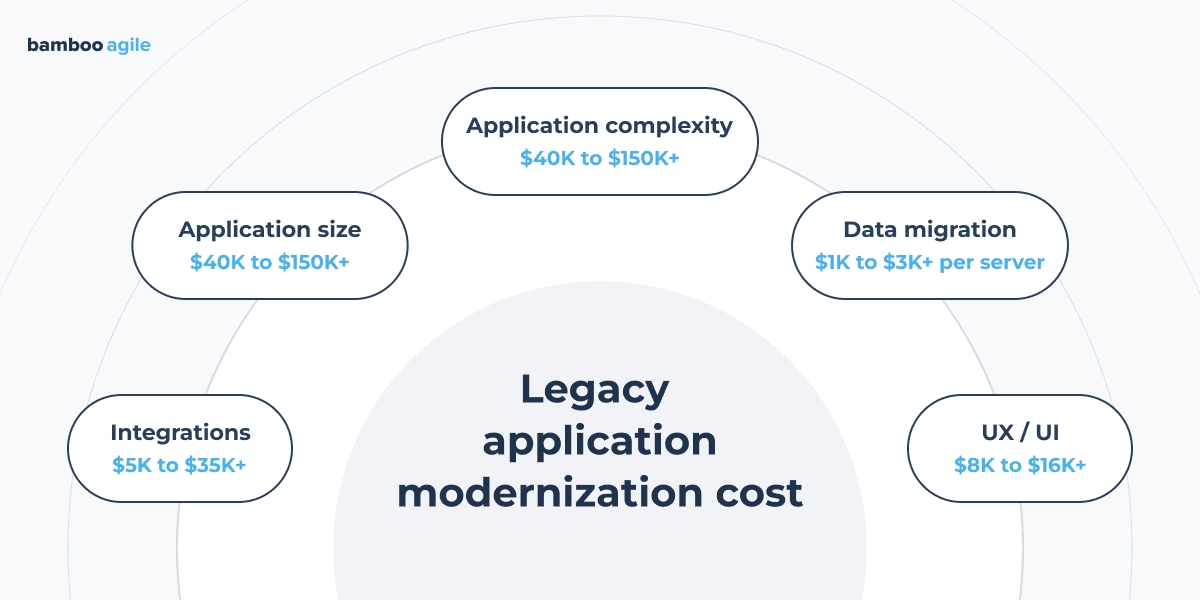
So you’ve decided that your software needs an upgrade. But how much will it cost you? There are several factors that go into determining the total, but the overall price can be anywhere from $40K to $150K and beyond.
We need to narrow it down a bit. Let’s take a look at what you need to take into consideration when budgeting a legacy system modernization project.
Application size
Let’s get the obvious out of the way.
The bigger the application is, the more work is required to develop it, and the more it will cost. Software size can be measured in pages or screens. Every time a user clicks a button, a menu option, or a link, they are taken to a different screen. So, for instance, the user profile and the page where the user edits their profile are classified as two different screens.
A small application contains 10 to 25 screens, a medium one goes up to 40, and a large one surpasses that number. With that in mind, modernizing a smaller app can be around $40-75K, a medium one – around $75-150K, and a large solution will go beyond that.
Application complexity
This notion refers to the software’s internal logic, its architecture, the amount of heavy analysis tasks it performs, conversions, scoring, number crunching, the number of nuances and permutations in the code, and so on, and so forth. This all affects how long it takes to upgrade the solution as a whole.
Note that modernizing complex software doesn’t just demand special attention in terms of coding and documentation. It also takes much longer to test, because the QA team needs to account for all the possible variables in the app performance and functionality. Of course, those extra hours will come at a price.
Integrations
Integrations are kind of unpredictable when it comes to cost. Of course, it depends on their number and complexity. But some services are simply built in a way that makes them easier to integrate (credit check services like Equifax and Experian, for example).
If the app needs to integrate with some older or lesser known software, it may pose a problem. Developers may not be as familiar with the way some third-party software processes and exchanges data. They may require extra hours and resources to figure out the best approach to setting the integration up and ensuring it functions the way it’s supposed to.
Data migration
You most likely have existing data that needs to be migrated from the old platform to the new one. That can be done with custom scripts that take that data from the software, reformat it, and store it in the new system accordingly.
The process sounds really simple on the surface. Yet it becomes rife with pitfalls and nuances if the two systems happen to organize their data differently. It’s something that requires lots of testing and development work, which, naturally, costs time and money.
UX / UI
Redesigning the user interface is one of the more fun parts of software development. But it is an investment as well. The pricing of that varies heavily depending on the number of screens, assets, custom animations, etc. Generally speaking, it’s reasonable to allocate from $8K to $16K for your UX / UI needs.
This will roughly cover creating the initial design, as well as a couple of revisions based on user feedback. Of course, if your design features a lot of custom artwork and 3D models, the price will be higher.
Want an example of software modernization? Check out our modernization project for Mediagun.
To sum up, when budgeting a legacy system modernization project, the total cost typically ranges from $40K to $150K+, depending on system structure and complexity. Below is a breakdown of the main cost drivers we’ve discussed with indicative benchmarks.
| Cost factor | What it includes | Cost impact |
|---|---|---|
| Application size | Number of screens, user flows, UI pages | Small (10–25 screens): $40K–$75K Medium (25–40 screens): $75K–$150K Large (40+ screens): $150K+ |
| Application complexity | Business logic, calculations, architecture depth, processing rules | Adds approximately +20% to +60% cost increase depending on logic density and QA scope |
| Integrations | External APIs, third-party systems, legacy connectors | Simple integrations: +$5K–$15K Complex/legacy integrations: +$20K–$50K+ |
| Data migration | Data extraction, transformation, restructuring, validation | Typically $10K–$40K, depending on data volume and schema mismatch complexity |
| UX / UI redesign | Interface redesign, screens, assets, animations | Typically $8K–$16K; complex/custom UI with advanced assets: $20K+ |
Key takeaways
- Many companies continue using legacy systems because they still work, but this creates significant long-term hidden costs and risks.
- Main costs include ongoing maintenance, infrastructure support, integrations, security updates, and incident recovery.
- Hidden costs are often greater than direct ones, including reduced productivity, slower workflows, and increased pressure on IT teams.
- IT teams spend roughly 17 hours per week per system on maintenance tasks, which translates into significant ongoing labor costs.
- Security-related spending can increase by 20–40% in environments heavily dependent on legacy infrastructure due to constant patching and risk management.
- Each major system outage can result in losses ranging from thousands to hundreds of thousands of dollars, depending on business scale and downtime duration.
- Integrating legacy systems with modern platforms often costs between $5K and $50K+ per integration due to custom development requirements.
- Older infrastructure can raise operational costs by approximately 10–30% compared to modern cloud-based or optimized architectures.
- Inefficient workflows can waste around 5 hours per employee per week, leading to large cumulative productivity losses across the organization.
- Modernization usually requires a one-time investment of around $40K–$150K+, which replaces continuous long-term operational and hidden costs.
Conclusion
Companies like to justify not moving on from old software platforms by wanting to save money. But the truth is, maintaining an outdated legacy app can be far more detrimental to the enterprise budget in the long run. So while the modernization of legacy systems can be very pricey, it’s a worthwhile investment that ensures your business efficiency far into the future.
Bamboo Agile has an extensive portfolio of modernizing legacy systems. If you believe it’s time to choose the right modernization approach and upgrade your company productivity, security, and profits, feel free to contact us for a free consultation.