
Why IoT projects fail: the overlooked implementation challenges
It is an uncomfortable, yet poignant observation: despite strong executive interest, successful IoT implementation remains far more difficult than most organizations anticipate.
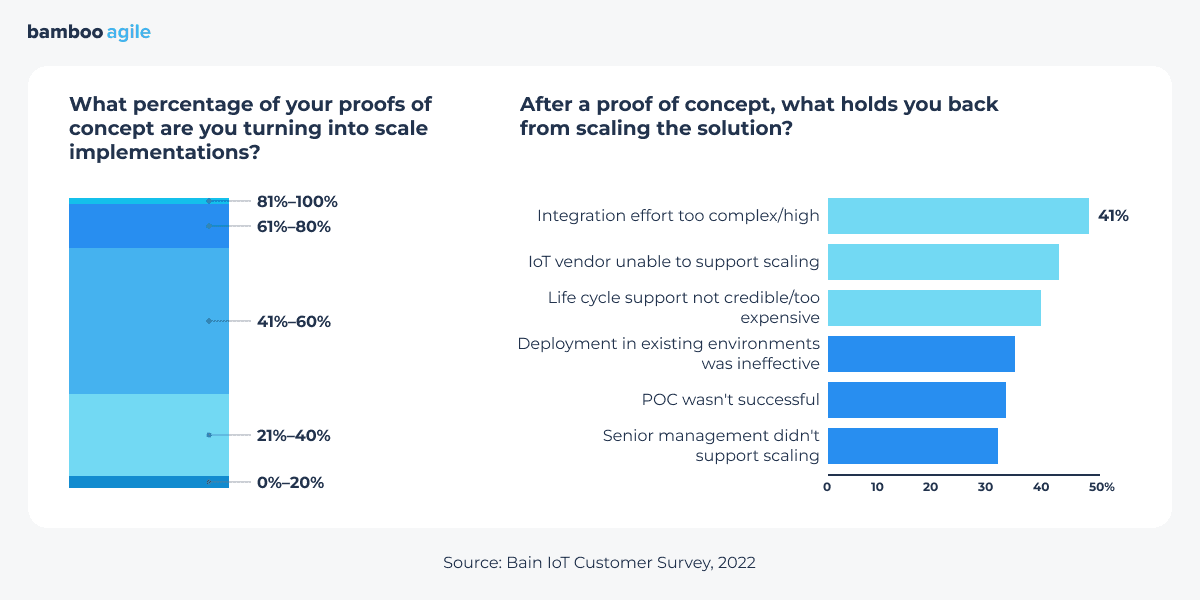
Research confirms what many CTOs and operations leaders may already suspect from experience. According to Bain & Company, while companies actively experiment with IoT, roughly 80% succeed in scaling fewer than 60% of their pilots into full production environments. The biggest obstacles are not innovation or funding, but implementation complexity and long-term operational challenges.
Other industry surveys arrive at similar conclusions – 74% of companies eventually considered their IoT projects a failure.
One prime example is the failure of GE’s Predix platform. It was developed as a cloud-based industrial IoT platform with the goal of collecting and analyzing data from industrial machines and transforming GE into a digital-industrial company. Predix aimed to monetize industrial data through predictive maintenance, operational insights, and software applications for both internal and external customers.
But despite over $7 billion of investments and ambitious plans to generate $15 billion in revenue by 2020, Predix failed to scale commercially and was retired by 2022. Among the main reasons, its analysts usually name:
– overly ambitious revenue targets,
– complexity integrating with diverse industrial hardware,
– limited external adoption,
– a cultural mismatch between traditional industrial operations and digital platform development.
In other words, organizations are eager to start IoT projects, but they struggle to make them work constantly and reliably over a long period of time.
There are several specific reasons for this.
Poor hardware design
A great number of IoT projects fail due to device-level issues, as stated in the 2025 State of IoT report by Eseye. 76% of 1,200 decision-makers confirmed that the so-called ‘hardware blind spot’ is hindering project success. They also found that 66% of organizations experience regular connectivity failures caused by hardware issues.
In fact, IoT systems operate in uncontrolled physical environments where reliability depends on multiple tightly coupled hardware factors:
- component selection (chipsets, antennas, power modules)
- connectivity design and signal resilience
- thermal and environmental resistance
- power management and battery lifecycle
- firmware-hardware interaction stability.
Moreover, IoT devices must function autonomously for years under fluctuating network conditions, temperature variations, and physical stress. Even minor hardware design flaws can cascade into systemic failure once deployments scale.

The promise of ‘5-10 years of battery life’ does not take into account actual operating temperatures, data transmission frequency, and data transmission conditions over the radio network. After six months of the project, the ‘battery hell’ begins, when the technical staff has to change the batteries on thousands of sensors in hard-to-reach places.
Dmitry Fostiy, Head of IoT and Hardware Engineering at Bamboo Agile
Scaling issues
Pilot is a common stage for IoT projects. It is done to test the solution already in a ‘live’ environment: with real users, real data, infrastructure, and processes.
However, even with good planning, the pilot may not completely coincide with the future production. It is limited in scope and often takes place in a more ‘supported’ mode, where engineers can respond to problems faster.
And this is certainly one of the main reasons IoT projects fail. According to Beecham Research’s survey, 50% of the failed IoT projects assessed were pilots or trials, with a further 35% being Stage One early deployments.
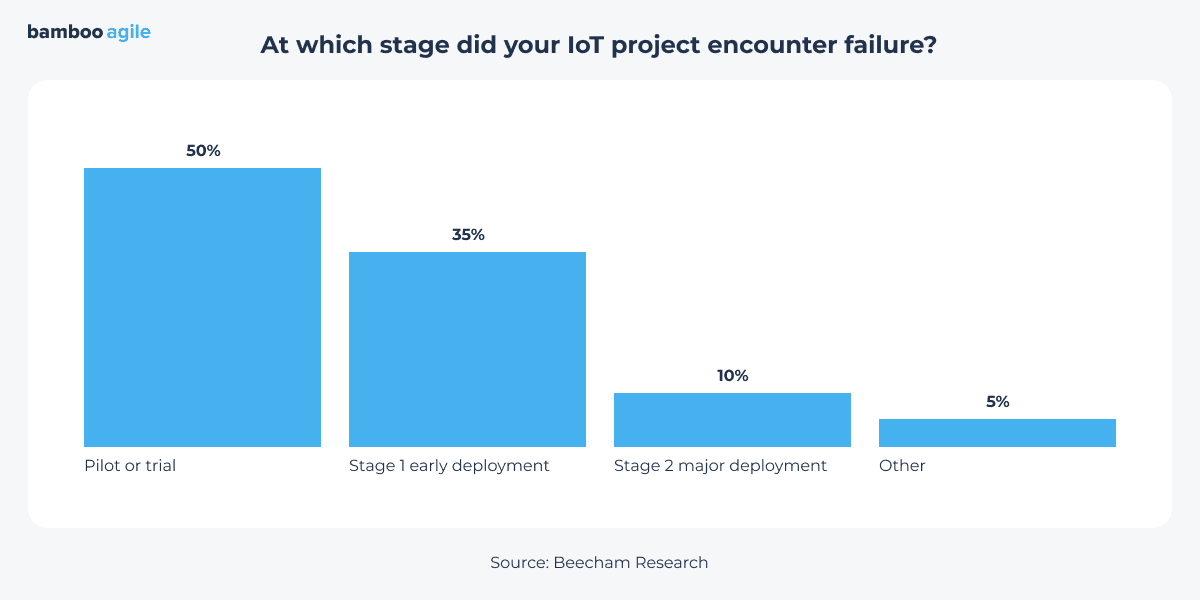
It is one of the most widespread IoT implementation challenges, because except for the size, the very nature of the system changes.
- Firstly, the burden on the infrastructure is increasing. Networks, brokers, and cloud services begin to run out of steam, with delays, data loss, and competition for resources.
- Secondly, device management becomes more complicated. Updates, monitoring, diagnostics, and support for hundreds or even thousands of devices require completely different tools and processes than in the pilot stage.
- Next is the operational complexity. There are more participants: technical support, field engineers, or business users.
- Reliability and fault tolerance issues also come up. The failure of one element already affects most of the system, redundancy, automatic recovery, and stricter security are needed.
- And finally, economics, as what was acceptable in terms of costs in the pilot, may become too expensive at scale in terms of traffic, maintenance, and equipment.
As a result, scaling can turn into redesigning the system to meet new conditions.
Complex integration
The core integration issue in complex IoT systems arises from the need to connect heterogeneous components. It may include devices, protocols, platforms, or legacy systems, that were built independently and follow different standards. Since there is no universal framework, each integration requires custom handling, translation layers, or middleware, which increases fragility and effort. And costs, inevitably.
Therefore, as more components are added, the number of interactions between them increases. This leads to difficulties with coordination and maintenance. Even small inconsistencies in data formats, timing, or communication can break the flow between systems, leading to failures that are difficult to trace.
Unpredictably expensive support
Early IoT business cases often focus on deployment costs. Devices, connectivity, and development – those numbers are tangible and easy to calculate. What receives far less attention is what happens after launch.
Over time, devices require firmware updates, batteries fail, sensors drift and need calibration, connectivity contracts evolve, security standards change, etc. Someone must monitor device health and respond when thousands of distributed endpoints behave unexpectedly.
Bain’s research notes that lifecycle support costs frequently become a scaling barrier because organizations realize too late that maintaining connected infrastructure requires permanent processes instead of temporary teams.
For example, a system fault might appear as a simple data error. At first, this seems like a quick software fix. However, further investigation may reveal that the issue is caused by a mix of factors: a device firmware bug, inconsistent data formatting, and intermittent network instability. As a result, what looked like a minor issue turns into multiple tasks like device updates, integration adjustments, and infrastructure checks.
In other words, support is expensive not because of the number of issues, but because each issue can expand unexpectedly in scope, making time, effort, and resources difficult to forecast.
Proofs of concept that answer the wrong question
Many IoT initiatives fail because their proofs of concept (PoCs) are designed to demonstrate technical capability rather than solve a clearly defined business problem.
In the unsuccessful Predix case mentioned earlier, many reviews and analyses claim that it is the excessive focus on the technological part and insufficient attention to the PoC that is one of the main reasons for the failure.
Such projects often begin with questions like ‘What can we measure?’ instead of ‘What outcome do we need to improve?’ As a result, PoCs successfully connect devices, collect data, and generate dashboards but fail to deliver measurable value such as reduced costs, improved efficiency, or increased revenue.
There is a lack of sufficient understanding of the business goal for implementation (the solution is being implemented for the sake of technology). Companies are considering the introduction of smart devices, but they cannot answer the question: ‘What specific business task are we solving, and what goals are being achieved?’ As a result, huge amounts of data are collected at the PoC stage, which no one analyzes, business processes do not adapt to the new solution, and the total cost of IoT implementation is high with a negative payback on the project.
Dmitry Fostiy, Head of IoT and Hardware Engineering at Bamboo Agile
For example, a manufacturer may deploy sensors to monitor machine temperature and vibration because the technology is readily available. While the PoC may confirm that real-time data can be captured and visualized, it does not address the root issue, which is poor maintenance scheduling or supply chain delays causing downtime. Consequently, the initiative produces insights without impact, and leadership sees little reason to scale it beyond the pilot phase.
McKinsey even coined a term for such a phenomenon – ‘pilot purgatory’, where technically successful PoCs never transition into full deployments.
However, a PoC that fails may not be the end of the story – it may be the start of a continuing thought process within a company that ultimately leads to a successful project. On the other hand, a failed PoC may lead to the company deciding not to proceed at all in spite of potential benefits downstream. That is why it deserves so much attention.
Human factor
In Beecham Research’s survey, integration within managerial, technical, or other groups and having sufficient expertise were cited among the most significant challenges in IoT project implementation (even more important than achieving ROI).
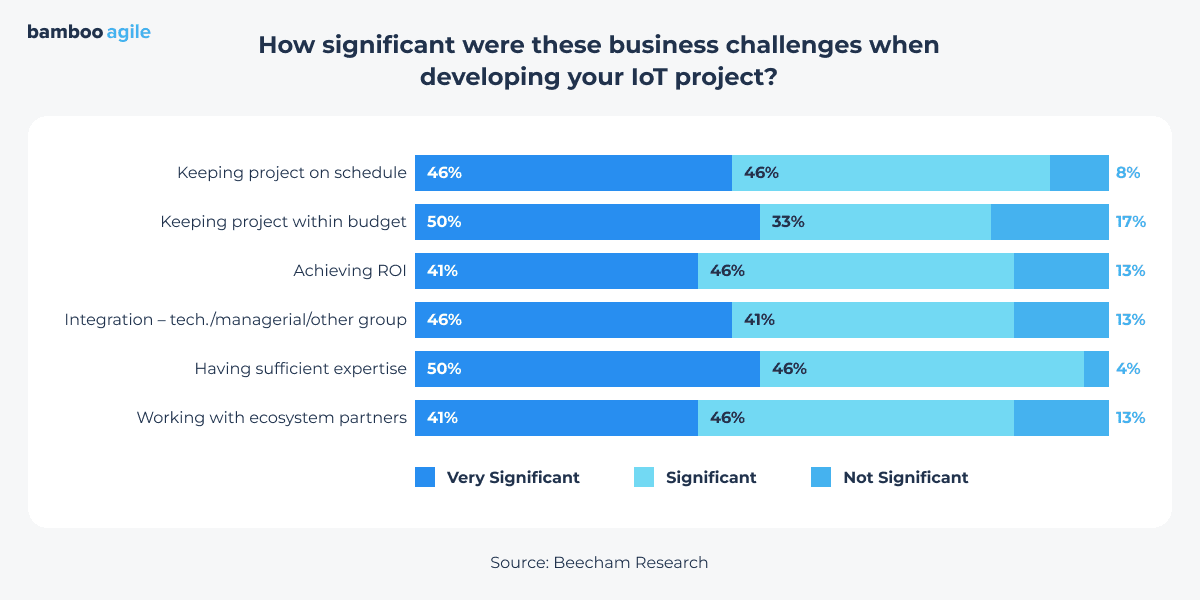
A key issue is that IoT projects often involve IT, operations, engineering, and business strategy domains. These groups often have different priorities, vocabularies, and success metrics, making coordination difficult. For example, IT teams may focus on security and infrastructure, while at the same time operations prioritize uptime and efficiency.
Closely related is the lack of in-house expertise. There is often a reluctance to engage external partners early enough, which can limit access to specialized knowledge. This combination can lead to fragmented understanding across teams and increases the risk of poorly defined use cases and misaligned implementations.
The problem is, many of these issues only show up later, when fixing them is already expensive. So the real question is: how ready is your company for IoT now? Take the quiz and see where you stand.
Cost realities and ROI of IoT projects
When organizations budget for IoT, the focus is usually on the visible costs: hardware, connectivity plans, initial integration, and perhaps cloud subscriptions. Yet the true economic burden of IoT is often in the hidden cost structures that reveal themselves over time and significantly change profit expectations.
Connectivity failures
‘Too many promising IoT projects are undermined by a short-sighted focus on upfront costs, leaving them vulnerable to connectivity failures, spiraling operational fees, and an inability to scale’, said Eseye CMO David Langton.
Their study found 68% of senior IoT decision-makers agree that cheap connectivity providers are not a good long-term investment. Soon it becomes obvious that their low upfront price masks performance gaps and future costs. In the same research, it was reported that 99.6% of IoT deployments ultimately fail to meet required connectivity levels when evaluated over the full device lifecycle. Ignoring this fact leads to a sharp increase in transaction costs, downtime, and delays in making a profit.
Earlier in my career, I was involved in a project that failed because the complexity of reliable data transmission was underestimated. We provided IoT implementation services, and the customer requested devices with support for NB-IoT technology, but after the devices were delivered, he realized that there might be no coverage of the NB-IoT network outside cities, which would lead to a loss of communication. Due to the lack of understanding of the final goals of the project and the lack of interest in further development of the project, NB-IoT SIM cards were never installed in the devices, and the customer lost a lot of money.
Dmitry Fostiy, Head of IoT and Hardware Engineering at Bamboo Agile
In this case, it makes sense to apply the Total Cost of Ownership (TCO) model.
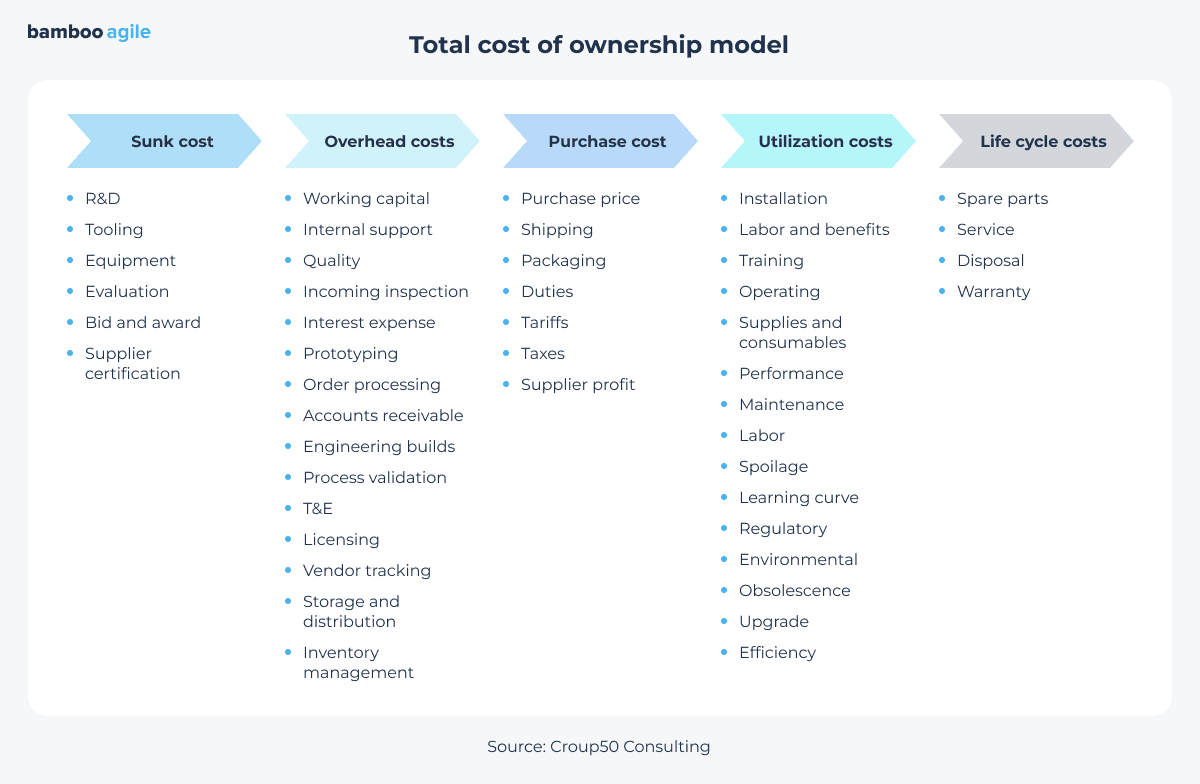
For example, Eseye partnered with a global advertising brand to assess its connectivity strategy. The five-year TCO assessment identified a net saving of £8.8m. These savings were achieved across multiple dimensions, including the elimination of redundant hardware, reduced data fees, fewer outages, and the avoidance of supplier lock-in.
Network and operational maintenance
Beyond connectivity, network and operational maintenance generate substantial ongoing costs. Infrastructure costs can increase in large deployments, where every replacement cycle, every unplanned maintenance visit, and every connectivity check adds to labor and service costs.
Another frequently overlooked factor is technological change within telecom infrastructure itself. Mobile operators regularly retire legacy network technologies. In the UK, operators including Vodafone and EE have shut down 3G services, following broader global phase-outs of older cellular standards.
Real-world consequences have already appeared. Early connected vehicle systems relying on legacy cellular modules lost functionality when supporting networks were discontinued, forcing costly remediation efforts.
Many IoT devices that were not designed to work on 4G and higher networks can be manually updated or withdrawn from sale. Some Nissan Leaf drivers encountered this problem in 2024, when the app could no longer interact with the 2G control units that were used in early versions of electric vehicles. In such cases, expensive restoration work is required.
Data management
When devices generate high‑volume telemetry, storage, transfer, and retrieval fees can escalate unpredictably. IoT platforms, especially those running on public clouds, often charge separately for data storage, data transfer, API calls, and analytics services, which makes cloud costs substantially larger than basic infrastructure fees alone. This can mean that a project that initially estimated moderate cloud fees finds itself paying multiples of those amounts as device counts increase, as data frequency intensifies, or as analytics workloads grow.
Roaming overages and mobile data costs
Moreover, roaming overages and mobile data costs in globally distributed IoT fleets are a persistent hidden burden. Devices operating across regions can incur unexpected charges when they connect via roaming networks, and without careful management, roaming fees can accumulate into very large bills. Techniques like eSIM localization (which allow devices to dynamically select the most efficient local network) have been shown to reduce global data costs by 60-80%, yet many IoT programs never incorporate this optimization because it is outside traditional cost models.
Unplanned downtime
Another dimension of the hidden costs of IoT implementation is unplanned downtime and associated losses. For enterprises with mission‑critical IoT use cases, device or network failures require technical fixes and can cause serious business impact. ITIC’s study in industrial IT contexts shows that 90% of firms experience downtime costs exceeding $300,000 per hour, with a significant share reporting hourly losses between $1 million and $5 million when IoT systems go offline.
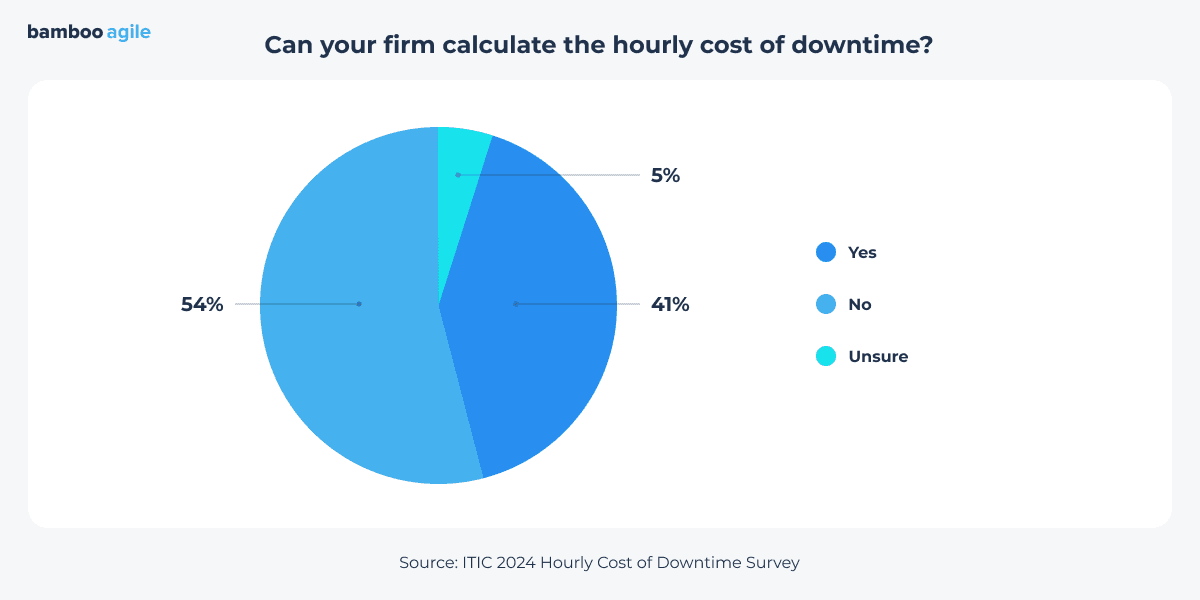
Apparently, such instability quickly turns into financial risks that go far beyond simple repair costs.
Security and compliance
According to IoT Insider, IoT devices were the most frequently targeted applications in 2024 for UK businesses. Firewalls saw more than 161 daily attacks against building control systems, security cameras, network printers, remote monitoring, and industrial automation systems. In the same report, businesses faced over 753,341 malicious attempts to breach online and IT systems on average in 2024.
At the same time, it is claimed that a single successful attack on an IoT device can cost an average of $330,000, while 34% of IoT-related breaches reach $5 million to $10 million in total losses.
IoT implementation strategy
Knowing the many challenges that often derail IoT projects, it might seem that success is elusive. Yet real-world examples showed it is far from impossible. Companies across industries have managed to move beyond pilot programs and build scalable, reliable IoT systems that deliver measurable business value.
The following framework outlines the critical steps organizations should consider to turn IoT experiments into sustainable, high-impact deployments.
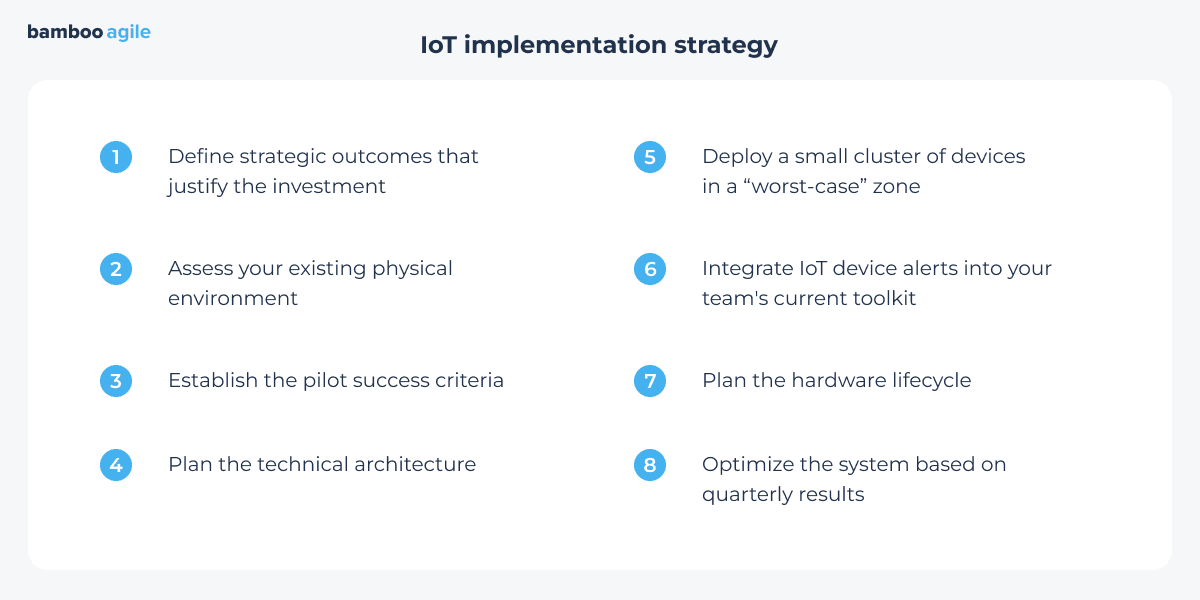
1. Define strategic outcomes that justify the investment
Before buying devices or choosing platforms, the organization must clarify what it hopes to achieve. IoT initiatives succeed when they are tied to concrete business goals: reducing downtime, improving efficiency, or cutting operational costs. The key is to define measurable outcomes rather than just to showcase technology. For example, a factory aiming to reduce equipment failures by 15% can focus its IoT deployment on critical machines and monitor the effect over time, rather than connecting every asset indiscriminately. Clear goals also help prioritize which data matters and make sure the pilot delivers actionable insights instead of dashboards full of numbers.
2. Assess your existing physical environment
IoT devices must survive in the real, often harsh physical world. Before deployment, companies need to evaluate power availability, connectivity constraints, temperature fluctuations, and the types of machinery that need monitoring. A sensor that works perfectly in the lab might fail under vibration, humidity, or electromagnetic interference.
3. Establish the pilot success criteria
A pilot is not successful simply because devices connect or dashboards populate. Success criteria must answer whether the system solves a real problem reliably. Teams should define thresholds for data accuracy, network uptime, maintenance effort, and integration with existing systems. It is a reality check that prevents the pilot from lingering indefinitely without proving real value.
4. Plan the technical architecture
Technical design decisions made at this stage largely determine whether scaling is feasible. Organizations must consider connectivity protocols, the IoT platform, device management, data pipelines, and security measures. Pilots sometimes hide complexity, as a few devices may work flawlessly, but scaling to hundreds or thousands exposes infrastructure limitations and integration challenges. Planning for production-level conditions, including over-the-air firmware updates, heterogeneous device types, and mixed network environments, reduces the risk of unexpected failures.
5. Deploy a small cluster of devices in a ‘worst-case’ zone
Rather than starting in ideal conditions, the first deployment should stress-test the system. Placing a few devices where connectivity is weak or environmental conditions are extreme helps identify potential failures before scaling. This approach also tests whether updates can be delivered remotely, whether data flow is consistent, and how devices handle unexpected stress. In fact, these early challenges often reveal gaps that would be invisible in a small, controlled pilot.
6. Integrate IoT device alerts into your team’s current toolkit
IoT systems deliver value only when teams use the data to act. Alerts should flow into existing workflows (whether it’s Microsoft Teams, Slack, or maintenance management systems) so they are visible and actionable. This way, operators don’t need to check a separate dashboard constantly.
7. Plan the hardware lifecycle
IoT hardware ages, batteries degrade, sensors drift, and connectivity contracts evolve. Successful programs anticipate these changes in their IoT implementation strategies over a 3-5 year horizon. Planning includes regular maintenance schedules, firmware updates, calibration intervals, and eventual decommissioning.
8. Optimize the system based on quarterly results
Even after deployment, IoT is not a ‘set and forget’ system. Teams should review operational metrics, connectivity performance, and support requirements on a regular basis. Insights from real-world operations often lead to architectural adjustments, software refinements, or process changes that improve reliability and ROI.
Explore real-world examples and case studies related to IoT implementation in our recent article.
Our IoT implementation services at Bamboo Agile
Research shows that IoT projects relying solely on in-house teams are far more likely to struggle. In fact, 57% of unsuccessful initiatives relied heavily on internal resources, compared to just 36% of successful ones. Projects that combined internal expertise with carefully chosen external IoT implementation companies were almost three times more likely to succeed.
At Bamboo Agile, we bring that external experience to complement your in-house teams, helping turn pilots into scalable, high-impact IoT deployments.
Our IoT implementation services cover the full IoT lifecycle and are carefully crafted to meet the needs of both small-scale experiments and enterprise-grade implementations. They incude:
- IoT consulting and strategy planning. We help align IoT initiatives with business goals, identify high-value use cases, and design roadmaps that connect technology with operational outcomes.
- IoT software development. From firmware for edge devices to cloud platforms, dashboards, and mobile apps, we build secure, scalable software that enables real-time monitoring and data-driven decision-making.
- Hardware prototyping and design. We create optimized prototypes, selecting components, designing PCBs, and testing devices in real-world conditions for reliability, energy efficiency, and regulatory compliance.
- Proof of Concept and MVP creation. Before large-scale deployment, we validate solutions with PoCs and MVPs, uncovering technical bottlenecks and gathering stakeholder feedback to reduce risk.
- Connectivity integration. We implement the right communication protocols for each use case, including Bluetooth, Zigbee, LoRa, and NB-IoT, to provide reliable, secure, and interoperable connections.
- Industry-specific IoT implementation. Our team adapts IoT solutions to sector-specific needs, from predictive maintenance in manufacturing and industrial context to patient safety in healthcare, fleet monitoring in logistics, and smart grid management in energy.
If you have any concerns or questions about your IoT project, or just want to explore how it could work for your business, why not start with a free consultation? We’d be happy to walk through your ideas, discuss potential challenges and costs, and help you find the best way forward. It’s a simple first step – just contact us.