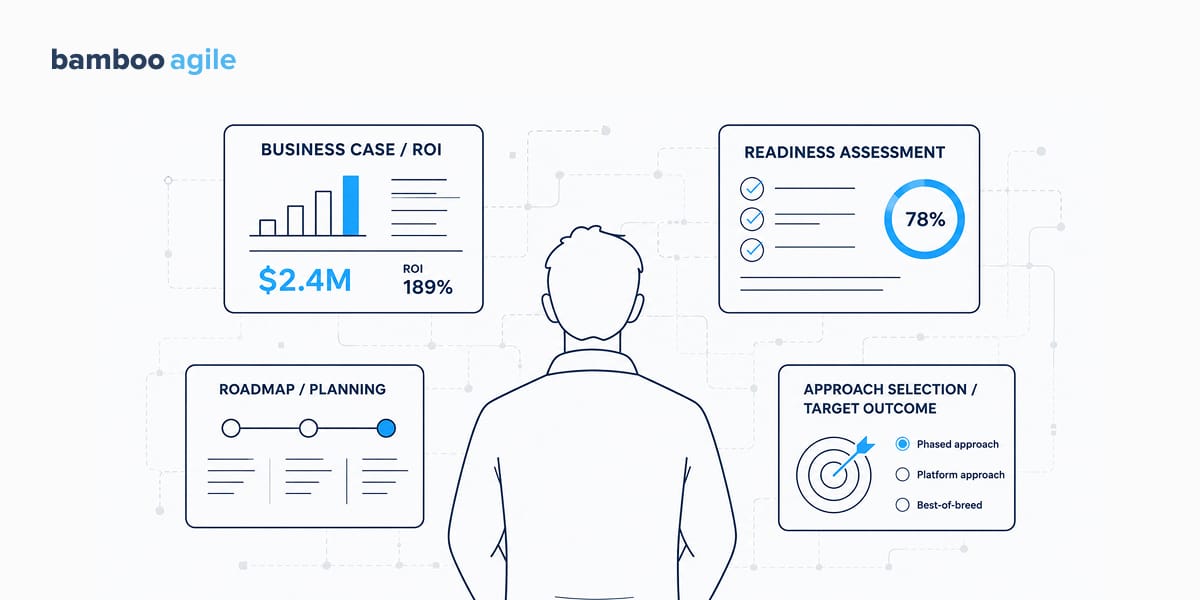
Most of what determines an IoT project’s outcome is settled at the decision stage. That is where the use case gets chosen and tied to a business problem worth solving, where the budget gets approved against a specific expectation, and where the architecture gets matched to the data infrastructure that has to support it.
Microsoft’s IoT Signals research, based on a survey of more than 3,000 IoT decision-makers, shows how much weight this stage carries: among organizations whose projects stalled, 28% pointed to pilots that demonstrated unclear business value or ROI, and 26% found it difficult to justify a business case without short-term impact. Nevertheless, 85% of enterprises surveyed had at least one IoT project underway, and 88% considered this technology critical to their business success.
Decisions made at this strategy stage are actually the cheapest to get right and the most valuable to get right early. In this article, we cover what IoT strategy consulting involves, how a business case for IoT gets built and defended, and – the part most guides skip – what a real strategy engagement produces.
What is IoT strategy consulting?
IoT strategy consulting is advisory work that helps an organization decide which IoT investments to make and why. It covers use-case identification, readiness assessment, business case development, and high-level technology direction. The output is a decision framework.
It’s worth distinguishing this from IoT development consulting, which the two are often conflated. Strategy answers “what should we build, in what order, and what will it return?” Development consulting answers “how do we build it, on what stack, with what architecture?” Both matter, but they’re different engagements with different deliverables, and running them in the wrong order is how companies end up with technically sound systems that solve the wrong problem. Strategy work typically sits at the front of a broader IoT consulting relationship rather than replacing it.
Why an IoT strategy must come before development
The pull toward building a product straight away is understandable. The technology is available, competitors are moving, and a strategy phase can feel like time waste. Still, what makes IoT different from conventional software is that early decisions are harder to revisit later. Software can be refactored, but if only you proceed with the wrong connectivity protocol or sensors specced for the wrong operating conditions, later you’ll need to introduce changes to hardware already installed in the field.
Alternatively, strategy work establishes what business decisions the data is meant to inform, which use cases justify their cost, and what the organization needs in place to support them. Teams that do this well tend to reach production faster overall, because the pilot is designed with future scaling in mind.
Assessing organizational readiness
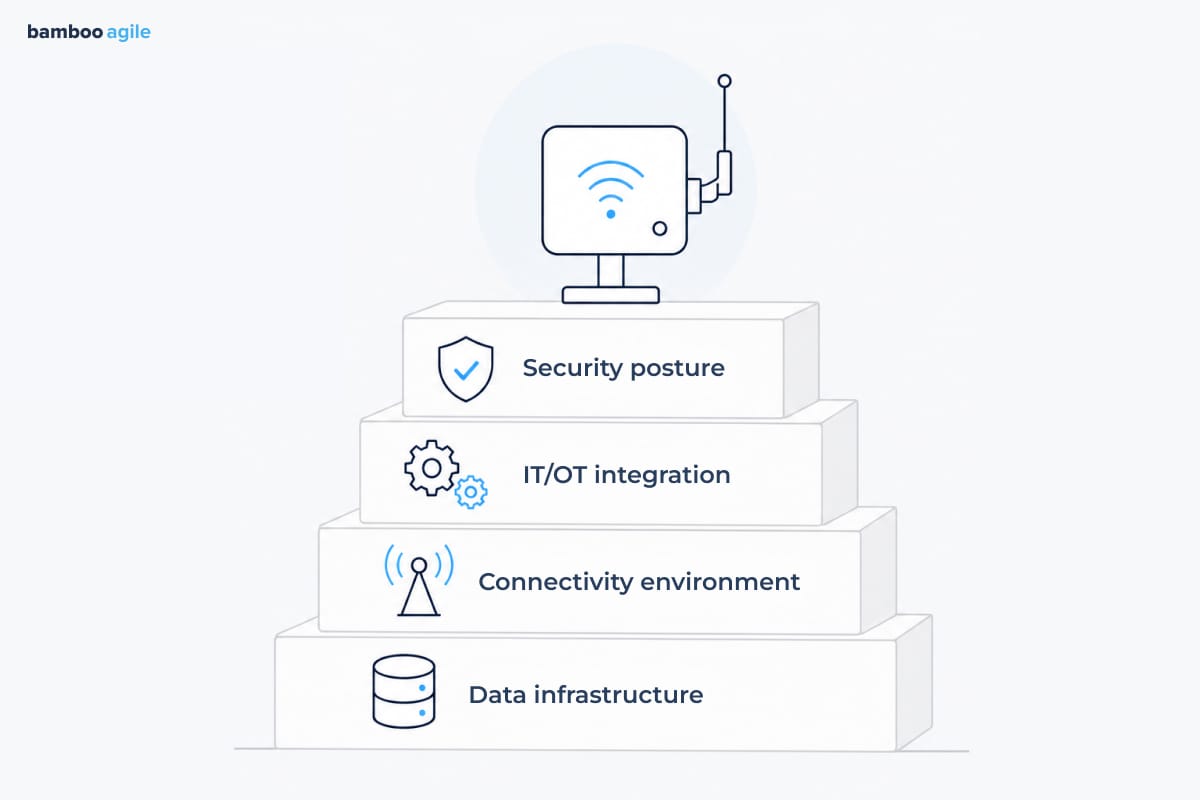
A strategy is only as good as the foundations it assumes. Honest readiness assessment is the least glamorous part of the work and consistently the most predictive of outcomes. There’s four dimensions that matter most:
- Data infrastructure. IoT deployments generate continuous telemetry at volumes most existing data estates weren’t designed for. Before committing to a use case, it’s worth establishing whether current storage, pipelines, and analytics tooling can absorb that load. In some cases the assessment shows the first project should be a data platform, with connected devices coming after.
- Connectivity environment. Coverage and network reliability at the actual deployment site constrain what’s possible. A predictive-maintenance concept that works in a facility with stable industrial Wi-Fi may need an entirely different connectivity approach in a remote pumping station.
- IT/OT integration. In industrial and energy contexts especially, IoT solutions must interface with operational technology that predates modern integration standards. Organizations where IT and OT teams already collaborate move considerably faster than those where these functions operate separately with different priorities and security models.
- Security posture. Connected devices expand the attack surface, but retrofitting security after deployment is both expensive and incomplete. Evaluate existing practices like identity management, patching discipline, and incident response, to establish what security work needs to happen.
Take a short IoT readiness quiz below to see where your foundations are already solid and where some groundwork would pay off before the project starts.
Building the business case
A strong IoT business case rests on a specific use case tied to a measurable result. Common claims about improved visibility or operational optimization are hard to defend in a meeting with C-level executives who expect more exact metrics.
Take, for example, predictive maintenance. You can state current unplanned downtime hours, the cost per hour, and which failure modes sensors could realistically catch early.
For asset tracking, the anchor numbers are how much equipment goes missing each year and what replacing it costs.
Energy optimization needs current consumption data alongside a credible estimate of what monitoring and control could shave off it.
Each of these calculations starts from a figure the organization already tracks, which is what makes it arguable.
The strategy phase is also where the shape of the investment gets defined – whether this is a contained pilot with a clear go/no-go decision point, or a multi-year platform commitment. The two require quite different approval processes, and separating them early tends to make procurement considerably smoother.
What an IoT strategy engagement actually looks like
You may find that different materials on this topic usually explain why strategy matters, but not how the engagement actually works and what’s needed from your company.
Duration and scope
A strategy engagement typically runs 2–6 weeks. The shorter option suits a company with one or two candidate use cases and reasonably mature data infrastructure; the longer process is typical for an organization with multiple business units involved, or when readiness assessment surfaces significant gaps that need mapping.
Who’s involved
On the client side, it’s 1) business stakeholders who own the operational problem, 2) someone from IT who understands the existing data and systems landscape, and – in industrial or energy settings – 3) an operations or OT lead who knows the physical environment.
On the consulting side, this would be a mix of specialists in technical architecture and business analysis.
What gets delivered
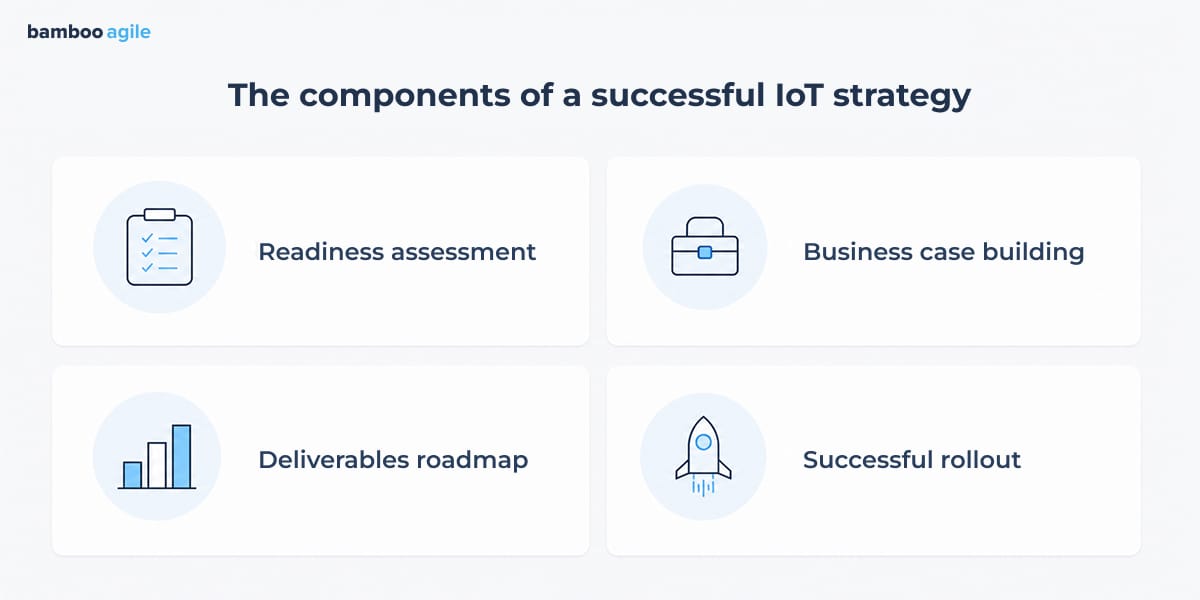
Strategy consulting should produce documentation you can act on and defend internally:
| Deliverable | What it contains |
| Use-case roadmap | Prioritized list of IoT applications ranked by feasibility and business value |
| Technology direction | High-level connectivity, cloud, and platform recommendations |
| Investment range | Rough budget bands for pilot versus full deployment |
| Success metrics | Defined KPIs the eventual solution will be measured against |
| Risk assessment | Key technical, security, and organizational risks flagged before development starts |
The distinction worth holding onto is between direction and specification. A strategy phase should tell you that a low-power wide-area network is the right category for your deployment and why. Over-specifying at this stage is truly harmful.
Still, remember that a strategy engagement isn’t a proof of concept, and it doesn’t produce working software. So, discuss the scope before signing the MSA with a contractor, because hourly rates on development work at the next stages could be potentially lower.
Peculiarities of IoT strategies by industry
Strategy priorities shift meaningfully depending on the operating environment, and the assessment questions that matter most differ by sector. Find below a few examples showing how differently the same technology gets justified.
Industrial and manufacturing
Strategy work here centers on IT/OT integration and on interfacing with equipment that may predate modern connectivity entirely.
The business case is comparatively well established: McKinsey research cited in an IIoT World analysis of predictive maintenance deployments puts maintenance cost reductions at 18–25% and unplanned downtime reductions at up to 50%. The case study of one chemical plant demonstrated that for them, it was possible to cut urgent maintenance from 43% of total activity to under 10% across 33 monitored assets. Numbers like these make the strategy conversation less about whether to invest and more about which assets to instrument first.
See our industrial IoT services for how this plays out in delivery.
Energy and utilities
In the energy sector, regulation often sets the strategy before internal ROI does. Thus, EU Directive 2019/944 pushed member states toward 80% smart meter penetration where cost-benefit analysis supported it, and the rollout that followed is now substantially complete.
Berg Insight estimates roughly 209 million smart electricity meters installed across the EU27+3 by the end of 2025, covering about two-thirds of customers.
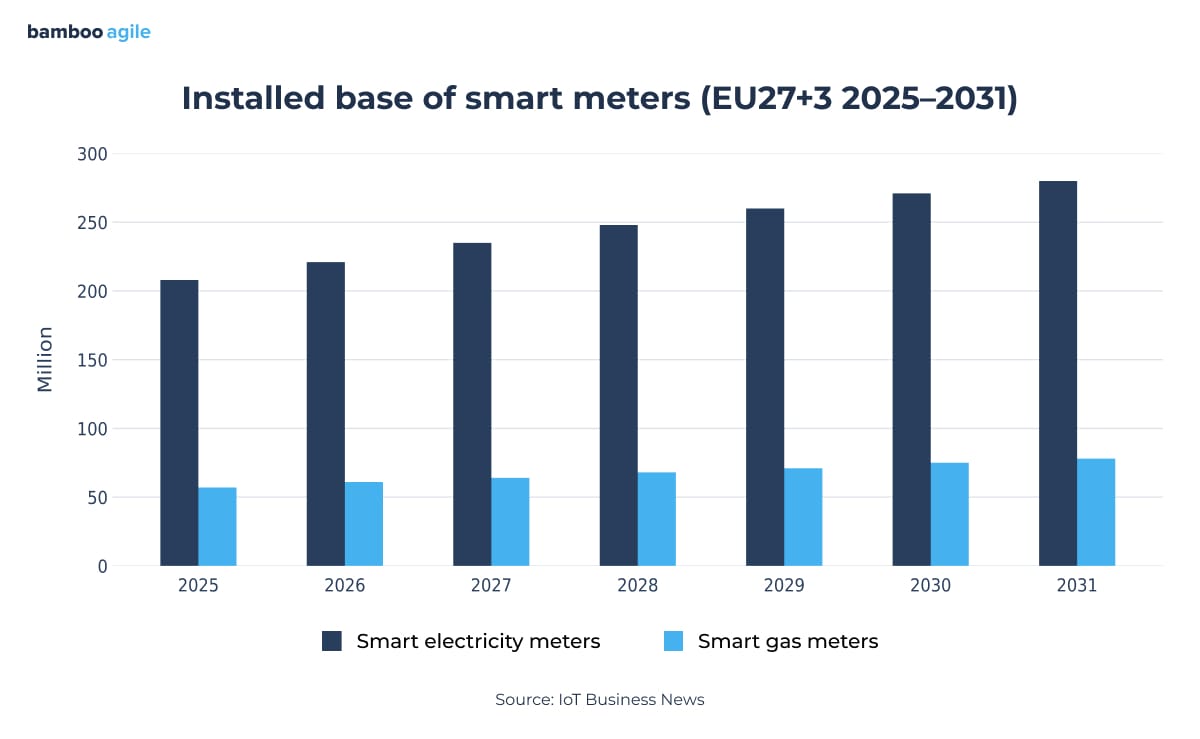
For utilities, the strategic question has largely shifted from whether to deploy toward second-generation devices, communications technology choices, and migration without disrupting existing back-office systems. Our IoT in energy coverage goes deeper on this topic.
Telecom
Network infrastructure decisions dominate strategy conversations here, and the connectivity layer is itself in transition. The abovementioned Berg Insight case reported that standalone wireless options were expected to exceed 50% of annual smart meter shipment volumes for most of the coming forecast period, and 3GPP-based LPWA technologies such as NB-IoT and LTE-M were rapidly driving that growth.
That shift is both a strategic opportunity and a long-lived commitment for telco operators, since meters stay in the field for well over a decade. Our article about the application of IoT in telecom covers this in more detail.
Choosing an IoT strategy consulting partner
For strategy work specifically, the qualities that matter differ from what you’d look for in a development vendor. Look for the following things:
- Cross-industry pattern recognition, since much of the value of an outside perspective comes from having seen what worked and what failed in adjacent sectors.
- Willingness to challenge assumptions. A consultant who accepts your initial use-case framing without probing it isn’t earning the engagement.
And the best signal of all is a partner comfortable telling you not to build something yet, or to solve a data infrastructure problem first.
Conclusion
Useful IoT strategy consulting leaves you with a defensible investment case, a prioritized roadmap, and a clear view of what your organization needs to fix first. Most importantly, it truly helps you discover pitfalls you didn’t think about before.
At Bamboo Agile, we help clients across Europe, the US, and the MENA region turn IoT ideas into well-defined initiatives, backed by our 20+ years of experience across industrial, energy, and enterprise projects. If you are deciding where to start with IoT, contact our team to discuss your goals, constraints, and the next practical steps.