Bamboo Agile | Bespoke software development company
Bamboo Agile is an Estonia-based custom software development company that crafts bespoke solutions for telecom, education, healthcare, finances, other sectors.
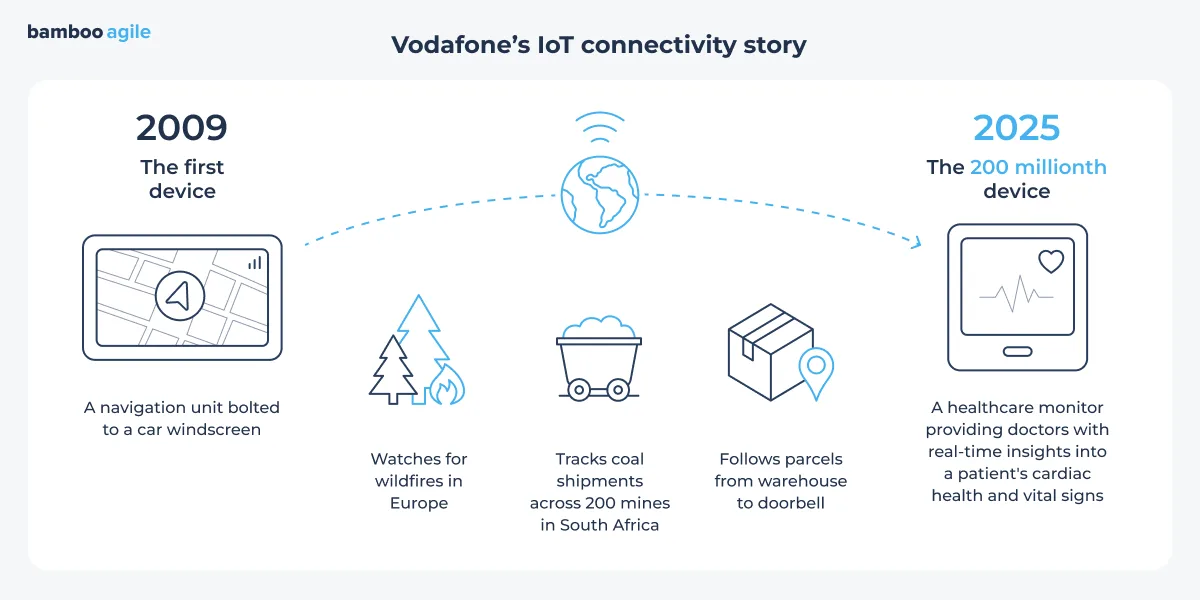
In April 2025, Vodafone connected the 200 millionth IoT device to its global network. It was a healthcare monitor that provides doctors with information about a patient’s cardiac health and certain vital signs remotely. The milestone device sits on a global IoT network that also watches for wildfires in Europe, tracks coal shipments across 200 mines in South Africa, and follows parcels from warehouse to doorbell.
The first gadget on that same network, back in 2009, was a navigation unit bolted to a car windscreen. Sixteen years and 200 million connections apart, the distance between those two devices tells you everything about where the telecom industry has landed. A navigation puck is a connectivity story – but a cardiac monitor is a patient-outcome story, and the value behind it is in whether the outcome holds up.
That is the real story behind IoT in telecom right now – and it is what the rest of this article covers in order. We define what counts as IoT in telecommunications and where the market stands today, walk through the two categories of use cases operators build for, then climb the four-rung value ladder that takes a carrier from selling connectivity to selling outcomes. Also, our team includes the most prominent use cases by Vodafone, AT&T, Telefónica, and others to offer concrete IoT implementation examples across industries for readers ready to move past case studies and into planning, while looking for best practices to implement.
What Is IoT in telecom?
IoT in telecom refers to cellular networks carrying data between connected machines, sensors, and devices instead of people. Operators supply the SIM, the spectrum, and often the platform that turns raw device signals into billable services. This represents a natural progression from earlier machine-to-machine (M2M) deployments, which typically connected two machines directly over a cellular link.
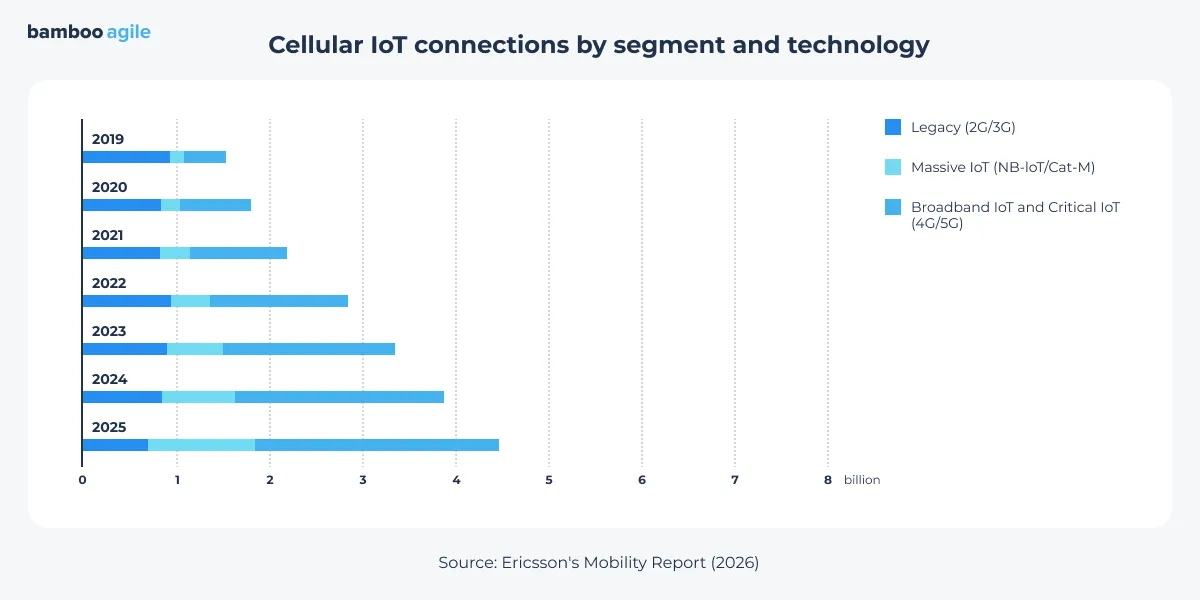
The scale backs up the hype. As per Ericsson’s Mobility Report, total cellular IoT connections reached around 4.5 billion at the end of 2025. By 2031, this number is set to approach 8 billion. Broadband and critical IoT make up almost 60 percent of all cellular IoT connections – a sign that operators are switching from simple sensor traffic to latency-sensitive and revenue-richer use cases.
IoT in telecommunications: Two use cases
Telecom providers approach IoT from two directions, and the split matters for anyone building a business case. One track keeps the network itself running better and cheaper, but the other turns spare network capacity into a product enterprises pay for directly.
Network operations (internal)
Network operations covers the infrastructure telecom companies maintain, but customers never see. A single tower site runs generators, HVAC systems, fuel tanks – each one a possible failure point, and sensors now sit on every one of them. Because of that, an operator watching data across thousands of sites catches a battery voltage sag or a fuel drop before a technician answers a call about dead coverage.
As an illustration, a 2026 market analysis of digital twin deployments on telecom towers puts failure-prediction accuracy at up to 87%, 90 days ahead of the event, cutting unplanned downtime by 45% against reactive maintenance (Dataintelo, 2026).
Customer-facing services
In telecom, IoT creates value when operators pair nationwide connectivity with a platform layer, then back it with industry expertise and managed services.
Smart metering shows the pattern clearly – utilities collect consumption data remotely, so a technician no longer has to read each meter in person. Fleet operators apply the same logic to vehicles. Route planning and diagnostics run off the same connection that also feeds driver behavior analysis and cargo monitoring – one data stream covers both compliance and efficiency. Industrial operators extend that further and track high-value assets across factories and supply chains. Cities pick up the thread at a larger scale. Street lighting and parking sensors report into a shared dashboard, while waste collection and environmental monitors add another layer to the same system.
Private cellular networks answer a different problem – performance and security that a public network cannot always guarantee. Here, factories and ports lead the adoption curve, running dedicated LTE or private 5G for applications where downtime carries a real cost. Airports and mines follow the same path, and energy sites join for the same security reasons.
Healthcare rounds out the picture with a lighter footprint but a similar shape. Remote patient monitoring and connected medical devices handle the data collection side, while hospital asset tracking applies the same tracking logic already at work on factory floors and shipping routes.
Use case type
What it covers
Who benefits
Network operations (internal)
Tower and site monitoring, predictive maintenance on network equipment, and energy management at cell sites
The operator itself – lower opex, fewer dispatches of technicians to the sites, and better uptime metrics
Customer-facing services
Smart metering, connected vehicles and fleet, asset tracking, smart cities, industrial/private networks, and connected health
Enterprise and government buyers purchasing connectivity, platforms, or managed services
Egor Fostsiy, Embedded System IoT expert at Bamboo Agile
IoT adoption in telecom has long ceased to be a mere trend and has become a core driver for infrastructure monetization and new B2B service creation. Traditional solutions based on obsolete 2G/3G networks and resource-heavy HTTP polling now actively give way to energy-efficient standards such as NB-IoT, LTE-M, and 5G RedCap. The main development vector has moved toward edge computing and real-time stream processing, where minimizing overhead plays a decisive role.
In our tracking and monitoring projects, for example, replacing classic REST requests or MQTT with custom streaming binary protocols allowed us to reduce transmission latency several times over and save mobile data at scale. In the near future, the market will belong to platforms capable of managing millions of connections efficiently, with ultra-low latency and strong ecosystem protection.
The telecom IoT value ladder
Every operator that sells IoT sits somewhere on a ladder, whether they have mapped it or not. Bottom rung – sell connectivity as a commodity, compete on price per SIM, and watch churn creep upward. Top rung – package data as an outcome a client pays for month after month, with no easy substitute on the market.
In the sections below, we walk you through each rung, with real operator examples at every stop.
Rung 1. Connectivity and choosing the right network
Connectivity still sits at the core of any IoT in telecommunications project, but the network decision carries more weight than most product teams give it credit for. Two problems keep showing up, namely, network strain at scale and coverage gaps in the places devices actually sit.
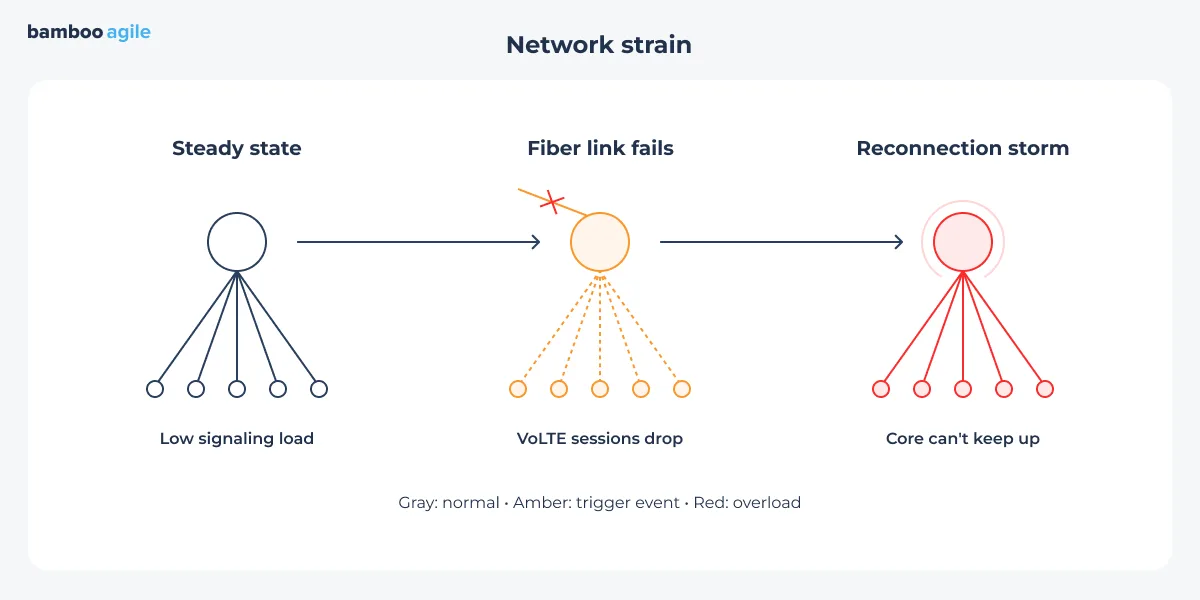
Network strain comes from signaling load more than bandwidth. A million meters checking in every fifteen minutes generates a control-plane burden that dwarfs the actual data payload, and networks built for phone traffic buckle under that pattern. The failure mode does not always start with device volume, either. T-Mobile’s June 2020 nationwide outage began with a routine fiber circuit failure, but the real damage came after. Devices that lost their VoLTE sessions retried registration in bulk, and that reconnection wave turned into an IP traffic storm that overwhelmed the IMS core’s capacity to process it.
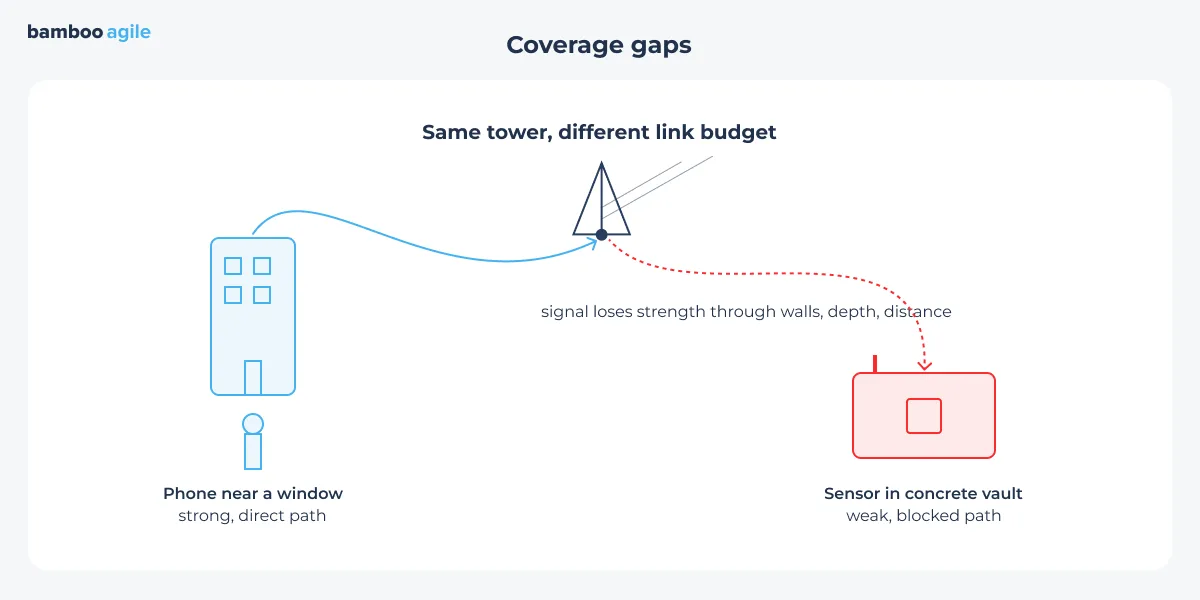
Coverage gaps compound the strain problem from a different angle. A smart meter in a basement or a tracker on a container ship needs a different power and propagation profile than a phone in someone’s pocket. Since standard cellular coverage was designed around a person who holds a phone near a window or walking down a street, it may not work just as well with a sensor bolted inside a concrete utility vault. If you push that same link underground or into a shipping container, the signal can drop below the point where a device can reliably connect at all.
Therefore, to resolve both problems at the network layer, you need to pick the right access technology before a platform or app ever touches the data. Get this rung wrong, and every layer built above it inherits the strain.
NB-IoT vs. LTE-M vs. 5G RedCap vs. 5G vs. LoRaWAN
No single access technology covers every IoT use case, which is why serious IoT in telecom portfolios run several in parallel.
5G RedCap, formally known as Reduced Capability, is a deliberately simplified device class, defined so that IoT hardware can connect to a 5G Standalone network without the cost, power draw, and radio complexity of a flagship handset.
According to Jason Sikes, VP of Device Technology at AT&T, 5G RedCap devices “offer reduced manufacturing costs and more compact form factors by featuring fewer antennas, lower processing power, less battery consumption, and simplified radio frequency components compared to full 5G devices.”
GSA’s April 2026 5G RedCap Industry Update shows that 42 operators across 27 countries and territories are actively investing in the technology. Some of the biggest names in the industry have already pushed it into production. For instance, in the United States, AT&T has achieved nationwide coverage for its 5G RedCap network. It now serves over 200 million Points of Presence (PoPs) across the country. In Europe, Deutsche Telekom (Germany) and KPN (the Netherlands) both ran RedCap trials through 2024 and moved to limited commercial availability in 2025.
Rung 2. Connectivity management platforms (CMPs)
Once connectivity is running, the CMP is where IoT in telecom stops being a raw access sale and starts being something a client depends on day to day. Similar capabilities are also offered by mobile virtual network enablers (MVNEs) that provide IoT connectivity management platforms to operators, although large carriers often run their own CMPs.
Enterprise customers move up this rung to solve three separate problems.
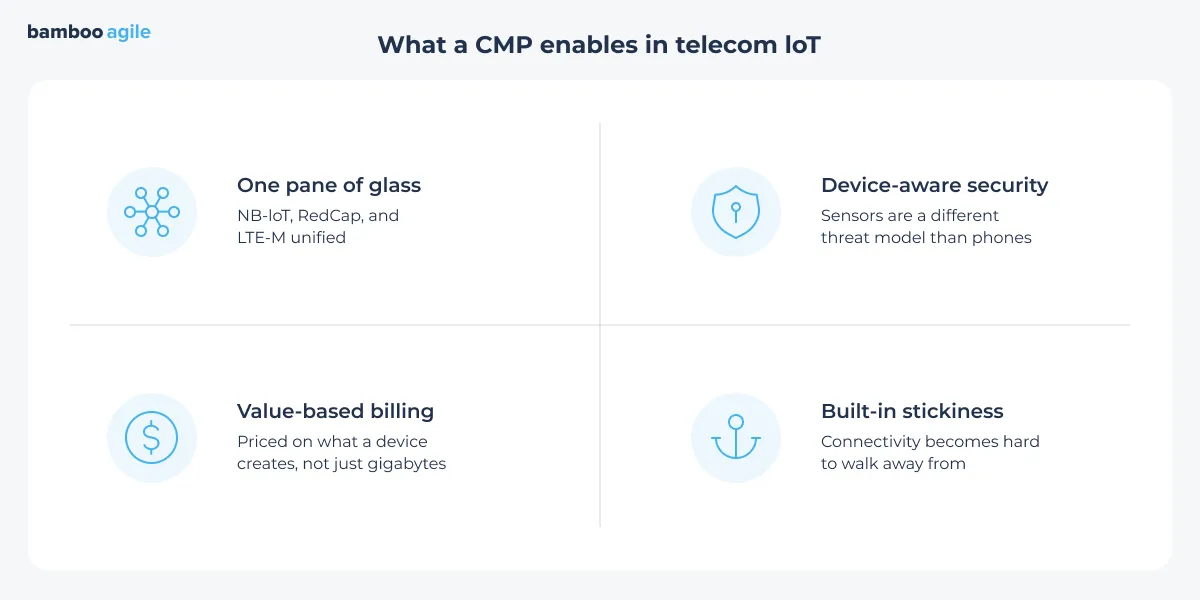
Fragmentation is usually the quiet killer of IoT projects. If a logistics company runs trackers on NB-IoT and cameras on RedCap, it still needs gateways on LTE-M. Without a CMP, that means three separate vendor portals instead of one pane of glass. Even once that is solved, the fleet itself becomes the next problem. A compromised sensor is a different threat model than a compromised smartphone, and most enterprise IT teams simply do not have the tooling built for it. Billing exposes the same gap from another direction. Machines do not generate revenue the way subscribers do, so a platform that only knows how to bill per gigabyte per month ends up missing most of the value a device actually creates.
A CMP built around these problems turns connectivity into a business a client cannot easily walk away from.
Telefónica Kite
Telefónica Tech runs its CMP business through Kite. By September 2025, the operator had passed 51 million active IoT connections worldwide, with SIM deployments across more than 190 countries. Kite covers SIM management and security monitoring, as well as analytics dashboards, in one place. Telefónica has folded machine learning into the platform to flag anomalies in device behavior, things like a meter suddenly transmitting at 3 a.m., or a tracker burning through data at ten times its normal rate.
Vodafone GDSP
Vodafone’s IoT arm, spun out from Vodafone Group as a standalone business, runs its own CMP called GDSP, the Global Data Service Platform. The unit passed 220 million IoT connections worldwide.
GDSP provides clients a single dashboard for features like diagnostics and spend control across the entire device fleet. The platform connects to local mobile networks in those markets where Vodafone lacks its own infrastructure. As an example, in the United States, Vodafone relies on roaming partnerships with AT&T and Verizon. At this level, the platform itself constitutes the product, while the underlying radio access network approaches commodity status.
Rung 3. Industry vertical solutions
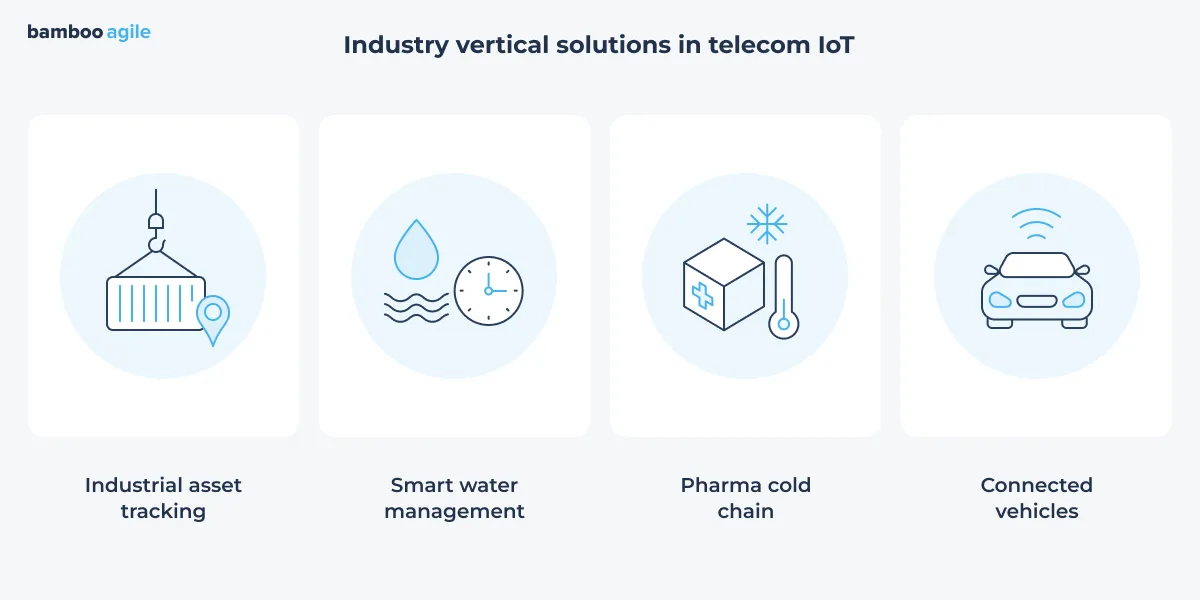
Rung three is where connectivity turns into a solution a specific industry actually needs, built around a workflow rather than a network protocol. In IoT in telecommunications, a generic platform tells a client their devices are online – but a vertical solution tells a mining company how much coal moved off site today.
Bamboo Agile has provided IoT development services to telecom operators working at exactly this rung, and helped them turn raw connectivity into applications industry buyers actually pay for. To achieve this, we keep track of industry trends and follow best practices from the worldwide telecom leaders, as shared in the real-life examples below.
Industrial asset tracking
Vodafone tracks coal shipments across roughly 200 mines in South Africa to follow the movement and quality of coal as it moves toward its destination. The mining application works as a case study because the value sits above connectivity – real-time visibility into a supply chain that Vodafone can package and sell as a service, not just the SIM card underneath it.
Smart water management
Another distinctive case by Vodafone is the company’s partnership with SUEZ. It is aimed at rolling out remote reading for next-generation smart water meters and connecting devices over Vodafone’s NB-IoT network. The two companies set a target of bringing more than 2 million NB-IoT meters into service by 2030. The project will launch in the UK before expanding into other European markets.
Pharma cold chain
Vodafone Business IoT connected Controlant’s monitoring solutions across pharmaceutical supply chains, and Controlant’s customers who ran the technology reported delivery success rates above 99%. Before telecom IoT monitoring, typical loss rates for perishable medicines ran around 35%. That gap is the kind of number that justifies premium pricing on its own.
Connected vehicles
Four out of five models in General Motors’ vehicle portfolio in Mexico run on IoT connectivity through Telefónica’s Kite platform, supporting OnStar services such as turn-by-turn navigation and automatic crash response.
This case predates RedCap and even most of today’s 5G rollouts. Instead, it runs on LTE connectivity managed through Kite. Yet, the case still belongs on this list because it shows the ceiling for rung three – an operator embedded so deeply in a client’s product that the connectivity becomes invisible to the end customer, who just experiences a car that calls for help after a crash without ever thinking about the network underneath.
Rung 4. Data monetization and outcomes
The top rung treats data itself as a product, not just a byproduct of running a network. Operators build AI and analytics on top of the platforms and vertical solutions already running. Kite by Telefónica carries dedicated analytics modules for anomaly detection and asset visualization, while Vodafone applies machine learning across its device fleet to catch unusual behavior before it becomes a support ticket or a security incident.
The next move is aggregating and anonymizing that data, then selling it as a compliant, privacy-safe product to buyers who never touch a single device. A retailer buying footfall patterns derived from anonymized mobility data does not need a SIM card or a platform login; the operator packages insight instead of infrastructure.
This is the rung where IoT in telecommunications stops competing with connectivity resellers altogether and starts competing with data and analytics companies on their own turf, at a margin most legacy connectivity businesses never touch.
IoT value ladder for telecom operators: A six-step implementation roadmap
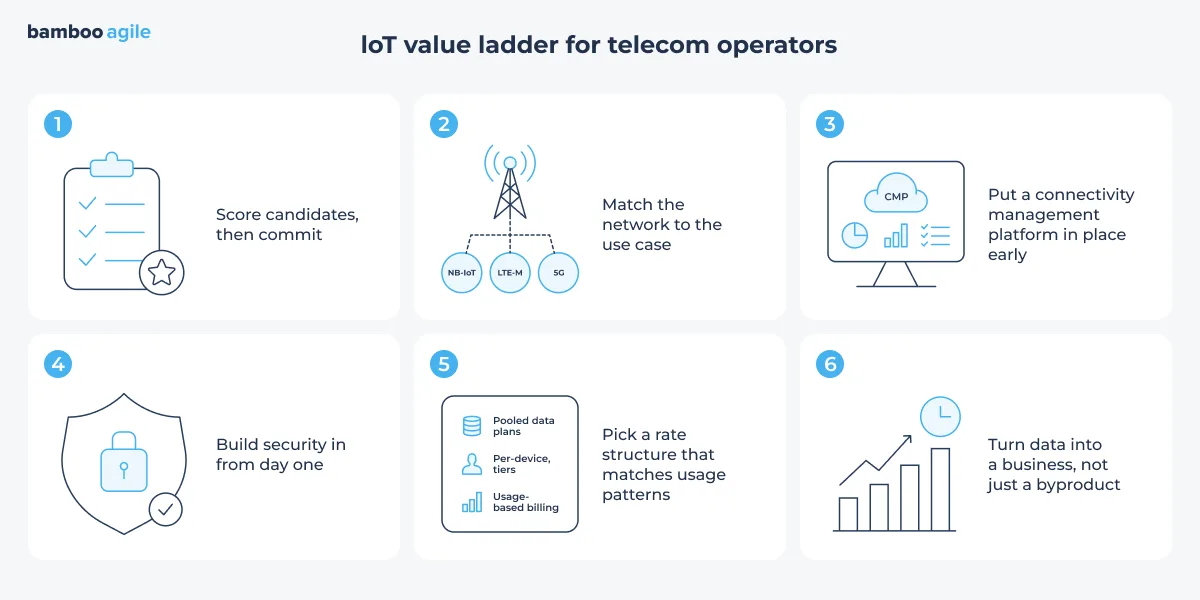
Operators who reach rung three or four on the value ladder rarely stumble into it; they follow a sequence. So, what are the rules that lead to successful telecom IoT projects? We can pinpoint six of those.
1. Score candidates, then commit
Start with five to ten use cases from the existing customer base. These could be fleet tracking, smart metering, or asset monitoring for clients already on the network. Then, score each on revenue potential against implementation effort, counting integration work, not just hardware cost. Usually one or two candidates survive.
Next, settle build-versus-buy-versus-partner for the application layer. A CMP is worth building once and reusing, but a one-off analytics platform for a single client rarely pays back. Finally, bring in a partner for telecom software development.
2. Match the network to the use case
Every use case has its own requirement for bandwidth and latency – and the technology choice follows from that, not the other way around. For example, a soil sensor that reports twice a day runs on NB-IoT. Meanwhile, a connected vehicle that streams telemetry belongs to 5G.
Decide early whether the deployment should run on licensed spectrum or unlicensed, and whether it needs a single network or several ones working together. Also, your customer might need both NB-IoT (for sensors) and 5G (for a few video feeds) on the same site. What you should do is plan from day one rather than retrofitting a second network after the first contract renewal.
3. Put a connectivity management platform in place early
A pilot that runs fifty SIMs holds up fine on a spreadsheet. At the same time, a rollout of fifty thousand does not. At this point, IoT in telecommunications tends to break down – the technology scales faster than the systems managing it. Therefore, before you scale past that pilot, put a CMP in place, whether built internally or brought in from a vendor, so that your provisioning, billing, and diagnostics run through one system instead of three.
If you skip this step, you will most certainly pay for it when your support team will not be able to tell which SIMs are stuck in a data loop and which ones stopped reporting because a sensor died in the field.
4. Build security in from day one
IoT deployments widen the attack surface, and customers judge operators on this point before they ask about pricing. SIM-based authentication, private APNs, traffic isolation, network slicing, anomaly detection – you should put all of it into the architecture from the very start.
An enterprise buyer signing for ten thousand connected devices wants proof that a compromised sensor in one location cannot reach a payment system in another. Put the security architecture on the table early, and the sales conversation moves faster.
5. Pick a rate structure that matches usage patterns
No single structure fits every customer. Match the rate model to how the devices actually behave, rather than offer the same plan to a smart-metering client and a fleet-tracking client.
Pooled data plans suit customers running thousands of low-traffic devices
Per-device tiers fit customers with steady consumption
Usage-based billing works for customers whose traffic swings with the season.
6. Turn data into a business, not just a byproduct
Capture device and network data from launch, and treat it as a deliberate part of the architecture rather than an afterthought. Data handled this way feeds outcome-based services later – predictive maintenance alerts, uptime guarantees, and usage benchmarks against comparable customers.
An operator that sits on years of aggregated, anonymized usage data holds a product that a competitor without that history cannot replicate fast. However, realizing this value is one of the biggest IoT implementation challenges, and it requires strong security and analytics architecture.
Your team can complete all six steps alone, but doing it efficiently takes backup from experienced engineers. Bamboo Agile works with telecom operators on CMP integration, application layer development, security architecture – so the operator keeps network operations in-house while moving faster through everything built on top of it.
In most IoT in telecom deployments, the challenge sits in the software layer, not in the network itself. If your team is putting the roadmap together for next year’s budget cycle, a conversation with people who have built that layer before might save a few expensive mistakes. Contact our team so we can walk through where your roadmap stands and where a second pair of hands might get you to market faster.
Ready to build a future-proof telecom IoT solution?
Benefit from Bamboo Agile’s extensive experience in the sector.
Darya has over 10 years of experience in the IT sector and specializes in producing clear, research-driven content for technology and business audiences.
At Bamboo Agile, she authored numerous articles covering emerging technologies, digital innovation, and industry-specific solutions, helping readers navigate complex industry developments. Darya collaborated closely with subject-matter experts to ensure accuracy and reliability of her works.
We use cookies to analyze user behavior and improve the website for you. Check our Privacy Policy for more information.
Functional
Always active
The technical storage or access is strictly necessary for the legitimate purpose of enabling the use of a specific service explicitly requested by the subscriber or user, or for the sole purpose of carrying out the transmission of a communication over an electronic communications network.
Preferences
The technical storage or access is necessary for the legitimate purpose of storing preferences that are not requested by the subscriber or user.
Statistics
The technical storage or access that is used exclusively for statistical purposes.The technical storage or access that is used exclusively for anonymous statistical purposes. Without a subpoena, voluntary compliance on the part of your Internet Service Provider, or additional records from a third party, information stored or retrieved for this purpose alone cannot usually be used to identify you.
Marketing
The technical storage or access is required to create user profiles to send advertising, or to track the user on a website or across several websites for similar marketing purposes.