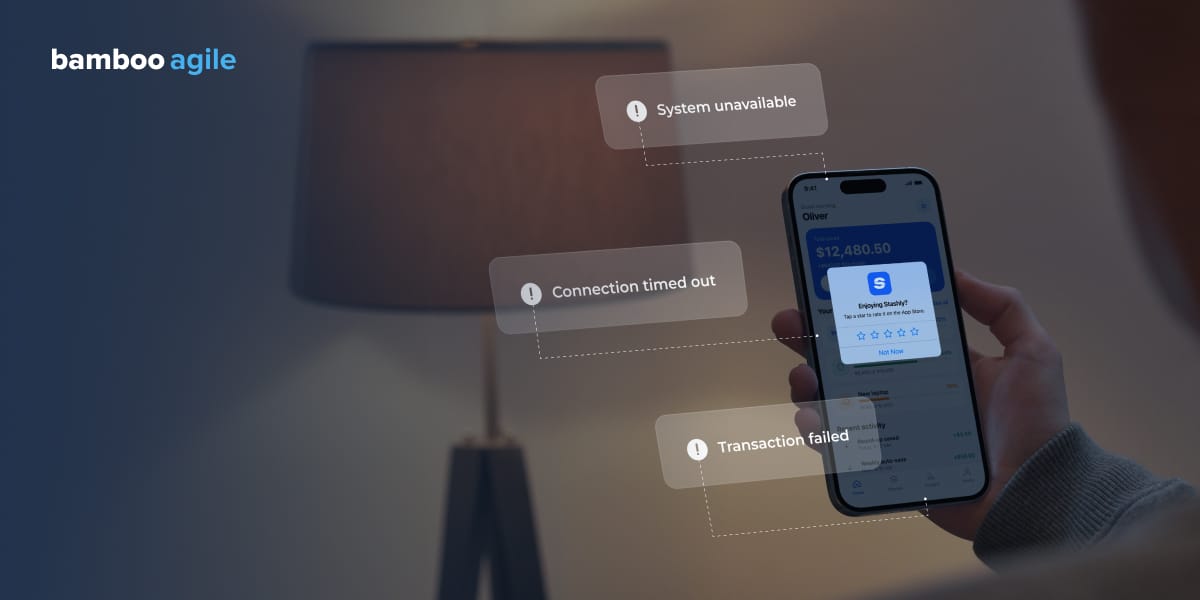
The app is built. Every feature on the list is shipped. And yet the product still can’t go live, because it keeps failing the uptime requirements the business set for it.
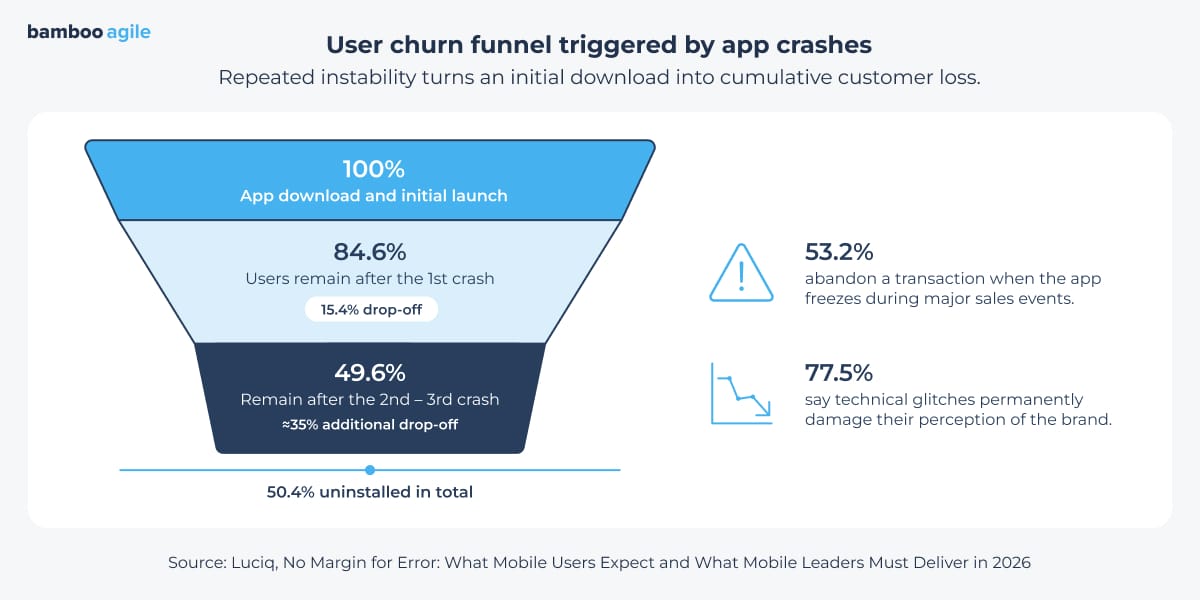
This disconnect between feature completion and production readiness is more common than most expect. In its 2026 survey of over 1,000 U.S. mobile users, Luciq found that 15.4% uninstalled an app after a single crash, and more than half left after two or three.
Usually, when a product encounters reliability problems like this, the team may need an independent technical assessment or software project rescue as a more extensive service. So, in this article, we’ll look at when recurring issues call for a mobile app audit, what you should examine first, and the deliverables you have in hand when it ends.
Industries where a technical audit is a regular practice
Every app loses users due to poor performance, but in a few industries, it’s the one requirement a product cannot fail.
Banking and fintech
A payment app handles a user’s money and their trust, so an outage immediately raises the question of whether funds are still safe. That risk is real: an AWS incident in October 2025 knocked out financial apps including Chime and Coinbase for hours. Luciq’s research backs this up from the user side too: finance is the app category customers are least willing to forgive for a failure.
Healthcare and telehealth
93% of patients now expect digital health services to be available around the clock, and healthcare downtime costs an average of $7,900 a minute. Under HIPAA, availability sits in the same regulatory sentence as confidentiality, so a platform that keeps a clinician from a patient’s record during an outage is failing the Security Rule requirement governing data privacy.
Retail and e-Commerce
Major sales events compress some of the year’s highest traffic and revenue potential into a short window. Statistically, 53% of users abandon a purchase if an application crashes or slows down during these events. So even a brief disruption of your m-Commerce app can erode revenue precisely when demand is strongest.
Shared mobility, delivery, logistics
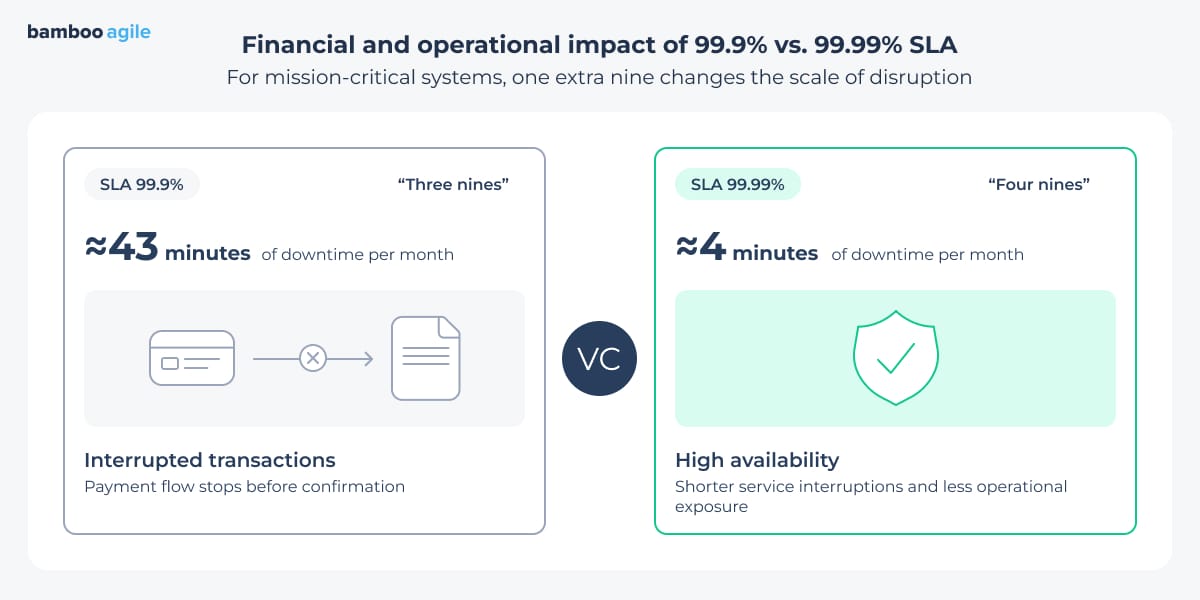
When it comes to ride-hailing or delivery apps, we deal with two-sided marketplaces running in real time: a passenger and a driver, or a courier and a customer, and both depend on the same session. When that session drops, both sides lose the connection. It’s also where SLA percentages stop being abstract: 99.9% uptime still allows about 43 minutes of downtime a month, when 99.99% – only 4. That difference decides whether an outage feels like a rare hiccup or a reason to switch providers.
Round-the-clock operations
Some other products never get a quiet maintenance window, because part of the team is always mid-shift somewhere else. This applies to any product coordinating a globally distributed workforce or supply chain: freight moving overnight, warehouses running shifts in different regions, whilst remote teams spread across time zones all need the system to hold up at night.
So, if your app sits in one of these categories, the availability requirement in your contract or roadmap reflects exactly what downtime costs you.
When an app audit is the right next step
There are a few situations that indicate that another minor bugfixing is unlikely to be enough:
- The app was handed off from another team or vendor, and now nobody fully owns the architecture.
- Reliability problems are blocking a launch date or contractual commitments promised to clients, partners, or its own leadership.
- The same failures keep showing up in support tickets and crash logs long after fixes go out.
- The dev team has theories about the root cause, but no one has had the time to verify which one is right.
- Leadership or investors need an external assessment before releasing more budget.
When one or a few of these patterns appear, timely software consulting becomes more useful than adding further feature work to the roadmap.
Not sure yet if you need an audit of your app?
Run your app against our 12-point mobile app audit checklist and see where the risk sits.
What a mobile application audit usually covers
An app audit means a structured review of the codebase, architecture, infrastructure, and other aspects behind an existing product, run by engineers who didn’t build it and have no reason to defend past decisions.
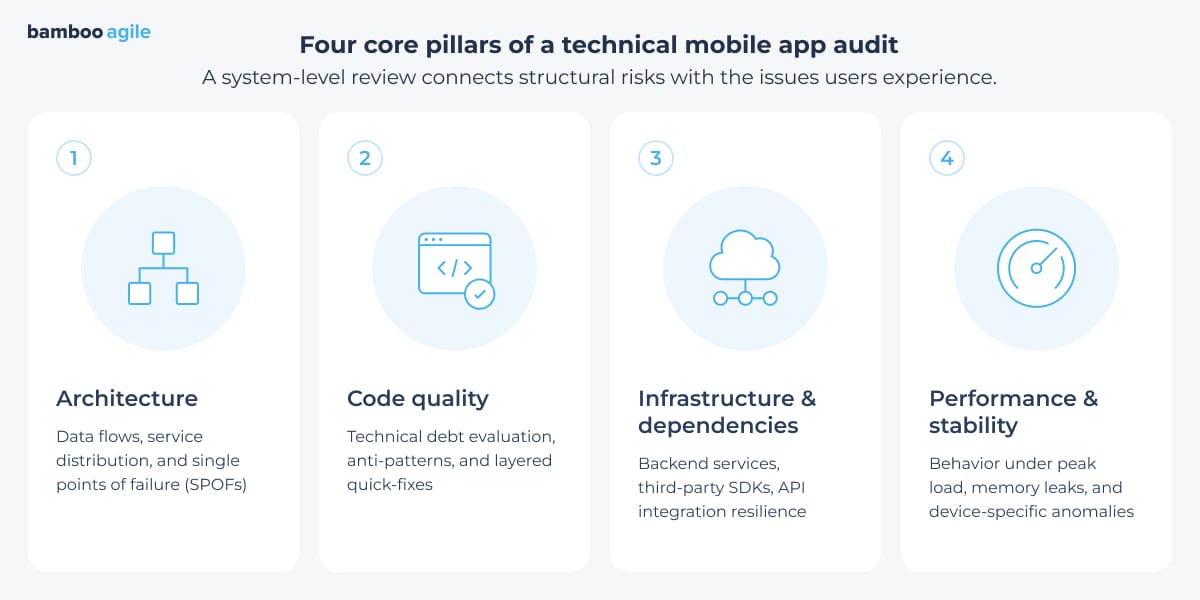
The instability usually traces back to any of the areas below, and it’s rarely just one of them in isolation:
- Architecture – how services, data flows, and the mobile client fit together, and where that structure creates single points of failure.
- Code quality – technical debt, inconsistent patterns, and areas where fixes have been layered on top of earlier ones.
- Infrastructure and dependencies – backend services, third-party SDKs, and API integrations the app depends on.
- Performance and stability – what fails under load, on specific devices, or after deployment, and why. This may require additional testing services.
The findings are usually consolidated into a few decision-ready outputs. Depending on the engagement, these may be separate documents or sections of one final report:
- Current-state assessment. This is an evaluation of all abovementioned four areas, supported by evidence from the review.
- Prioritized issue register, where each finding is linked to the affected component, observed symptoms, likely root cause, severity, and technical or business impact.
- Remediation roadmap. Specific actions are mapped and divided into stabilization measures, medium-term improvements, and longer-term architectural work.
- Implementation estimate. It covers the recommended team composition, effort range, timeline, dependencies, and assumptions needed to plan the remediation phase and its budget.
Together, these outputs give engineering and leadership a shared basis for deciding what to fix first and what requires deeper redesign, and the resources the work will require.
Additional areas an audit may cover
Depending on the product, its regulatory environment, and the purpose of the audit, the assessment may also include several separate workstreams, such as:
- Security – authentication and authorization, data storage and transmission, mobile permissions, exposed secrets, vulnerabilities, API security, and protection against common threats.
- UI/UX – in-app navigation, critical user flows, interface consistency, error states, usability barriers, and adaptation across devices and screens.
- Accessibility – support for readers, text scaling, color contrast, tap-target sizes, and alignment with relevant WCAG and platform requirements.
- Scalability – whether the backend, APIs, data model, and client-side behavior can support projected growth, traffic spikes, and larger transaction volumes without degrading availability or performance.
Such works should be scoped explicitly. Their relevance depends on the problems the business needs to investigate and the decisions the audit is expected to support.
Mobile app audit services by Bamboo Agile
A meaningful audit requires hands-on code analysis and a system-level view of how the components interact. To bring these perspectives together, Bamboo Agile runs each software audit as a focused engagement with a fixed scope. Typically, this takes two weeks and involves mobile app developers and architects who examine both the codebase and the wider system around it.
Once the audit is complete, some clients take the recommendations in-house and handle the remediation themselves; others continue partnering with Bamboo Agile on the stabilization and ongoing maintenance. In either case, the client receives a documented explanation of the main issues and a prioritized plan for resolving them.