It’s easy to assume the energy industry runs on turbines, transformers, and pipelines. However, more often than it may seem, it runs on code. Here’s some evidence:
- Renewables made up 85.6% of all new global power capacity added in 2025.
- More than 68% of utility operators had adopted cloud-based monitoring by 2025, and 74% of power distribution companies had folded predictive analytics into daily operations. This is proof that the software layer is being built out in parallel with (and partly instead of) new physical capacity.
- The global energy management software market, worth $12.60 billion in 2025, is projected to reach $44.31 billion by 2035 at a 13.4% CAGR, and the EU alone has committed $548 billion by 2030 specifically to grid digitalization – smart meters, automated grid management, and the software tying it together.
- The AI-in-renewables market is projected to grow from $20.63 billion in 2025 to $26.30 billion in 2026 at a 25.65% CAGR, and 65% of renewable energy companies already use AI for predictive maintenance.
Put together, it’s a straightforward cause and effect: the physical grid can’t scale fast enough on its own, renewables make what does get built harder to manage, and software is what utilities are actually buying to close that gap.
None of it builds itself, though. Many energy tech solution companies are stepping up to provide these tools. However, finding the right renewable energy software company is key.
We did the legwork: below are ten vendors that specifically build for energy, so you don’t have to cross-reference ten different ‘about us’ pages yourself.
How we picked these energy software development companies
Here’s what we actually weighed, roughly in order of importance:
- Energy-specific project history. Named clients and documented work in generation, distribution, trading, or asset management.
- Compliance depth. ISO 27001/9001 as a baseline, plus energy-specific standards, including IEC 61850, NERC CIP, IEC 62056.
- Independent review evidence. Clutch rating, review volume, and how many years the company has actually operated in the sector.
- Technical range. SCADA / IoT integration, cloud infrastructure, AI / predictive maintenance, and data engineering should be in the toolkit that modern energy management software development companies actually need to ship.
- Delivery flexibility. Team size, geographic position, and whether the vendor can scale from a two-week pilot to a multi-year program without a re-negotiation every quarter.
The 10 best energy software development companies in 2026
A short glance
| Company | Founded | Team size | HQ | Clutch rating |
|---|---|---|---|---|
| Cegal | 1992 | 800–950 | Norway | – |
| Techstack | 2013 | ~200 | Wrocław, Poland | 5.0/5 |
| Bamboo Agile | 2002 | ~100 | Tallinn, Estonia | 4.9/5 |
| Transition Technologies (TT Group) | 1991 | 2,300+ | Warsaw/Łódź, Poland | – |
| Computools | 2013 | 250–999 | Warsaw, Poland | 4.9/5 |
| Velvetech | 2004 | 150+ | Sunny Isles Beach, FL, USA | 5.0/5 |
| EPAM Systems | 1993 | 62,000+ | Newtown, PA, USA | 5.0/5 |
| Apriorit | 2002 | 250–650 | Needham, MA, USA | 4.9/5 |
| Blackthorn Vision | 2009 | 100+ | Lviv, Ukraine | 4.8/5 |
| Albiorix Technology | 2016 | 100+ | Ahmedabad, India | 4.9/5 |
1. Cegal
Cegal has been building for the energy sector out of Norway since 1992, and it shows. Its work centers on subsurface and geoscience software, hydrocarbon accounting (the EnergyX suite), plus cloud and cybersecurity work for oil & gas, renewables, and ocean industries.
This breadth sets Cegal apart: few renewable energy software companies on this list can claim three decades of unbroken focus on the sector, and fewer still back that history with a named product suite rather than a generic services pitch.
2. Techstack
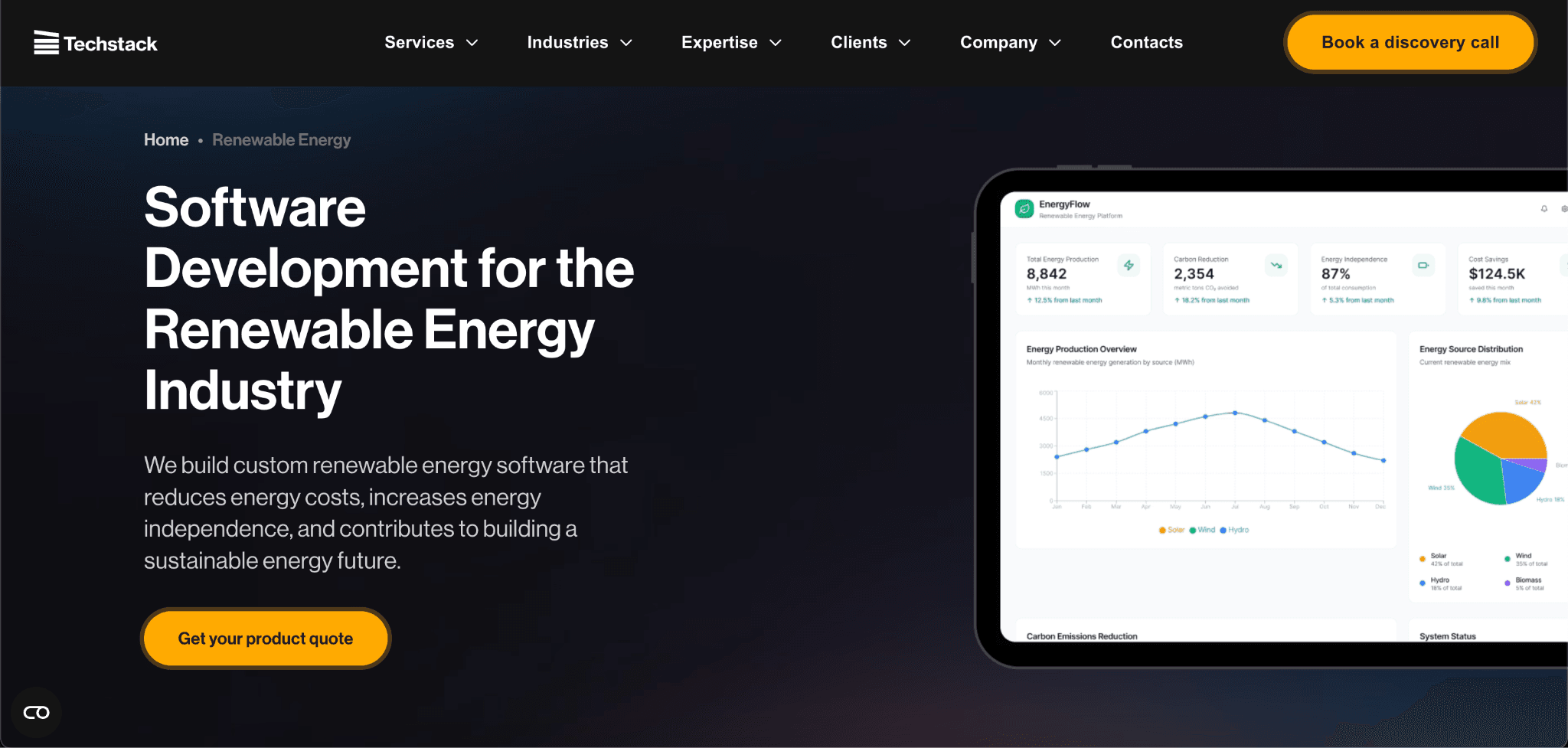
Based in Wrocław, Poland, Techstack has built its energy practice around unified data platforms, distributed asset orchestration, grid optimization, and storage-management software for renewable developers and utilities.
Techstack’s work centers on data unification and asset orchestration for distributed energy resources – the practical problem of aggregating telemetry from geographically dispersed wind, solar, and storage assets into a coherent operational picture.
Its grid optimization and storage-management software addresses dispatch and balancing decisions that renewable portfolios require given intermittent generation, a technical domain distinct from conventional generation monitoring.
3. Bamboo Agile
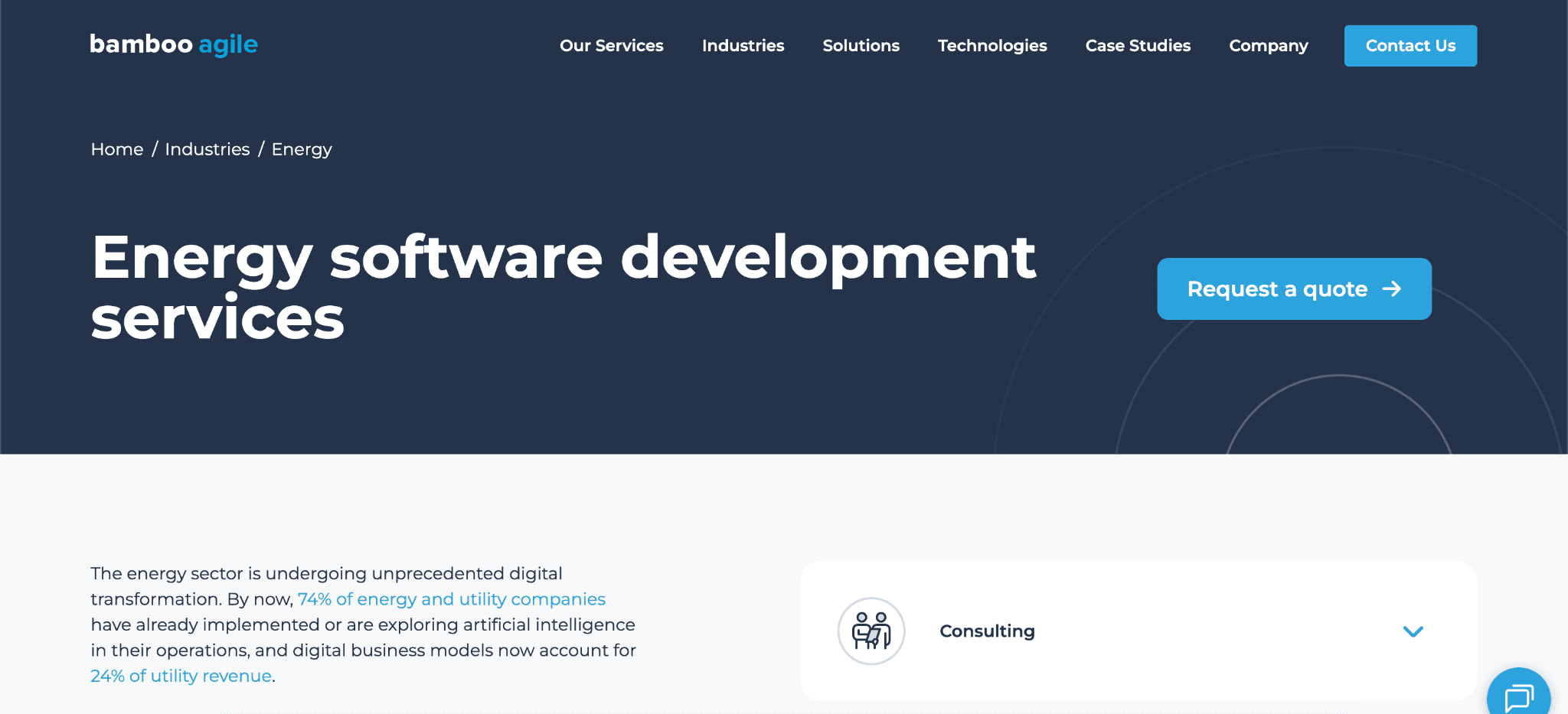
Bamboo Agile was founded in Estonia in 2002. Its broader reputation rests on telecom, fintech, and EdTech work. In addition, the company runs a dedicated energy software practice. This covers energy management systems, AI driven analytics, exploration and production (E&P) software, and custom IoT solutions.
Its portfolio includes several notable projects. One involved maintenance and feature development for a subsurface technology platform. Another was a simulation platform built to train personnel for an offshore wind farm. A third was an IoT-based access management system for critical infrastructure. That system relies on environmental sensors, geomapping, and real-time alerts.
Even though client names remain confidential, it is known that they include one of the largest utility providers in the MENA region and a Norwegian multinational energy company.
Bamboo Agile also carries ISO 27001 certification. MSECB awarded this certification in November 2023. As an EU-based entity, the company operates under GDPR. It also defaults to EU data residency.
4. Transition Technologies (TT Group)
TT Group has been operating out of Poland since 1991, making it one of the longest-running names on this list.
Its energy delivery mainly runs through two arms:
- Transition Technologies – Systems, which handles implementation and maintenance for power and gas utilities (and has expanded into Ukraine)
- Transition Technologies – Control Solutions.
A related but separately branded entity, Transition Technologies MS, runs its own specialist team building grid monitoring and compliance platforms aligned to IEC 61850 and NIS2.
That’s a company whose energy expertise is organized around utility operations and grid compliance.
5. Computools
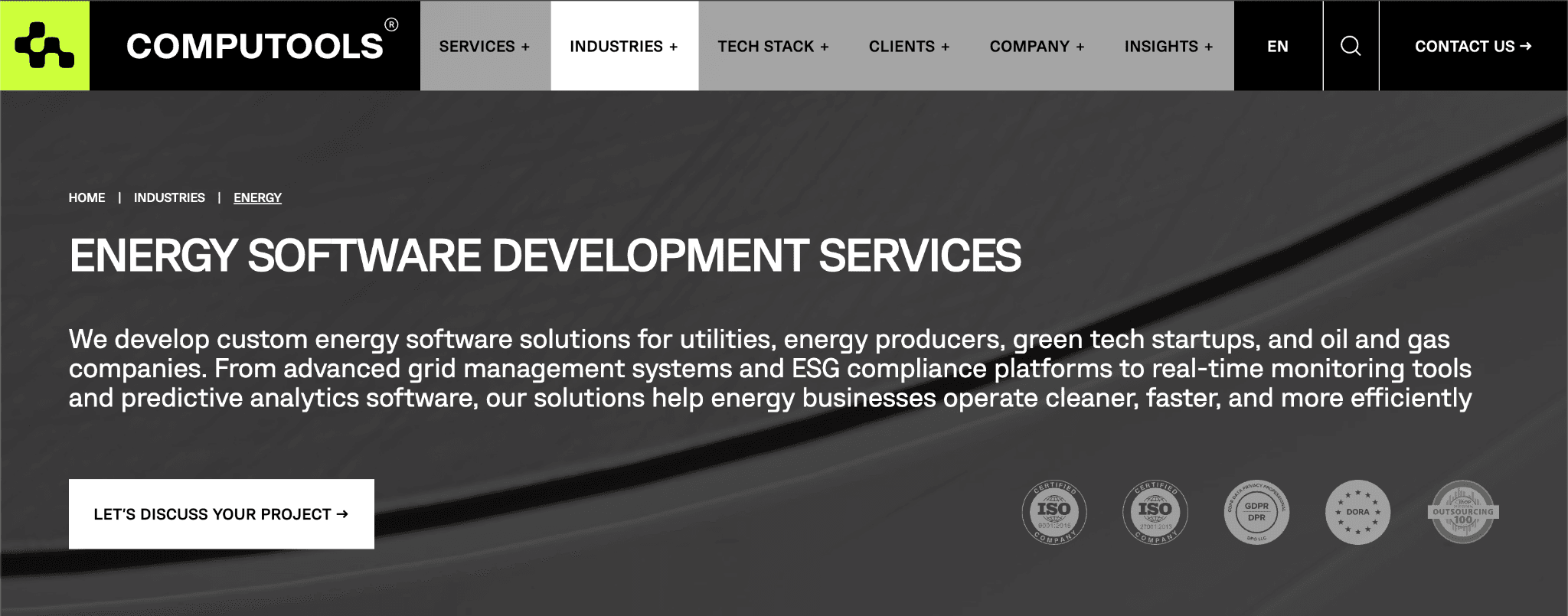
Founded in Kyiv in 2013 and now headquartered in Warsaw (it relocated in 2022), Computools has grown into a 250+ engineer, 400+ project consultancy.
Their relevant expertise lies in building software to security and regulatory standards applicable to energy operational environments:
- ISO 9001:2015 for quality management
- ISO 27001 for information security
- GDPR/HIPAA-aligned data-handling practices
Their energy practice covers several core areas. They build grid monitoring and outage tracking systems for utilities; develop smart metering platforms and process AMI data; create custom SCADA and IoT solutions for real time monitoring of pipelines, substations, and generation assets.
Their work also extends to predictive maintenance tools, load forecasting, and renewable energy monitoring applications that support solar, wind, and battery storage integration.
6. Velvetech
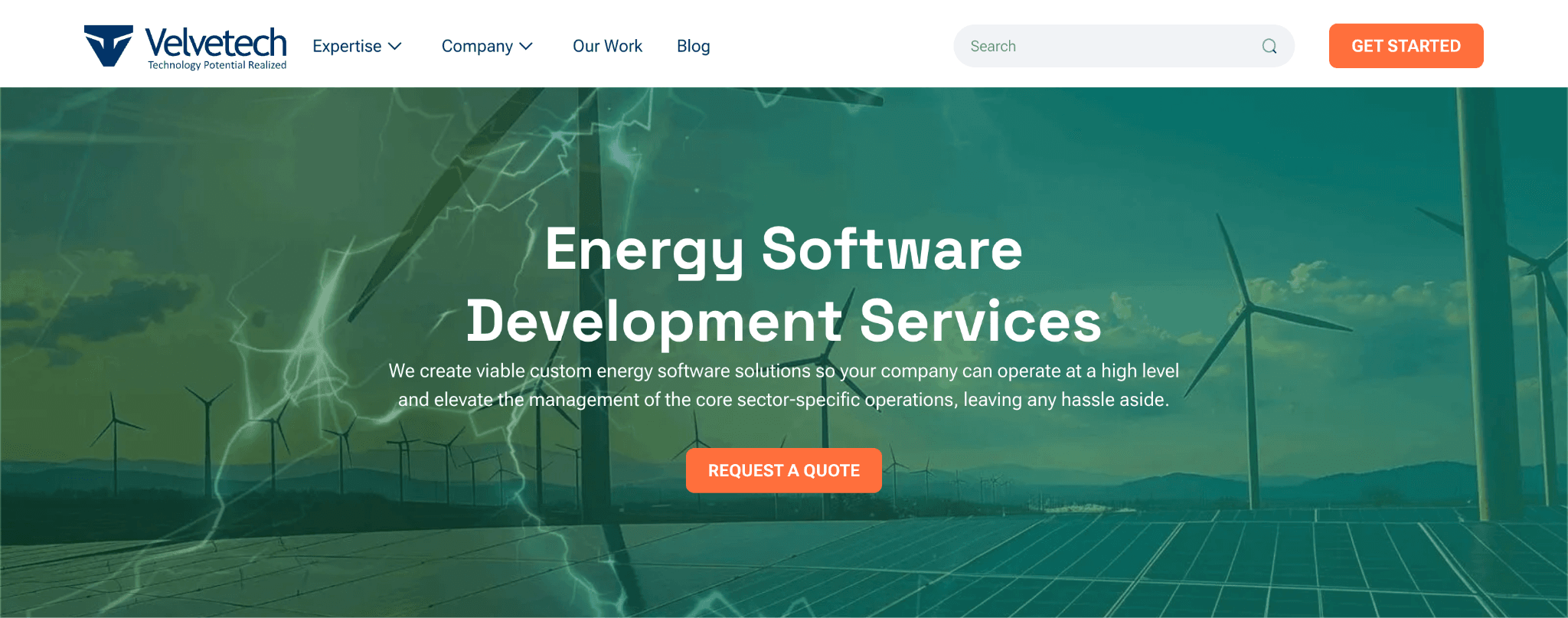
Velvetech is one of the leading energy tech solution companies with 20+ years in IT services.
Their energy practice covers SCADA system design including real-time monitoring and control of physical processes. They also offer energy trading platform development, which involves market-data integration and transaction logic distinct from operational software.
In addition, the company builds EV charging network software and has delivered oil & gas systems spanning upstream (exploration / production), midstream (transport / storage), and downstream (refining / distribution) operations.
7. EPAM Systems
EPAM plays in a different weight class than other energy software companies on this list – a publicly traded, S&P 500-listed company (NYSE: EPAM) with roughly 62,000–65,000 employees.
Their energy expertise is rooted in large-scale systems integration and digital transformation delivery. These capabilities are suited to utilities and energy companies undertaking enterprise-wide modernization including legacy system replacement, data platform consolidation, and cloud migration.
8. Apriorit
Apriorit was founded in 2002 and now has 250+ engineers, has spent two decades specializing in low-level, kernel, and embedded systems work.
Its energy practice is mostly hardware-first: custom firmware for energy-sector devices, IoT connectivity for monitoring production, storage, and delivery equipment, sensor retrofits for legacy hardware, and predictive-maintenance AI layered on top of all of it.
The company also holds ISO 27001, ISO 9001, and TISAX certification.
9. Blackthorn Vision
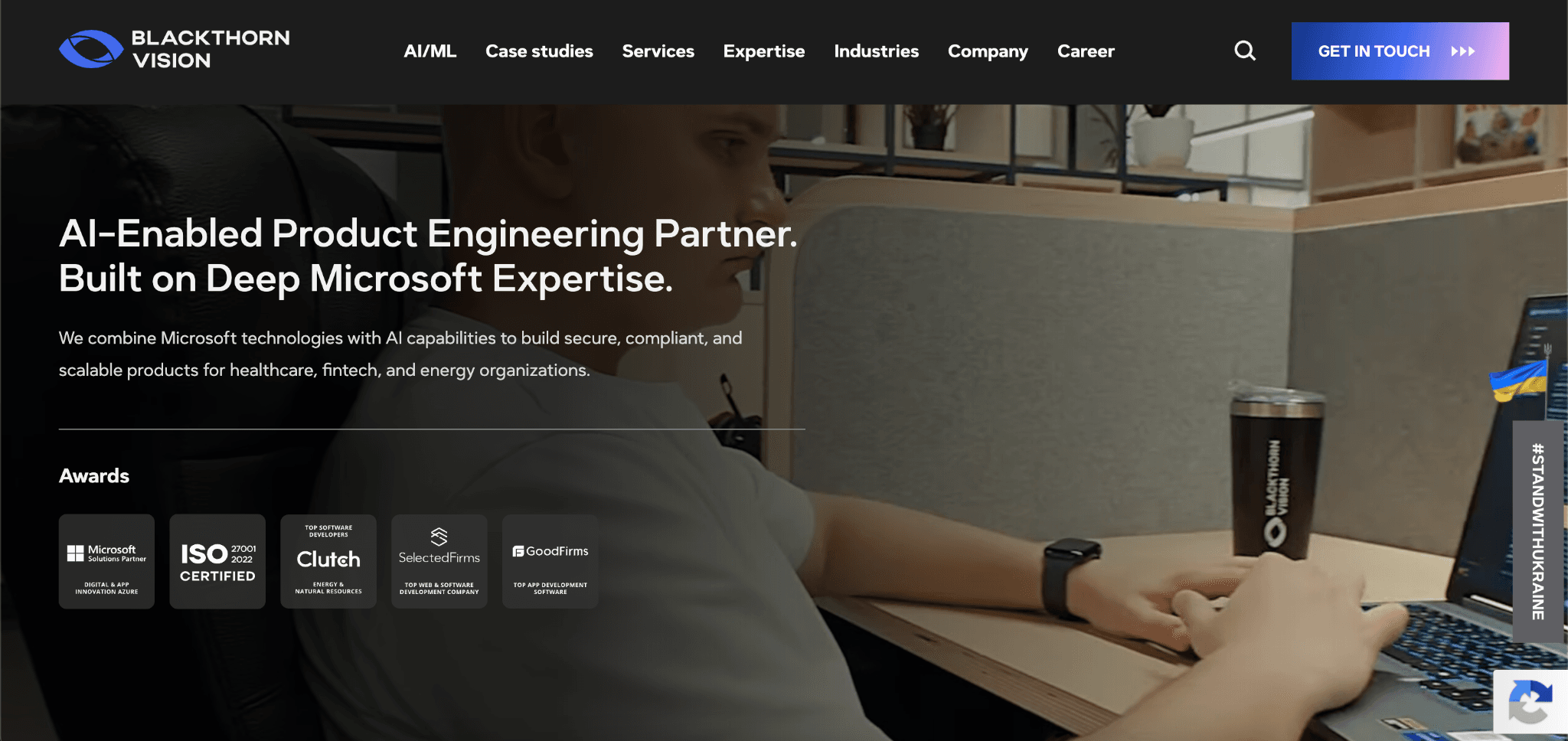
Blackthorn Vision is a Ukrainian custom software company founded in 2009 and based in Lviv. They are a Microsoft Solutions Partner. The company carries ISO 27001 certification as well.
Their relevant capability is its AI/ML practice – built on TensorFlow, Scikit-learn, and Azure ML – combined with a full-stack engineering base (.NET/C#, Python, Golang, React, Angular). These are the technical building blocks for load forecasting, anomaly detection, and predictive-maintenance models, which are core to how utilities and generation operators manage grid reliability and asset lifecycle.
10. Albiorix Technology
Founded in India in 2016, Albiorix is another of the growing energy tech solution companies. It has grown to 100+ employees and delivered 700+ projects across 22 countries.
Their engineering capacity spans a high volume of delivered projects across many markets, giving it broad exposure to varied technical stacks and integration patterns. For energy-sector engagements, this translates into flexibility on smaller-scope technical builds – monitoring dashboards, data pipelines, integration work – where breadth of prior delivery experience matters more than deep vertical specialization.
How to choose among these energy software development companies
Start with the actual problem you need solved, not the general label ‘energy software.’ These vendors cover very different types of work.
- If you’re dealing with subsurface data, geoscience modeling, or hydrocarbon accounting, look for a vendor with real experience in that specific domain. This kind of expertise is hard to fake and usually can’t come from a general software team.
- If you are managing distributed renewable assets like wind, solar, and storage across many sites, the key skill is data aggregation and grid balancing. This is a different challenge than building a single application, since it involves handling constant, messy input from many sources at once. You need one of the specialized renewable energy software companies.
- If your project needs to meet specific grid or cybersecurity standards such as IEC 61850 or NIS2, ask the vendor directly whether they’ve built products around these standards before. A general certification like ISO 27001 is a baseline. Direct experience with a specific standard is a stronger signal of real capability.
- If your system involves financial elements like energy trading or market data, that’s a separate skill set from operational software such as SCADA. A vendor that’s strong in one area isn’t automatically strong in the other.
- If the work is closer to hardware than to the cloud, such as firmware or embedded sensors, you need a team with real kernel level or embedded systems experience. A typical software vendor usually isn’t equipped for this kind of work.
- If you’re planning a large-scale modernization project, such as replacing old systems or consolidating data platforms, size and integration experience matter more than a narrow energy specialty. A vendor used to managing large, multi-year programs will usually handle this better than a small boutique team.
- If your priority is applying AI for things like forecasting or predictive maintenance, look for a dedicated machine learning practice rather than a vague mention of AI in their service list. Real machine learning work requires ongoing model tuning and careful data handling, which is more involved than a one-time feature.
- If you have a smaller, well-defined task like a dashboard or a simple integration, a vendor with broad general experience across many projects can often do the job well and at a lower cost, without needing deep energy-specific expertise.
The most useful thing you can do with any of these energy software companies is ask for a specific example of past work that matches your exact problem. This is the fastest way to tell real experience from a services page that simply lists energy as one of many industries it covers.
If you’d like to see how this applies to your own project, feel free to reach out. We’re happy to walk you through relevant case studies and point you toward the kind of experience your specific problem actually calls for.