Introduction
The global education technology market is projected to double from $213.2 billion in 2026 to $437.5 billion by 2033 (Grand View Research). Most of that growth is flowing into off-the-shelf, subscription-based platforms, and per-user pricing means the bill keeps climbing every time a K-12 school, university, or corporate training provider adds another student or employee.
Custom education software flips that model: instead of a license that scales with headcount indefinitely, you’re paying for infrastructure and a build that’s shaped around your own workflows, data, and students from the start.
Here’s what that trade-off actually looks like, side by side:
| Criteria | Off-the-shelf software | Custom educational software |
| Time to launch | Fast: running in days or weeks | Slower: often 3-6 months for an initial build |
| Upfront cost | Low; subscription-based | Higher; you’re paying for development, not a license |
| Long-term cost | Scales with headcount: more students, more seats, more cost, indefinitely | Grows with actual infrastructure usage, not with how many students or employees you add |
| Fit to your workflow | Built for the average customer; you adapt to it | Built around your actual process; it adapts to you |
| Data and compliance | Subject to the vendor’s own data policies | Full control over how you architect for FERPA, COPPA, and GDPR |
| Maintenance and security | Patching, uptime, and updates are the vendor’s job | Requires your own ongoing DevOps and SLA support, in exchange for full control |
| Feature control | You wait on the vendor’s roadmap and release calendar | You build and prioritize what your institution actually needs, when you need it |
| Differentiation | Same platform as competitors, so it’s hard to stand out | Proprietary features or an approach a licensed competitor can’t easily replicate |
| Integration | Often a closed ecosystem; migrating existing tools can be painful | Built to plug into what you already run |
Naturally, software development requires a clear upfront commitment. It comes with ongoing responsibility for maintenance, updates, and security that a vendor would otherwise handle, and that responsibility is real; a custom build is not maintenance-free. What it does avoid is the specific way SaaS pricing scales.
A licensed platform typically charges more every time you add a student or employee; custom infrastructure costs grow with actual server and usage load, not with headcount, so a school or training provider that doubles its enrollment doesn’t automatically double its software bill the way a per-seat license would.
That’s a genuinely different, more predictable total cost of ownership, not a maintenance-free one. It’s also why a mature off-the-shelf platform still makes sense for institutions with genuinely generic, stable needs and small enough headcount that per-seat pricing never becomes painful.
For everyone else, K-12 schools, higher-ed institutions, and corporate or vocational training providers whose needs have outgrown the average customer profile, the rest of this article covers exactly where that trade-off pays off, and what to actually build.
Where custom education software delivers the most value in 2026
A few shifts are redefining educational technology in 2026, starting with the rapid adoption of AI. However, these shifts often expose the limitations of one-size-fits-all platforms.
Custom education software development delivers the most value in areas where architecture, integrations, security requirements, or user experiences need to be designed around an institution’s specific environment. Let’s take a look at some of the cases of specific product capabilities.
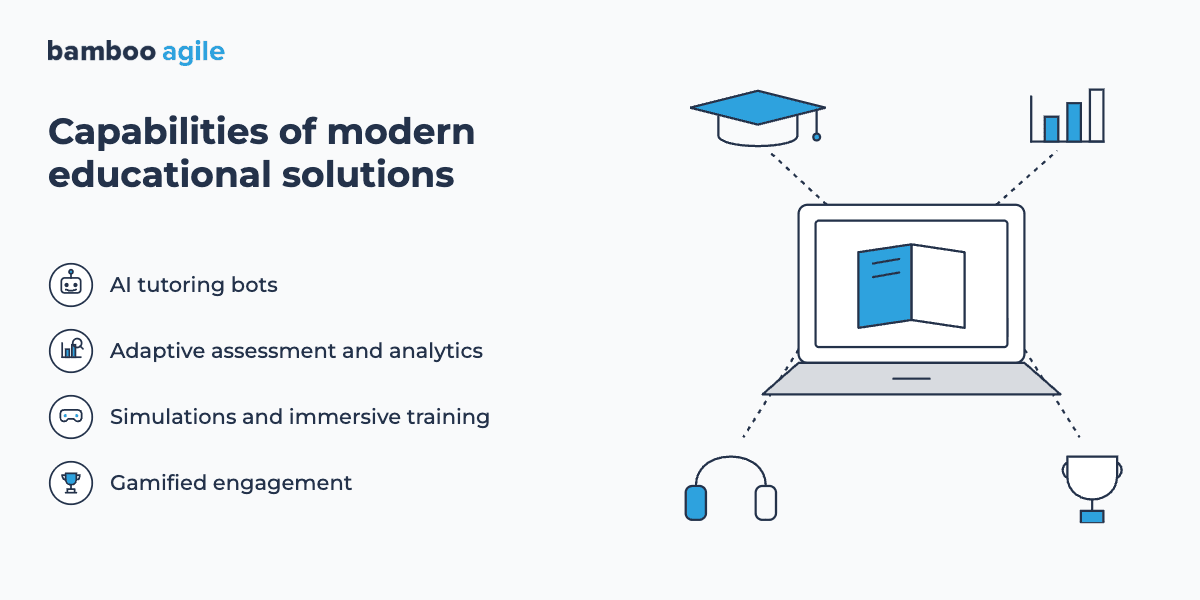
AI tutoring bots and automated, personalized support
AI personalization isn’t new, but the kind of AI showing up in classrooms and training programs is changing. Instead of a chatbot students query when they have a question, the newer generation of tools acts proactively: it analyzes a learner’s history and initiates help before they ask for it, automating the administrative and tutoring workload that would otherwise fall on staff.
HolonIQ’s 2026 Education Trends Snapshot frames this as a shift from experimentation to execution, with institutions now expecting proof that a tool improves outcomes rather than just engagement.
The outcome a custom build delivers here is specificity: an AI assistant, or AI bot, that references the exact material a course actually teaches, flags misconceptions your instructors already know show up, and hands off to a human using your institution’s own escalation rules, none of which a generic model trained for the average customer can match.
Custom educational software also gives institutions greater control over long-term costs and AI capabilities. Denver Public Schools, for example, had to secure new local funding to keep an AI lesson-planning tool it initially received for free after the vendor moved it to a paid pricing tier.
Still, nowadays, many organizations are responding by investing in AI platforms they own, allowing them to decide how AI evolves, what data it uses, and how it integrates with existing learning systems.
UC Irvine is one example of this approach. In January 2024, the university launched ZotGPT, an in-house AI platform built on Azure AI and AWS rather than a licensed chatbot product, now serving more than 15,000 unique users. A year later, it introduced ZotGPT ClassChat, enabling instructors to ground AI responses in their own course materials instead of relying on a generic model.
UC San Diego is a good example of what that specificity actually looks like in practice. Its own news office describes the tool, piloted since Fall 2025 in a genetics course and an entry-level programming course, as a “bespoke AI tutor,” and the research team is tracking student perceptions directly as one of the measures of the tool’s effectiveness, funded by California’s AI Grand Challenge program and expanding through the 2025-26 academic year to San Diego State University and several community colleges.
Simulations, models, and immersive technology
Digital models, simulations, and immersive technology (AR, VR, and MR, where mixed reality combines elements of both) help learners grasp concepts a static picture or a lab experiment can’t easily demonstrate. VR is especially valuable in fields like medical or technical training, where a learner can practice a specific, high-stakes scenario in a low-risk setting instead of on a live patient, a live client, or a live piece of equipment.
Apparently, a custom simulation matched to your program’s exact clinical scenarios or technical curriculum goes considerably further than a generic library that only approximately fits what you teach. This is a mature category by now, which is exactly why a purpose-built version of it stands out from something generic.
Gamification and verified skill credentialing
Turning learning into a more engaging process through gamification remains one of the most reliable ways to lift participation and retention, and it delivers the most value when the mechanics (points, levels, streaks) are built around the actual subject and age group in front of you rather than retrofitted onto a generic points-and-badges plugin. That’s a genuine, if modest, outcome on its own: a more engaging product keeps students and trainees coming back.
Adaptive assessment and actionable learning analytics
Custom-built assessment tracks exactly the metrics that matter to your institution (assignment volume, time spent per problem, patterns across a specific cohort) and adapts what a learner sees next based on their own performance, rather than a fixed branching path built for every customer at once.
In a K-12 or higher-ed setting, that specificity is what actually helps a teacher see what a student is struggling with, and what to do about it, instead of working from a report designed for the average customer. In a corporate or vocational training context, the same specificity turns into something a training budget owner can actually defend: clear ROI reporting, visibility into which skill gaps a program is actually closing, and workforce upskilling data tied to your own competency framework rather than a generic completion percentage.
Credentialing is a separate outcome, and it’s worth keeping distinct from game mechanics rather than conflating the two. Employers hire based on verified competencies. What’s actually growing fast here is competency-based micro-credentialing: formal, LMS-integrated records that map to a specific skill or standard, verifiable by an employer rather than self-reported.
The market size and employer-hiring figures above make the case; custom educational software can tie that kind of credential directly to your own competency framework and track it through your LMS, rather than issuing a generic badge that carries no verified meaning outside the platform that produced it.
Features you won’t find on an off-the-shelf platform
Beyond the general trade-offs, there’re a few more specific things that aren’t available at all from a licensed product, no matter how much you’re willing to pay for a premium tier. These tend to be the ones a technical buyer asks about first and a generic vendor has the hardest time answering.
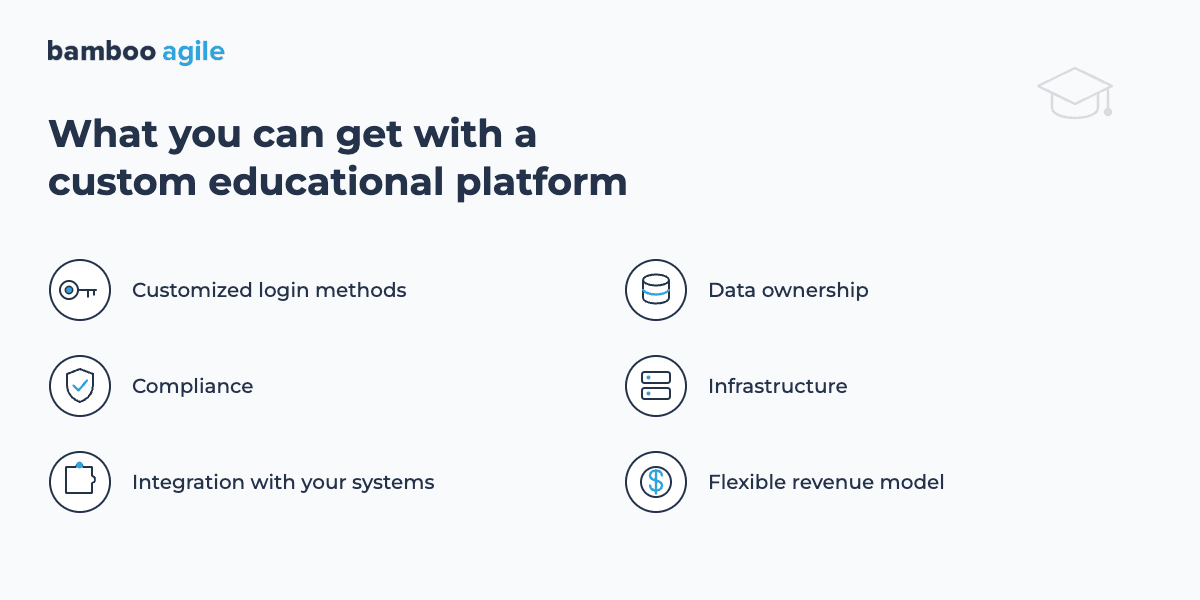
A login that works with the identity system you already have
Most off-the-shelf tools ship with their own standalone login, which means an employee or student ends up managing yet another password, and an IT department ends up managing yet another identity system to secure.
A custom build can integrate SSO (single sign-on) directly with whatever your institution already uses (Okta, Azure Active Directory, Google Workspace, or a district’s own identity provider), so access is provisioned and revoked automatically the moment someone joins or leaves, rather than through a separate admin panel a vendor controls.
Data ownership, compliance, and infrastructure
A custom build earns credibility with technical stakeholders by integrating with the standards their learning ecosystem already relies on. That includes LTI (Learning Tools Interoperability) for launching tools within an LMS, SCORM and xAPI (Experience API) for tracking learner activity, and QTI for portable assessment items. Supporting these standards from the outset allows new functionality to fit into existing workflows instead of forcing institutions to adapt to the subset of integrations a commercial platform happens to support.
The same principle applies to compliance. K-12 platforms benefit from architectures designed around FERPA and COPPA from day one, while corporate and vocational training solutions often need to meet GDPR, ISO 27001, and SOC 2 requirements. Support for SSO (single sign-on) further strengthens security by integrating the platform with an organization’s existing identity and access management infrastructure instead of introducing another standalone login.
Infrastructure decisions also have long-term implications for security and governance. Licensed platforms typically run on shared, multi-tenant environments, where every customer relies on the same underlying infrastructure. Custom education software solutions, by contrast, can be deployed in a dedicated AWS or Azure environment provisioned specifically for your institution, giving you greater control over data residency, security policies, and audit requirements.
Some institutions are taking this approach further by extending that control to AI governance. Cornell University demonstrated this with its internal AI Platform, unveiled at AWS re:Invent in December 2025. Rather than applying the same approval process to every AI use case, the platform classifies workloads by risk level: staff and researchers can build AI agents directly when working with moderate-risk data, while projects involving high-risk data require review by Cornell’s IT Security Office. The result is an AI environment where governance policies reflect the institution’s own security and compliance requirements instead of a third party’s default model.
Direct integration with the systems you already run
A generic platform is often a closed ecosystem, built to keep customers inside its own suite of tools rather than to talk to whatever else an institution already runs. A custom build can integrate directly with an existing student information system (SIS), HR platform, or finance system from day one, so enrollment, grading, and billing data flow automatically instead of being re-entered by hand or synced through a fragile third-party connector that breaks every time one system updates.
A revenue model you control
Most off-the-shelf course marketplaces and LMS platforms take a cut of every transaction, or charge a platform fee layered on top of whatever you charge a learner.
Custom software lets a training provider or EdTech company run its own payment and subscription model directly, keeping the full margin on every enrollment instead of splitting it with a platform that had nothing to do with building the course.
What custom education software to build, by institutional context
The capabilities above can be layered into almost any platform. What follows are the complete products institutions and training providers actually commission, grouped by who’s buying, since a K-12 school and a corporate training provider tend to need very different things built.
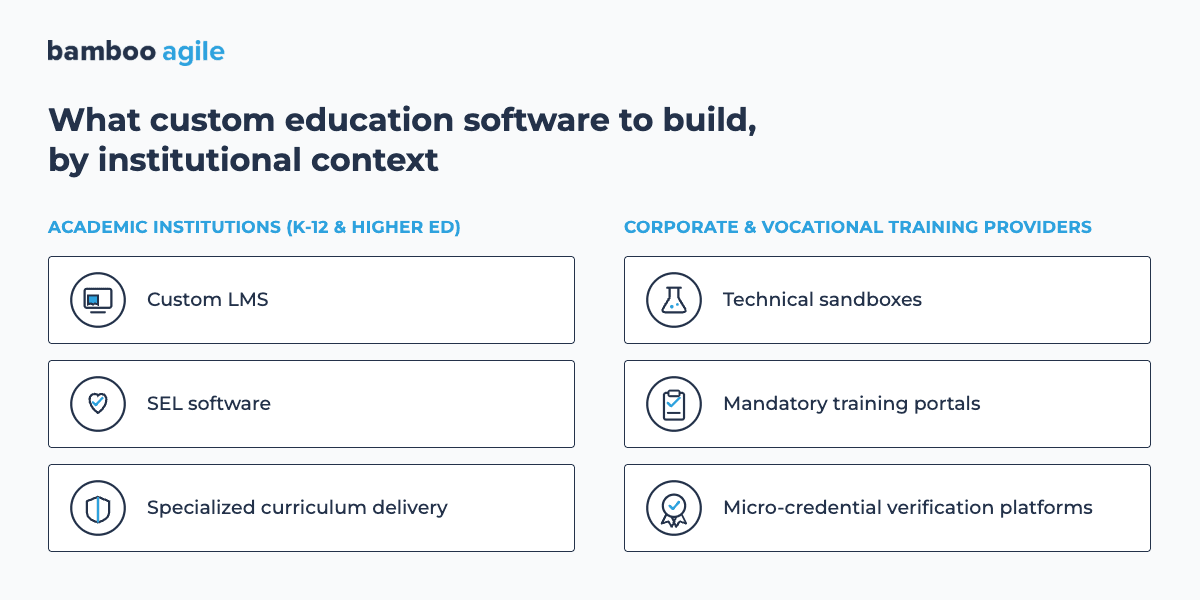
Academic institutions (K-12 and higher ed)
Custom LMS
A bespoke Learning Management System delivers benefits a generic one structurally can’t: a modular architecture that supports a custom assessment engine, direct integration with your student information system (SIS), and, for multi-campus institutions, consistent branding across every site, rather than forcing every course into the same rigid template.
Plenty of ready-to-use learning management systems already offer some room for customization, but many educational centers and course providers end up running their own custom LMS to keep the software fully aligned with their own processes.
It’s the clearest example of when a custom education software solution outperforms an off-the-shelf product.
SEL software
A custom build maps directly to your institution’s own SEL framework and the five core competencies (self-management, self-awareness, social awareness, responsible decision-making, and relationship skills), delivering personalized tracking, evaluation, and communication tools matched to your framework, rather than a generic curriculum bolted onto an existing LMS.
Specialized curriculum delivery
This mostly covers the age- and subject-specific tools a generic platform rarely gets right:
- early learning apps built for a preschooler’s limited technical skills and short attention span (a market too small and specialized for most vendors to prioritize);
- coding and technology platforms with a curriculum sequence mapped to your own grade levels;
- e-Learning content built around your own instructional design instead of a generic template.
Each one benefits from full ownership of the underlying curriculum IP, bespoke progress tracking mapped to your own standards, and data privacy over student work kept under your own governance, rather than licensed from, and controlled by, a third-party vendor.
Corporate and vocational training providers
Technical sandboxes
Low-stakes, hands-on practice environments (a coding sandbox, a clinical simulation, a technical equipment walkthrough) matter more to a vocational or technical training provider than a generic course, because the whole point is safe repetition of a specific, high-stakes scenario before a trainee ever does it for real. This is the same simulation and immersive-training capability covered above, applied as a standalone product a training provider commissions on its own.
Mandatory training portals
A dedicated portal for tracking mandatory training (safety, regulatory, onboarding) benefits from the same compliance architecture covered above: FERPA/COPPA where relevant, GDPR, ISO 27001, and SOC 2 as a baseline, and SSO so the portal plugs into an employer’s existing identity system instead of becoming another disconnected login every employee has to manage separately.
Micro-credential verification platforms
Rather than hosting content on a shared course marketplace, a training provider gains real business value from a dedicated platform built around its own content, brand, and learner journey: full ownership of learner data and engagement analytics, a payment and subscription model without platform fees cutting into revenue, and direct integration with the competency-based credentialing covered above, so a completed course maps to a verifiable credential rather than a generic completion certificate.
Conclusion
The benefits of custom education software development come down to one thing: technology that matches your actual teaching process, your own data policies, and your own students, instead of asking you to match it. Whether that means a fully bespoke build or a heavily tailored LMS, the further your institution’s needs move from the average use case, the more those benefits compound, and the more education industry gains from the specialized, varied technology that only custom development tends to produce.
Bamboo Agile helps schools, training providers, and EdTech companies unlock the true value of learning with custom software development for the educational industry, built around your goals from the start. Fill out the contact form and our team will be in touch to discuss next steps.