You are here:

Telecom app development for operators and service providers

Request a quote

Annual churn in telecommunications ranges from 20% to 50%, driven by aggressive competition and poor customer support. For a provider with 1 million subscribers at a $50 monthly ARPU, even a 20% churn rate results in $120 million in lost annual revenue (Document360).

This makes subscriber-facing telecom applications a critical retention lever. Self-service apps and portals now directly shape how customers perceive the brand and whether they stay loyal or leave.

At Bamboo Agile, we strive to address this. We provide custom telecom app development services for mobile network operators, MVNOs, internet service providers, and infrastructure companies. Our teams have worked inside the telecom stack since 2002, across 60+ operator partnerships, delivering applications that run in production and handle real subscriber volumes.
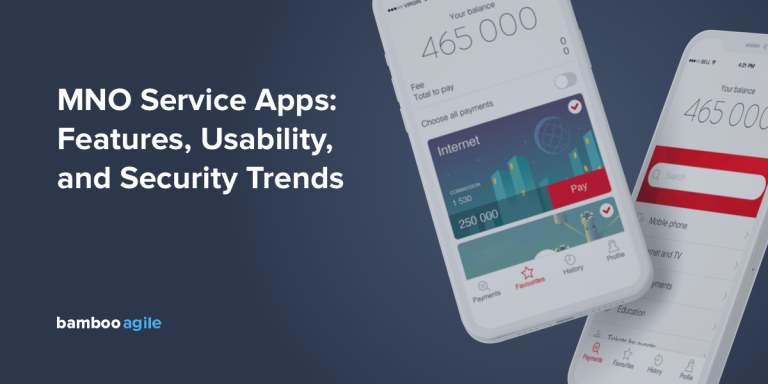

As part of our broader software development services, we help operators deliver modern web and mobile telecom applications, including:

  • Customer self-service apps and portals
  • Field engineer tools with offline-first capability
  • VoIP and softphone clients for enterprise and MVNO products
  • IPTV and streaming clients for content bundle products

By 2025, around 85% of customer service organizations are expected to have adopted generative AI (Gartner). For telecom product leaders, the question is not whether to integrate AI but where it moves the metrics that matter.

Integrate AI capabilities and chatbots with us to:

  • Automate handling of high-volume, low-complexity queries, which can reduce call center costs by up to 45% (McKinsey)
  • Predict churn by usage patterns
  • Increase retention with personalization and recommendations
  • Automatically detect faults for faster response to network events

Legacy applications create two problems simultaneously: a subscriber-facing one, as older apps fall behind expectations and drive churn, and an internal one, as engineering teams spend disproportionate time maintaining systems that are slow to change.

We modernize incrementally, delivering improvements sprint by sprint while keeping current systems live throughout. Where you need expertise in legacy telecom technologies to bridge the gap during migration, we can source the right specialists rather than leaving you with a knowledge gap mid-project.

Applications we build

With over two decades of experience in the sector, we bring to fruition the right applications for operators at every stage of their growth.

Self-service portals and apps are among the highest-leverage investments an operator can make. Businesses that deploy self-service tools report up to a 45% reduction in call centre costs, and nearly 48% of enterprises are implementing automation-driven systems specifically to reduce service resolution time (The Business Research Company).

We build web and mobile apps that put operators on the right side of that shift, covering both B2C subscriber journeys and B2B carrier and partner management.

  • Account and subscription management
  • Bill payment and usage dashboards
  • Plan upgrades and add-on purchases
  • AI-powered support chat and automated query resolution
  • 24/7 self-service access to service provisioning and history

Every hour a network fault goes undetected costs more than the fix itself. We build internal operations applications with offline-first architecture and direct OSS integration, so your NOC teams and field engineers can identify and resolve issues before they reach subscribers, even in sites with no connectivity.

  • Real-time network performance dashboards
  • Fault management, alerting, and incident routing
  • Field engineer job management and GPS navigation
  • Network topology views with direct OSS integration

Billing data is some of the most actionable your business holds, yet most operators surface only a fraction of it to the teams who need it. We build applications that expose charging, usage, and revenue data to the right people at the right time, without requiring changes to the billing systems underneath.

  • Usage and charging dashboards
  • Prepaid, postpaid, and converged plan management
  • Revenue assurance and analytics
  • Wholesale settlement and interconnect management

Enterprise clients are moving voice infrastructure to cloud-based and SIP-driven stacks, and operators who can offer a native communication application alongside connectivity have a clear cross-sell advantage. We can build custom VoIP applications that integrate cleanly with existing telephony systems rather than running as a separate stack.

  • SIP trunking and softphone clients
  • Conference and collaboration tools
  • IVR and call queue management
  • WebRTC-based browser communication features

Loyalty schemes influence the purchasing decisions of 35% of telecom subscribers, yet only 36% of customers actually use the scheme their operator offers (Omdia), most often because a poor app experience makes it too easy to ignore. We build VAS applications that close that gap and help operators generate revenue beyond the core plan.

  • IPTV and live streaming clients for content bundle products
  • Loyalty and rewards platforms tied to subscriber plans
  • Smart radio, RBT, and entertainment apps
  • Telematics and GPS tracking applications

Case studies

Check the telecom apps and features that we’ve built for both local and global mobile operators.

What makes us stand out as a partner in telecom app development

Working with a large operator is a different challenge from building a consumer app. Subscriber databases run into the millions, peak traffic is unpredictable, and a billing error affects real people’s accounts. We have been building for that environment since 2002. Our team has delivered a multitude of MNO software projects with the architecture designed to support millions of concurrent users.

The operators gaining competitive ground are the ones using IoT, AI, AR, and edge computing as core product capabilities rather than future roadmap items. We can integrate these technologies into telecom applications at the architecture stage, which means they perform reliably at subscriber scale rather than appearing as fragile add-ons. We do not apply emerging tech for its own sake, but when it is the right solution, our teams have delivered it in production.

78% of operators already use API platforms for core functions including billing and identity, and the global telecom API market is projected to reach USD 455.5 billion by 2026 (360researchreports). That growth means your next application will almost certainly depend on API integrations that did not exist when your current systems were built. We have hands-on experience integrating interfaces across live operator environments, so those integrations don’t represent an engineering problem for us.

Subscriber data and financial transactions require a higher security baseline than most software. We conduct end-to-end security assessments (according to ISO-27001) throughout the build and help you ensure the application meets the regulatory and compliance requirements relevant to your operating markets.

FAQ

What is telecom application development?

Telecom application development is the process of designing, building, testing, and deploying software applications for use by telecommunications companies or their subscribers. This covers customer-facing mobile apps, internal operations tools, BSS/OSS integrations, VoIP clients, B2B portals, and any other software that sits within an operator’s ecosystem.

How do you handle integration with existing BSS and OSS systems?

Integration is scoped before development begins. We map your existing interfaces, design the integration layer as a core part of the application architecture, and build to those specifications throughout. We have direct experience with SMPP, SIP, VoIP, IVR, and billing systems from major telecom vendors.

How long does a telecom application typically take to build?

A self-service app with account management and billing typically takes 12 to 16 weeks. Applications involving custom BSS/OSS integrations or multi-platform builds generally take four to nine months. Working software is visible from the first sprint.

Do you work with MVNOs and smaller operators?

Yes. We work with MNOs, MVNOs, ISPs, and infrastructure providers across a wide range of sizes. MVNOs in particular benefit from lightweight, fast-to-market applications, and we have direct experience building for that segment.

What is your security approach for telecom applications?

Security is a baseline requirement rather than a phase. We apply OWASP guidelines throughout development, conduct end-to-end assessments and penetration testing before release, and provide network security recommendations where relevant.

Explore more insights on telecom application development

Ready to modernize your customer experience?

Join 60+ MNOs who have optimized their digital touchpoints with Bamboo Agile. Reduce support costs and drive loyalty today. Contact us now to get a free consultation.

Our consultant

Natalia Minayeva
Strategic Partnerships Executive

They trust us

trusted us