Bamboo Agile | Bespoke software development company
Bamboo Agile is an Estonia-based custom software development company that crafts bespoke solutions for telecom, education, healthcare, finances, other sectors.
What does your energy network struggle with? Whatever your answer is, it definitely will not be ‘lack of data’. If we hazard a guess, it will most likely be ‘too much data arriving too late, from systems that do not talk to each other’.
Energy IoT changes the timing of that information. Here, it arrives while the equipment is still running, in the systems operators actually use to take action – so teams can respond before the issue turns into downtime or lost production.
At Bamboo Agile, we have accumulated years of experience in IoT development services, including projects for the energy industry. In the article, we share where IoT can deliver results across the energy sector, and the technical decisions operators face when building reliable systems.
You handle the energy markets. We handle the software.
Let Bamboo Agile build your energy IoT application.
IoT in energyuses connected sensors, meters, controllers, and industrial equipment to collect operational data and exchange it in real time. Utilities and energy companies get direct visibility into assets, power flows, equipment health, and field operations across generation, transmission, distribution, and customer sites.
If we look deeper into the market, we can see the growing investments. According to the Internet of Things in Energy Market Size & Share Analysis – Growth Trends and Forecasts (2026-2031)report by Mordor Intelligence, the IoT in the energy sector was valued at $34.26 billion in 2026, which is a substantial increase compared to $29.87 billion in 2025.
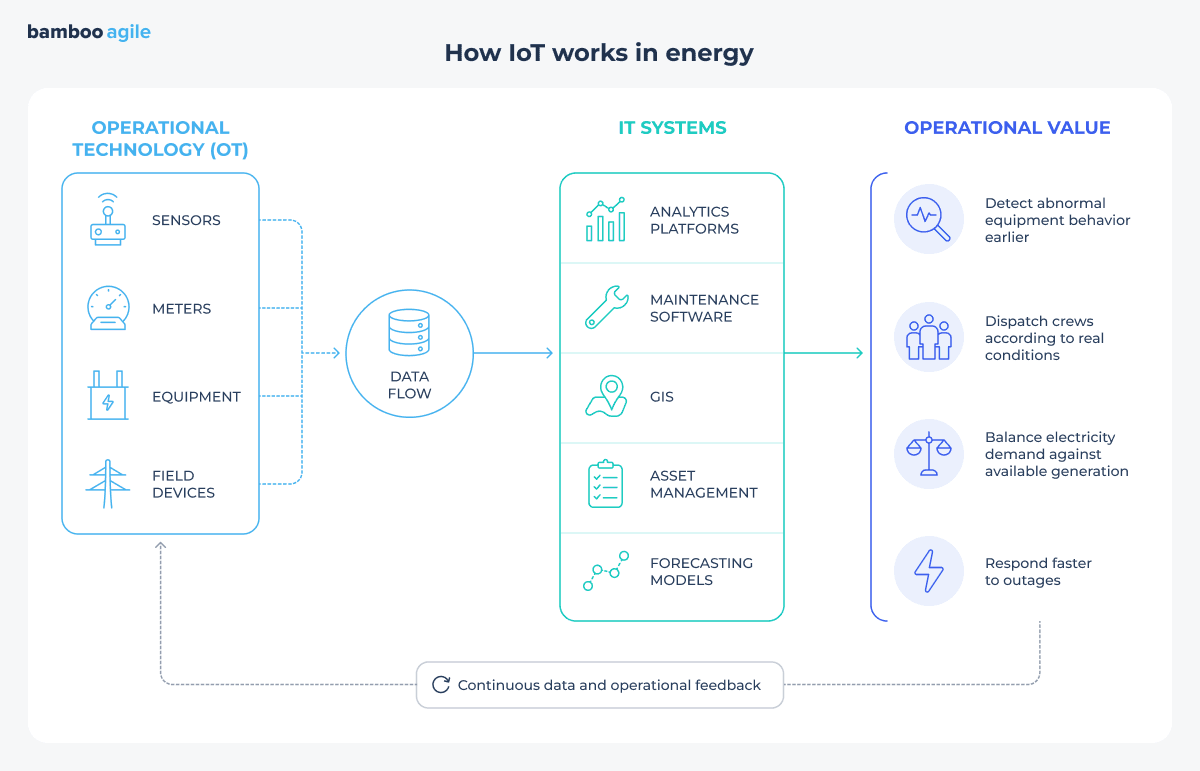
But the real value emerges when operational technology (OT) connects with IT systems. Sensor data flows into analytics platforms, maintenance software, GIS, asset management tools, and forecasting models. It helps engineers detect abnormal equipment behavior earlier and dispatch crews according to conditions. They can also balance electricity demand against available generation and respond faster to outages.
Egor Fostsiy, Embedded System IoT expert at Bamboo Agile
The main benefit of IoT in energy management today is the move from simple data collection to measurable business results – for instance, lower energy consumption through on-site analytics. Alongside this, the major trend is the widespread combination of AI and IoT, which turns peripheral devices into smart analysts that make real-time decisions without cloud delays.
Yet, the term Internet of Things grows outdated faster than the technologies themselves. In the future, literally everything will have a connection, and the concept of connected products will replace the old one.
Take smart buildings on open platforms as an example. The brand does not matter there; what matters is the capacity for integration and energy management system (EMS) functionality to oversee total ownership cost. In the long run, a cheap, unsupported sensor becomes a costly problem.
Real-world uses of IoT in energy: How operators are deploying it now
Connected sensors have become part of everyday asset management, with global energy leaders dedicating entire innovation programs to energy IoT. We highlight some of the most prominent examples of such uses.
Smart grid monitoring
McKinsey’s Global Energy Perspective 2025 says that “investing in grid infrastructure, flexible capacity, energy security, and storage solutions will be vital to accommodate rising power demand and volatile supply”. This supports the broader point that more complex power systems need stronger operational intelligence.
One of the best application examples of IoT in energy management is Duke Energy’s self-healing grid. When a fault occurs on Duke Energy Florida’s power lines, sensors detect the interruption and relay the issue to automated control systems. The technology isolates the damaged section and immediately redirects electrical flow along alternate routes. It returns service to unaffected customers within seconds, often before they realize an outage has happened. In 2022, this automated switching and fault isolation prevented roughly 513,000 prolonged outages and saved Florida customers more than 3.8 million total hours without power.
Renewable energy asset monitoring
Wind, solar, and hydro assets now make up a larger piece of utility portfolios than they used to. In its Renewables 2025 report, the International Energy Agency states that renewable power capacity is projected to increase almost 4,600 GW between 2025 and 2030, double the deployment of the previous five years. Solar PV will deliver close to 80% of that new capacity. Such growth has pushed continuous remote monitoring out of the nice-to-have category and into everyday operations.
Thus, as renewable capacity grows, operators oversee thousands of geographically distributed assets. Renewable energy IoT gives operations teams continuous visibility into equipment performance and helps them reduce unnecessary site visits.
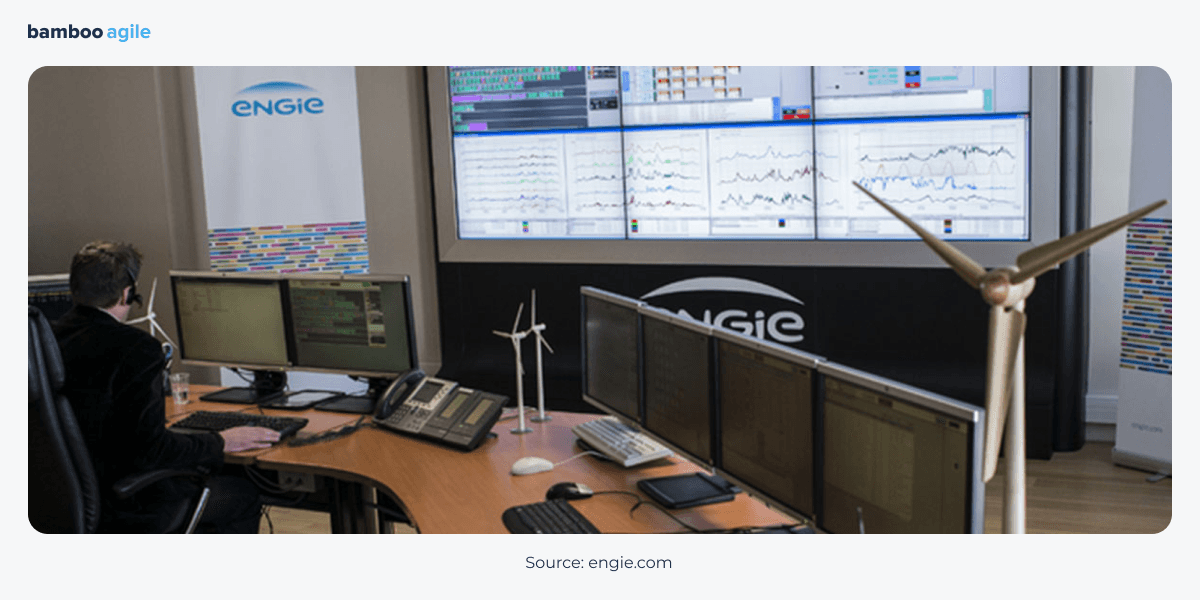
For instance, we may look at the Darwin platform by ENGIE. It collects millions of IoT signals per second from wind, solar, and hydro assets worldwide. ENGIE moved Darwin to Microsoft’s Azure, combining cloud analytics with edge computing to process that data in real time and apply AI models that forecast weather and detect performance anomalies. Operational teams view those insights through dashboards that compare time series and flag underperforming equipment. The Darwin platform remains a textbook example of an IoT energy efficiency project.
Industrial asset tracking and control
Utilities already track millions of physical assets, yet many still depend on periodic inspections or fragmented operational data. IoT in the energy sector provides continuous visibility into equipment location and status. And adoption continues to rise. The International Data Corporation projects utility investment in IoT at roughly $48 billion in 2025, with remote monitoring ranking as the industry’s top spending priority.
Moreover, based on the IoT Analytics’ 2025 research, large enterprises track over 166,000 assets per day on average, and roughly 3.7 billion connected IoT devices worldwide support asset-tracking applications.
This data is reflected in the daily operations of global brands like Vodafone. In 2025, the company connected its 200 millionth IoT device. Also, between 2020 and 2025, Vodafone more than doubled the number of IoT connections in its network. IoT devices connected by Vodafone track the movement, quality, and quantity of coal from 200 mines across South Africa. The communications company estimates that these connections automate energy-use monitoring across national electricity grids, track consumption in smart buildings, and detect and regulate traffic congestion.
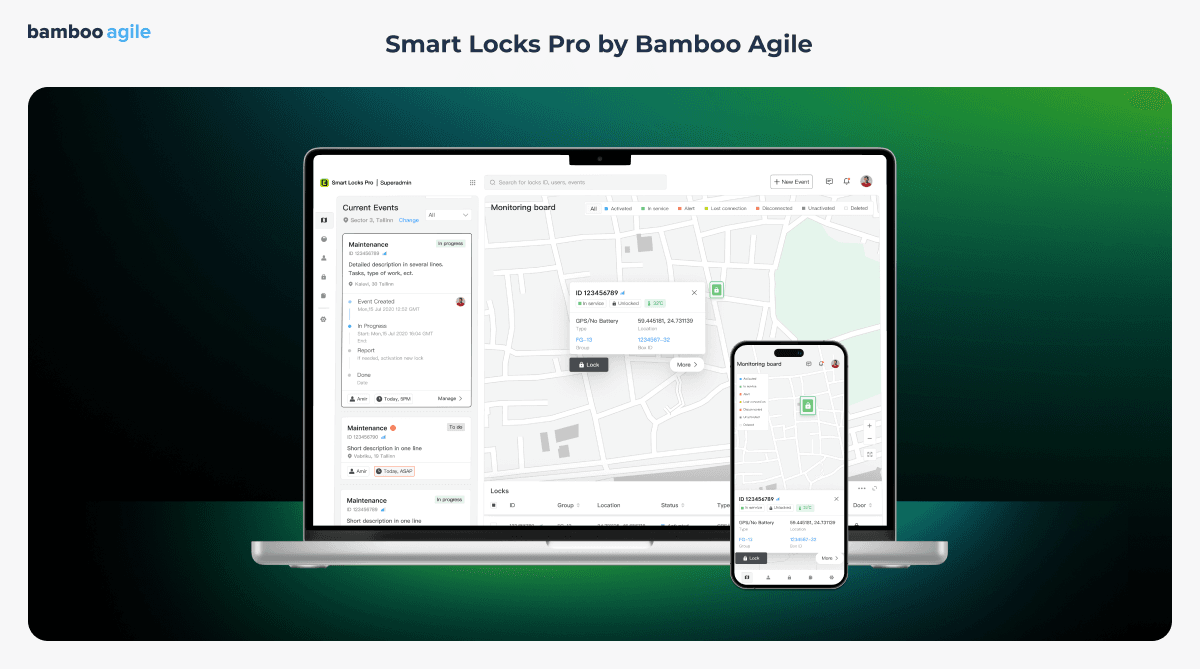
Another example of IoT in energy management is Smart Locks Pro by Bamboo Agile. Designed with the electricity environment in mind, the system evolved into an all-encompassing solution for safeguarding critical infrastructure. Smart Locks Pro includes intrusion detection, environmental sensors, geomapping, task management, and real-time alerts.
Smart metering at scale
Over the past decade, smart meters have transformed from pilot projects to large-scale utility programs. A recent estimate from Transforma Insights places the global smart meter installed base at roughly 2.1 billion devices in 2025, with electricity meters making up most deployments. The same forecast projects growth to 3.9 billion devices by 2035.
Here, the technology behind the meter matters as much as the meter itself – and that is where IoT consulting becomes critical as a framework for bringing together network architecture and data governance. Without that strategic layer, even the best hardware can create silos instead of solutions.
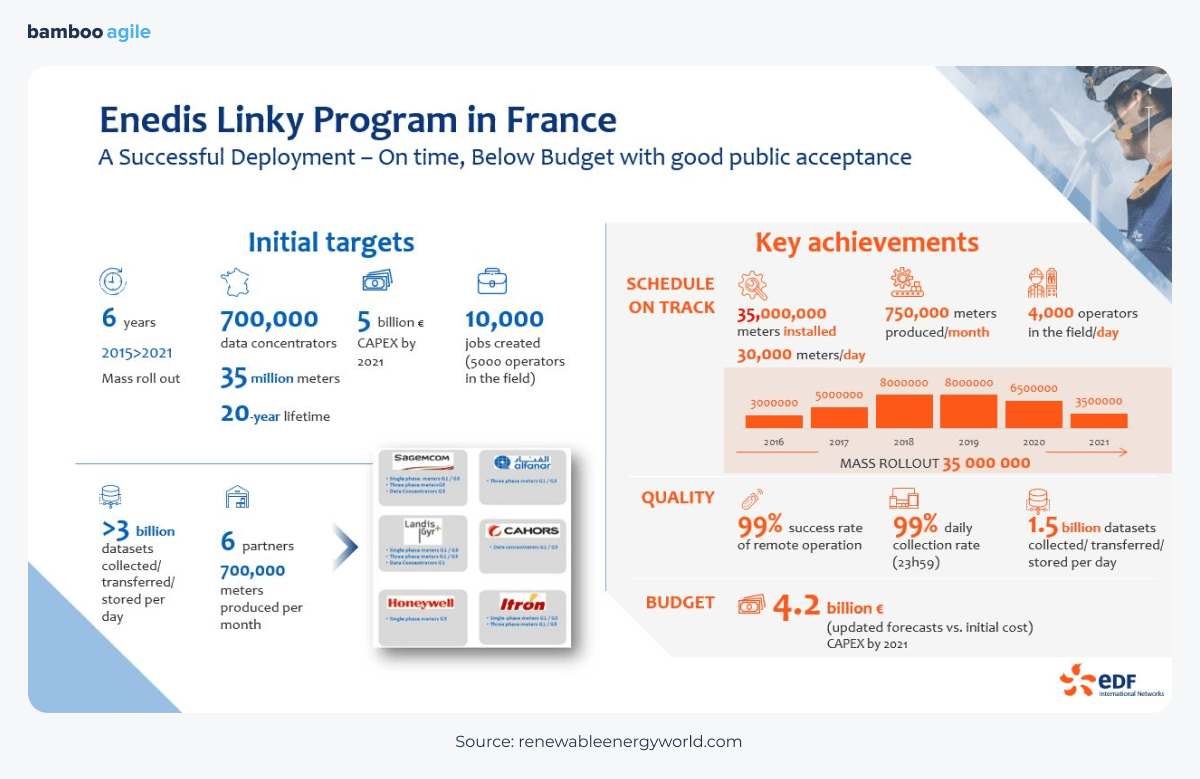
If we look at successful examples of smart meter implementations for IoT in energy management, France’s Linky Smart Meter (AMI 1.5) stands out as one of the most prominent ones. Between 2015 and 2021, Enedis, France’s main Distribution System Operator (DSO), deployed 35.7 million Linky smart meters across the country – and reached a 99% daily data collection rate.
Predictive maintenance
Last but not least in energy IoT comes predictive maintenance. According to a 2025 study in Sensors, IoT-based predictive maintenance is gaining ground in energy-intensive industries. Operators now combine real-time sensor data with analytics to spot equipment degradation earlier.
Overall, global energy giants like ENGIE actively employ predictive maintenance at their plants. The French utility company built two predictive maintenance platforms on Amazon Web Services. The platforms run nearly 10,000 connected equipment units through dozens of machine learning models each. When a model flags a potential issue, the system generates maintenance alerts that allow crews to intervene during scheduled downtime rather than responding to unplanned outages. This approach saves ENGIE an estimated €800,000 annually.
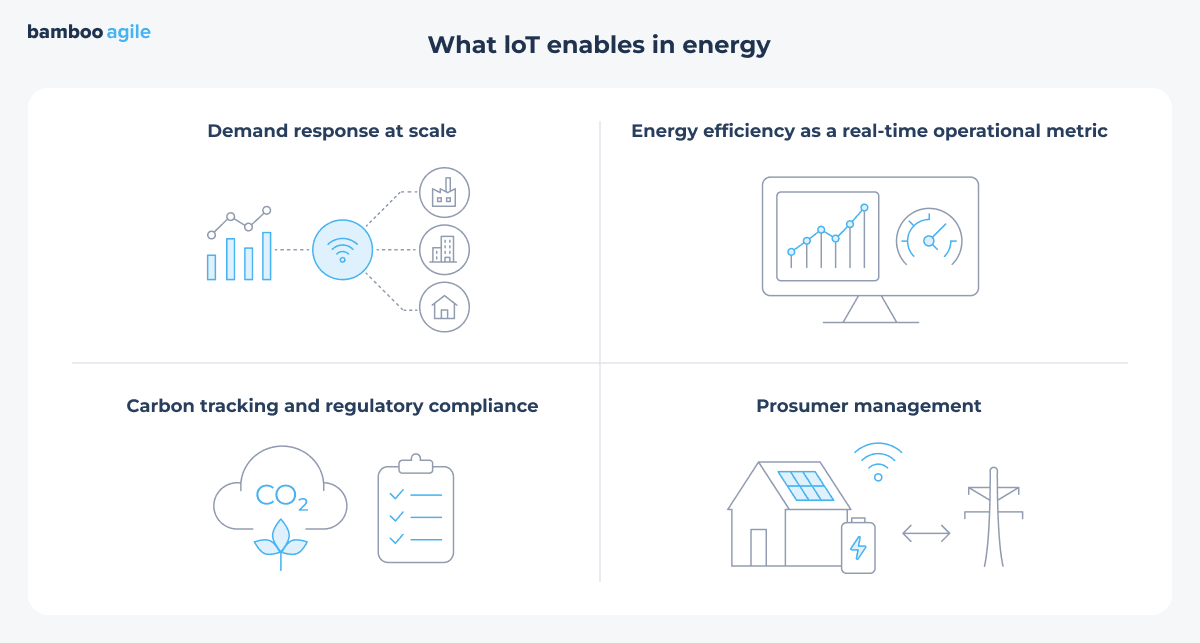
What IoT enables in energy: Outcomes that were not possible before
For many energy companies, the value of IoT lies in replacing delayed information with real-time awareness. Operators see what happens across their network as conditions change and act before small issues turn into costly problems.
Demand response at scale
Demand response once relied on broad forecasts and customer participation programs. IoT in the energy sector adds precision, as it connects utilities with devices that adjust usage when the grid needs support. Smart meters, industrial equipment, connected appliances – all these give operators more options to manage peak demand while maintaining service quality.
Energy efficiency as a real-time operational metric
A similar principle applies to energy efficiency – it becomes more actionable when companies measure it continuously. Connected equipment shows where consumption rises and where assets perform below expectations, as well as where operational changes can reduce waste. Thus, teams address inefficiencies as they appear.
Carbon tracking and regulatory compliance
The very same operational data that optimizes efficiency also supports carbon tracking and regulatory compliance. Accurate carbon reporting starts with trustworthy records. IoT systems collect information directly from energy assets, and they help companies strengthen renewable energy monitoring and understand actual consumption and emissions patterns.
Prosumer management
If we look beyond internal operations, IoT in energy management also changes how utilities relate to customers. It happens as the growth of distributed energy resources modifies the customer’s role in the grid. In such a scenario, households and businesses with solar panels or EV chargers become active participants rather than passive consumers. IoT helps utilities monitor these resources to coordinate energy flows and build services around a more flexible grid.
How operators build IoT energy systems: Decisions and constraints
Every IoT energy system begins with operational realities – technology choices come next. First, operators decide the following:
what data they need
how fast systems must respond
where assets are located
what power sources are available.
Below, we accentuate the factors that you need to keep in mind if you want to build a successful solution for IoT energy efficiency.
Connectivity – the decision that shapes cost and capabilities
Protocol
Best for
Data rate
Battery life
Approximate range
MQTT (cellular/Wi-Fi)
Real-time bidirectional communication, smart meters, and active grid control
High
N/A (mains-powered devices)
Network-dependent
NB-IoT
Low-data static sensors and wide-area metering
Low
Years
Wide
LoRaWAN
Remote assets, battery-powered devices, and infrequent data transmission
Very low
Years
15 km+
OPC-UA
Industrial automation, SCADA, and PLC integration
Medium
N/A
LAN/WAN
BLE
Short-range building environments, HVAC, and occupancy monitoring
Low
Months to years
~100 m
Real-world deployments show why no single connectivity option works everywhere for IoT energy efficiency. Duke Energy uses MQTT-based communication for applications where timely data exchange matters to grid operations. Meanwhile, mining and industrial IoT tracking projects often choose LoRaWAN when devices operate across large areas with limited power access. The right choice depends on latency requirements and asset geography – and available power infrastructure, too.
Data architecture, or why standard databases do not work at IoT energy scale
Traditional databases often struggle with this volume and frequency, so operators usually turn to specialized time-series platforms. These platforms store telemetry efficiently and support real-time analysis. They also keep historical data available for forecasting and asset management.
Moreover, a continuous historical record is the essential foundation for a digital twin, which is a virtual model that uses both past and present data to mirror the asset’s real-world condition.
Integration with existing systems is usually the hardest part
Sensors rarely create value on their own. The difficult work usually lies in connecting energy IoT platforms with SCADA, enterprise software, maintenance tools, and grid management systems. Operators, therefore, need integration strategies that respect older infrastructure while letting new digital capabilities fit into daily operational workflows.
Ready to move from pilot to production?
We deliver Energy IoT applications that perform at scale.
Energy companies treat IoT security as part of operational safety. Since connected assets expand the attack surface, teams need strict access controls and device authentication, as well as network segmentation and continuous monitoring. Security decisions must account for both modern cloud systems and older equipment that may remain in service for decades.
Build vs. integrate, or what operators typically get wrong
As an operator, it is easy to underestimate the effort behind custom development – and overestimate what ready-made platforms can solve. If you opt for off-the-shelf IoT products, they may cover basic monitoring. But IoT in energy management often requires integration work and domain-specific software. The right approach usually combines existing technology with targeted custom components.
Where it leaves you
Across the examples above, one pattern repeats – the companies with the strongest results did not succeed because they installed more sensors. They connected operational data to the systems their teams already used, then built architectures that could support those connections over time.
Integration with existing platforms and security across critical infrastructure remain the hardest parts of the project. Bamboo Agile supports companies with energy software development and helps them build connected systems for traditional utilities and renewable energy IoT initiatives. So, if you are planning an IoT project, let us discuss what the right architecture looks like for your environment.
Darya has over 10 years of experience in the IT sector and specializes in producing clear, research-driven content for technology and business audiences.
At Bamboo Agile, she authored numerous articles covering emerging technologies, digital innovation, and industry-specific solutions, helping readers navigate complex industry developments. Darya collaborated closely with subject-matter experts to ensure accuracy and reliability of her works.
We use cookies to analyze user behavior and improve the website for you. Check our Privacy Policy for more information.
Functional
Always active
The technical storage or access is strictly necessary for the legitimate purpose of enabling the use of a specific service explicitly requested by the subscriber or user, or for the sole purpose of carrying out the transmission of a communication over an electronic communications network.
Preferences
The technical storage or access is necessary for the legitimate purpose of storing preferences that are not requested by the subscriber or user.
Statistics
The technical storage or access that is used exclusively for statistical purposes.The technical storage or access that is used exclusively for anonymous statistical purposes. Without a subpoena, voluntary compliance on the part of your Internet Service Provider, or additional records from a third party, information stored or retrieved for this purpose alone cannot usually be used to identify you.
Marketing
The technical storage or access is required to create user profiles to send advertising, or to track the user on a website or across several websites for similar marketing purposes.