Bamboo Agile | Bespoke software development company
Bamboo Agile is an Estonia-based custom software development company that crafts bespoke solutions for telecom, education, healthcare, finances, other sectors.
A digital wallet stores payment credentials and balances and moves money between them.
Wallets carried 56% of global e-Commerce value and 33% of in-store value in 2025. AI now sits in the fraud, KYC, and support layers as standard.
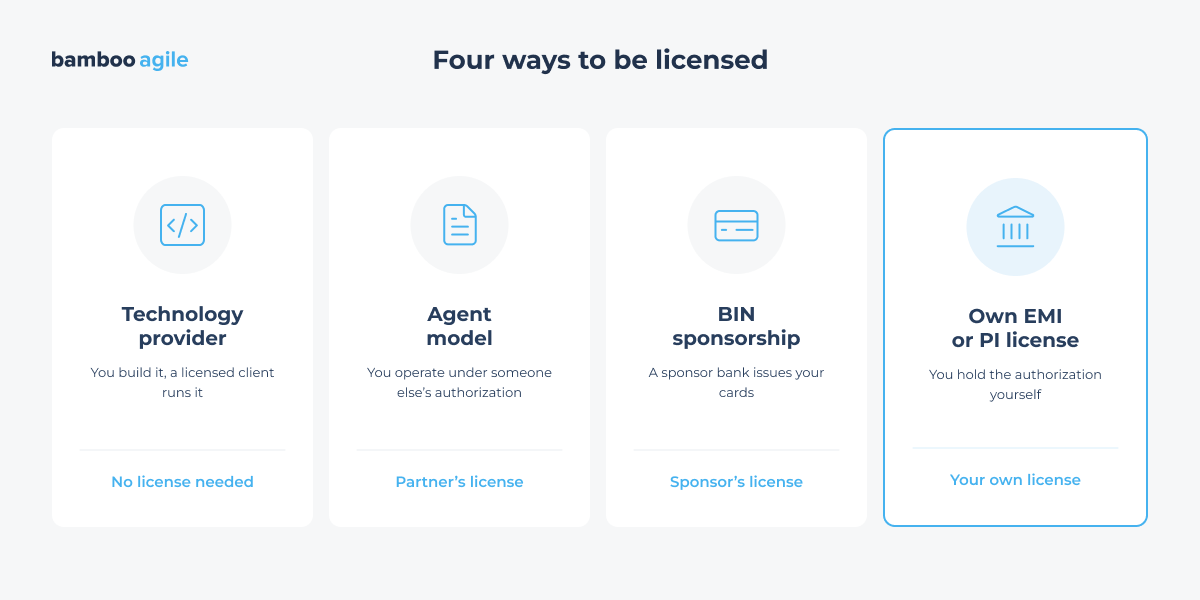
Four licensing routes exist in the EU: your own EMI or PI authorization, acting as an agent, BIN sponsorship, or staying a technology provider. The choice moves the budget by an order of magnitude.
Expect 4–8 months to a compliance-ready MVP, and longer if you hold the license yourself.
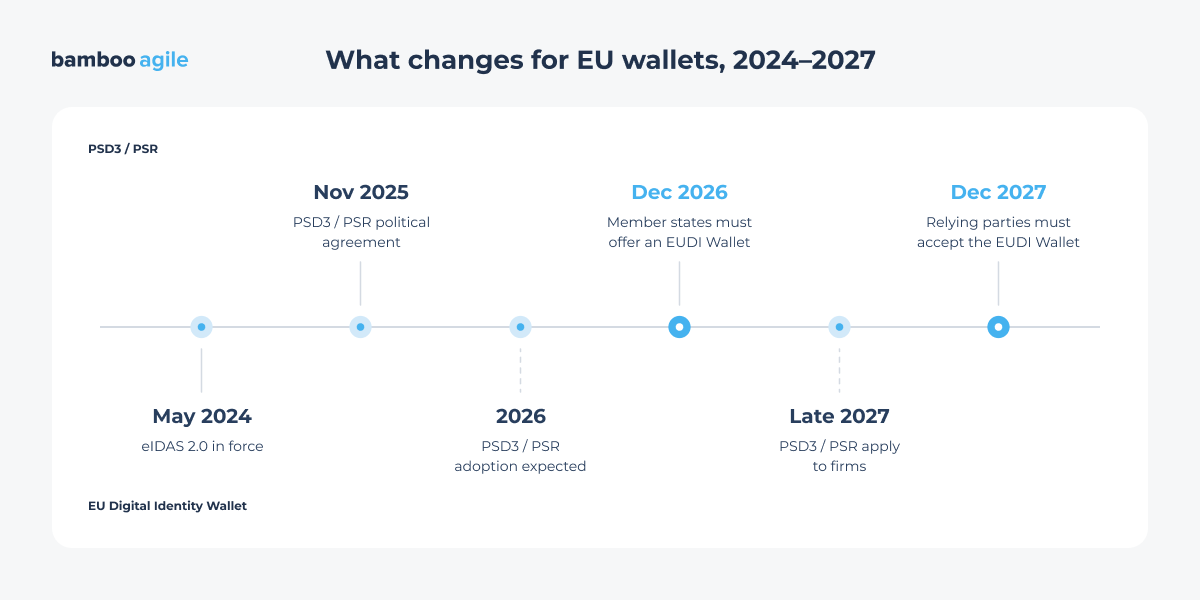
Two deadlines are coming: PSD3 and the PSR replace the e-money regime, and EU member states must offer an EU Digital Identity Wallet by late December 2026.
Introduction
Digital wallets have become increasingly popular in recent years, especially with the growing use of mobile devices and the internet. They offer numerous benefits to both consumers and businesses, including faster transactions, lower costs, improved security, and greater convenience.
In the EU, the regulation around them is changing on a fixed schedule. The e-money license that wallet businesses rely on is being replaced, and “digital wallet” now also describes a government-issued identity wallet that member states must offer by the end of 2026.
This article will answer the questions of:
What is a digital wallet?
Why launch one?
What kinds of wallets are there?
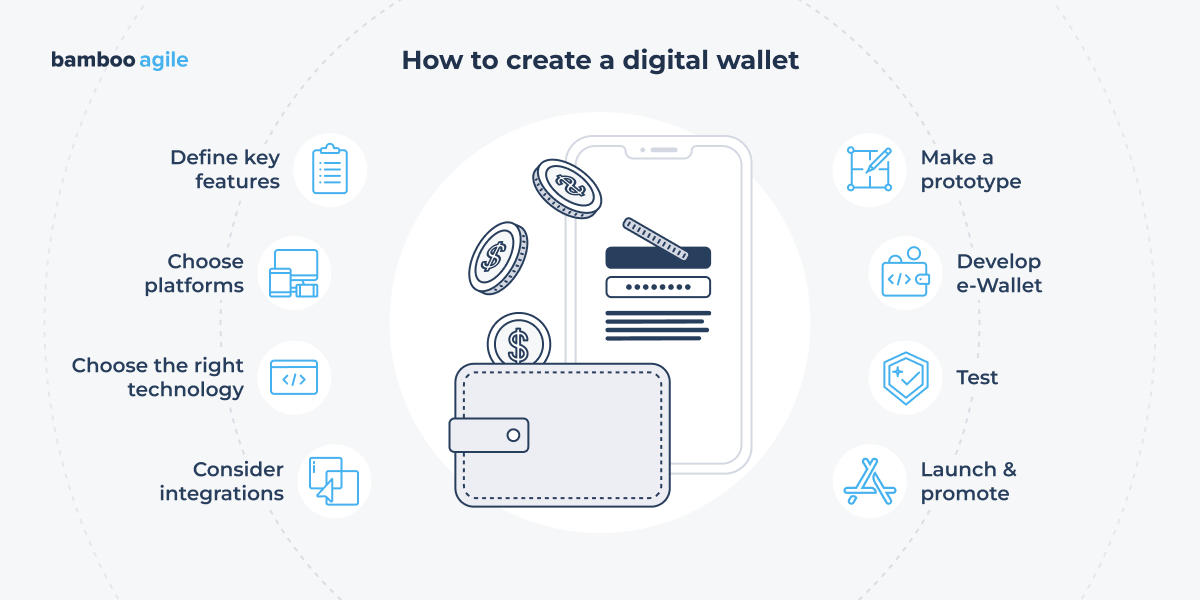
How to create a digital wallet?
What does it cost, and how long does it take?
Do you need a license?
What does AI change, in the product and in the build?
How to ensure it is secure?
..and everything else you need to know about e-Wallets.
Let’s get right into it.
What is a digital wallet?
A digital wallet (a.k.a. an e-Wallet) is a software solution that lets you keep, manage, and transfer money with just your phone, tablet, or computer. It also allows you to manage all kinds of digital assets, including bank accounts, cards, crypto, and so on.
Here is how it works. You submit your payment information and personal data for the wallet to remember. So when you make purchases, you will not need to enter any of it again. All you need to do is select the appropriate payment option and confirm the transaction with a password, fingerprint, or other authentication method. The whole process takes only a couple seconds.
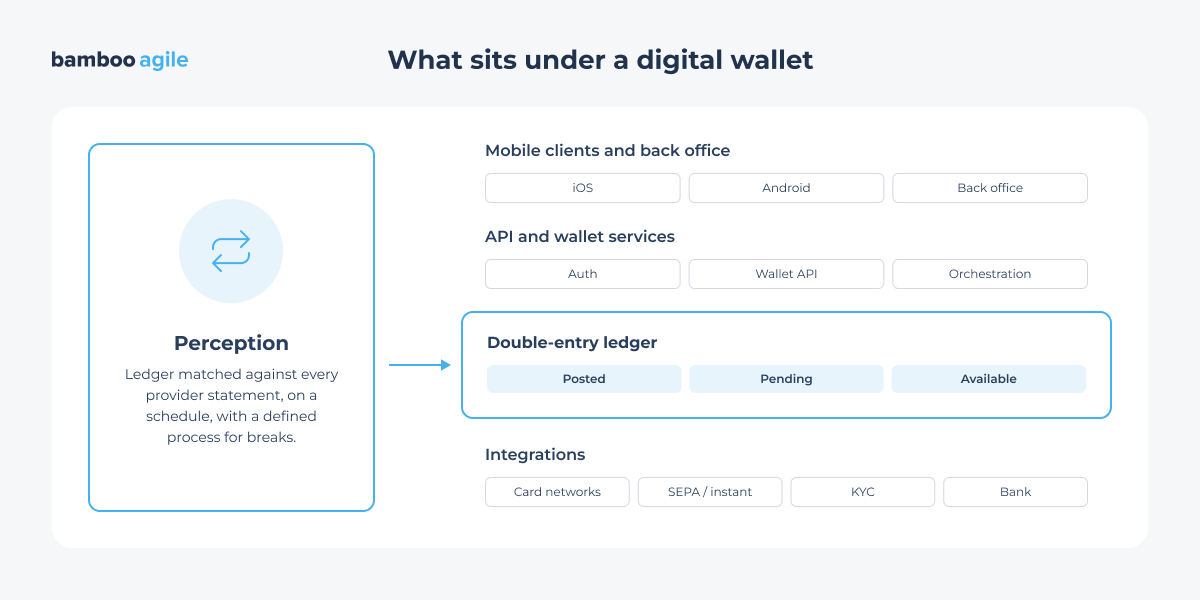
Behind that interaction sit three things: a ledger that records every movement of money, integrations with banks and card networks, and a compliance layer that checks who the user is.
Benefits of launching a digital wallet app
Launching an e-Wallet app can offer several benefits to businesses, including increased customer loyalty, improved data protection, and enhanced user experience.
Digital wallets accounted for 56% of global e-Commerce value and 33% of point-of-sale value in 2025, worth more than $13.8 trillion in combined spending, according to the Global Payments Report 2026. In Western Europe, Germany leads at 52% of online value.
This highlights a further shift in user behavior toward digital-first payment methods. As wallet adoption expands every year, launching a custom digital wallet allows businesses to capture emerging transaction volume while delivering specific security, loyalty, and efficiency advantages. We will look at these below.
Improved security
Software-based wallets provide an additional layer of security by encrypting payment information and using tokenization to mask sensitive data. This reduces the risk of fraud and data breaches, making digital wallet transactions safer than traditional payment methods.
For instance, Apple Pay requires users to authenticate transactions with Touch ID or Face ID, and their payment information is safely stored in the iPhone’s Secure Element.
Customer loyalty
The software can help businesses build stronger relationships with their customers by providing convenient and seamless payment experiences. This leads to increased customer satisfaction and repeat purchases.
A notable case is Starbucks, whose mobile wallet app has been hugely successful in building customer loyalty. The app allowed users to easily pay for their coffee and earn rewards points, as well as make orders in advance and skip the queue.
Greater convenience
Wallet apps allow users to keep all their payment information in one place, making it easier and faster to complete transactions. They also eliminate the need to carry physical payment cards or cash.
As an illustration, PayPal offers users the ability to make purchases online, send and receive money, and even pay at participating merchants using QR codes.
Reduced transaction costs
Digital wallets can help businesses reduce the costs associated with processing payments, such as transaction fees and chargebacks.
Consider Cash App, which allows users to send and receive money for free while charging businesses a lower transaction fee than traditional payment processors.
Enhanced user experience
Wallet solutions offer a more seamless and intuitive experience than traditional payment methods, improving customer retention and reducing cart abandonment rates.
Take Google Pay as a prime example: it provides users with a simple and intuitive payment experience, letting them make purchases as well as send and request money using their mobile devices.
Types of digital wallets and their pros and cons
Wallets come in several types, and they differ in more than the device they run on. The device shapes the experience. The business model behind the wallet decides its license, its integrations, and its budget.
By business model
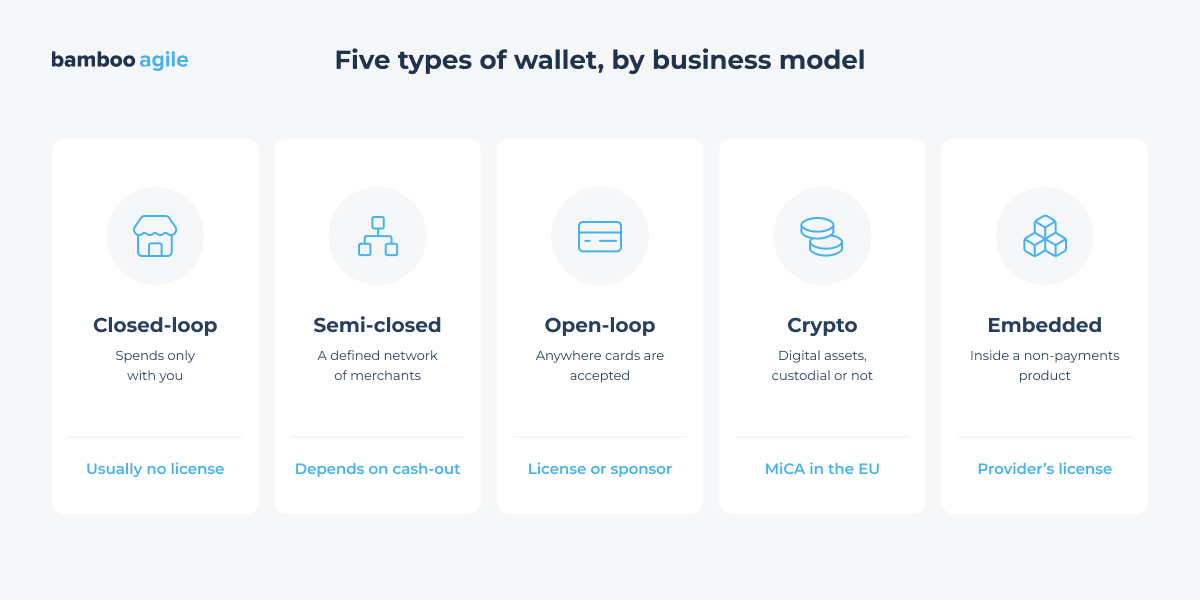
A closed-loop wallet and an open-loop wallet can look identical on a phone and still differ by a year of work and a regulatory authorization. The table below sets out the five business models and what each one implies for the build.
Type
What it does
What it means for the build
Closed-loop
Spends only with you. Store credit, transit, campus, gaming balances.
The simplest route. Usually no payment license needed, though you are holding customer funds, so you still need a real ledger and clear terms.
Semi-closed
Spends across a defined network of partner merchants.
Partner onboarding, settlement between merchants, revenue share logic. License exposure depends on whether users can cash out.
Open-loop
Spends anywhere cards are accepted, usually through an issued card.
The heaviest route. Card scheme certification, BIN sponsorship or your own license, PCI DSS scope, full KYC and AML.
Crypto
Holds and moves digital assets. Custodial or non-custodial.
Key management, chain integrations, and MiCA obligations if you serve EU users.
Embedded
Wallet features inside a product that is not primarily a payments app: a marketplace, a payroll tool, a SaaS platform.
Fastest to market through a provider. You own the user experience; the provider owns the license and often the ledger.
By device
Mobile wallets
Mobile wallets are applications that can be downloaded onto a smartphone or tablet. Well-known examples of mobile e-Wallets include Apple Pay and Google Pay. These offer convenience, accessibility, and ease of use, but they also come with some potential drawbacks.
Pros:
Convenience. Mobile wallets are designed to be used on the go, making them incredibly convenient. Users can pay for goods and services with just a few taps on their smartphone, eliminating the need to carry cash or credit cards.
Accessibility. Mobile wallets are available to anyone with a smartphone or tablet, making them accessible to a wide range of consumers. They are particularly popular among younger generations who prefer to manage their finances digitally.
Ease of use. Mobile wallets are typically very user-friendly, with intuitive interfaces and straightforward payment processes. This makes them easy for consumers to use, even if they have limited experience with digital finance.
Cons:
Safety risks. Mobile wallets are susceptible to a range of security risks, including hacking, phishing, and malware. If a user’s phone is lost or stolen, their wallet could be compromised, putting their personal data at risk.
Compatibility issues. Mobile wallets may not be compatible with all merchants or payment systems, which can limit their usefulness in certain situations. Additionally, some mobile wallets require a specific type of phone or operating system. This can exclude users who do not meet these requirements.
Limited functionality. Mobile wallets may not offer the same level of functionality as other types of wallets. This is particularly noticeable when it comes to cryptocurrencies.
Desktop wallets
Desktop wallets are installed on a user’s computer. Electrum and Exodus are popular examples of ones that work with cryptocurrency. This type of wallet boasts superior security and functionality, but may also be less convenient than mobile wallets.
Pros:
Security. Desktop wallets are generally considered more secure than mobile wallets, as they are not as susceptible to hacking or malware. They also offer users greater control over their private keys, which can be used to safeguard their digital assets.
Functionality. Desktop wallets often offer more advanced functionality than mobile wallets, especially when working with crypto. They may offer features such as multi-sig support, coin mixing, and cold storage.
Customizability. Desktop wallets can be customized to suit a user’s specific needs and preferences, allowing them to choose the functionality and settings that suit them best.
Cons:
Limited accessibility. Desktop wallets can only be accessed from a single computer, making them less available than mobile wallets. This can be inconvenient for users who need to manage their finances from multiple devices.
Complexity. Desktop wallets can be more complex and difficult to use than mobile wallets, especially for users who are not familiar with digital finance. They may require some technical knowledge to set up and use effectively.
Vulnerability to hardware failures. Desktop wallets are vulnerable to hardware failures, which can result in the loss of private user keys and digital assets.
Hardware wallets
Hardware wallets are physical devices that keep private keys and digital assets offline, offering the highest level of protection among digital wallets. However, they may also be less convenient and more expensive than other types of e-Wallets. The most popular hardware wallet brands today are Ledger and Trezor, which offer crypto wallet functionality.
Pros:
Data protection. Hardware wallets keep all the assets and user data offline, away from potential hacking or malware attacks. They are also resistant to physical damage, such as water and fire.
Control. Hardware wallets give users complete control over their information and digital assets with minimal third-party involvement.
Compatibility. Hardware wallets are compatible with a wide range of cryptocurrencies, making them a versatile option for users who hold multiple digital assets.
Cons:
Cost. Hardware wallets can be more expensive than other types of wallets, with prices ranging from around $50 to $200 or more.
Inconvenience. Hardware wallets are less convenient than desktop or mobile wallets, as they require a physical device to access funds. Users must also ensure that their device is kept in a safe place and is not lost or stolen.
Limited functionality. Hardware wallets may not offer the same level of functionality as other types of digital wallets. They may require additional software or tools to access certain features.
Build, buy, or something in between
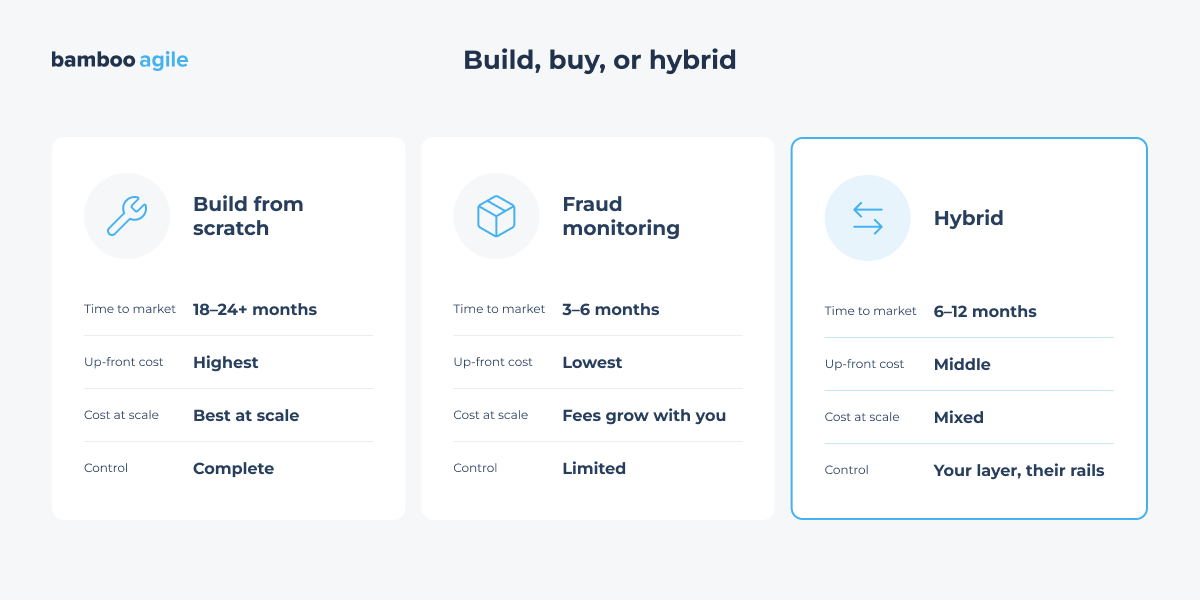
Three routes are open to you: writing the wallet from scratch, licensing a white-label platform, or combining the two. The choice is mostly about where the money goes. A build costs engineering time up front and little afterward, while a platform costs little up front and a slice of every transaction for as long as you run it. The table below compares the three on time, cost, control, and the kind of company each one suits.
Criteria
Build from scratch
White-label platform
Hybrid
Time to market
18–24+ months
3–6 months
6–12 months
Control
Complete
Whatever the vendor exposes
Your product layer, their rails
Up-front cost
Highest
Lowest
Middle
Cost at scale
Best economics once volume arrives
Per-transaction fees that grow with you
Mixed
Differentiation
Anything you can design
Limited; you resemble other customers
Good where it matters, standard elsewhere
Suits
Payments is your core business
A wallet supporting a business that is not payments
Most companies, most of the time
Buy the parts that are regulated and commoditized – KYC, card issuing, often the ledger – and build the parts your users touch. A full custom build earns its cost when payment flow is the business itself, when no provider covers your markets, or when per-transaction fees at your projected volume outgrow the cost of building.
There is also a case for not building. If you are adding a wallet to an existing product and cannot name a payment behavior your users want that a provider already offers, an integration will serve you better.
How to create a digital wallet: a step-by-step guide
Now let’s talk about how e-Wallet software is made. Financial app development can seem like a daunting task, but by following these steps, you can ensure a successful launch of your e-Wallet app.
Step 0. Decide what success looks like
Write down three things: the one job the wallet does for your users, the constraint you cannot move (a launch date, a budget ceiling, a license you already hold), and the number that tells you it worked – funded accounts, transaction volume, share of checkout. Every later decision, the license route included, gets easier once these are on paper.
Without a success metric you cannot size the ledger or the support team, so both end up sized by accident.
Define key features
Before you start creating your wallet software, you need to define the key features you want to include. Some of the essentials are:
Secure user authentication
Account funding and withdrawal
Balance and transaction history
Easy-to-use interface for sending and receiving payments
Identity verification (KYC) built into onboarding
Multi-language support and multi-currency support
Backup and restore options
24/7 customer support
An admin back office
Here, research is essential. Hold surveys, interviews, and simply scout the internet for objective data to determine the state of the market and the demands of potential customers. Define the key features accordingly – you will ensure that your solution meets the core needs of its target audience.
Choose platforms
Choosing the right platform is essential for the success of your wallet solution.
You need to decide whether you want to develop your app for iOS, Android, or both if you are doing mobile; Windows, MacOS, or Linux, if you are doing desktop. You can also consider developing a web-based app that can be accessed from any device with an internet connection.
In any case, always consider the target audience and the platform they are most likely to use. For example, if you are targeting tech-savvy millennials, developing for iOS and Android might be the best option.
You will ship updates on the app stores’ schedule, so keep anything that may need an emergency change – limits, fees, feature flags – on the server side.
Choose the right technology and framework
Choosing the right technology and framework is crucial for the development of your wallet app. Some popular technologies and frameworks for developing such applications include React Native, Swift, Java, and Kotlin.
Of course, you should always consider the scalability of your app and whether the chosen technology can handle a large number of users and transactions.
Your database choice matters more than your framework choice. A wallet’s ledger needs transactional guarantees, which rules out some otherwise fine options.
Consider integrations
Integrations with other platforms and services can add a lot of value to your digital wallet app. For example, you can integrate with payment gateways and acquirers (Stripe, Adyen, PayPal), bank rails (SEPA, SEPA Instant, local instant payment schemes), card networks, open banking providers, KYC and sanctions-screening vendors, cryptocurrency exchanges (Binance, Kraken, Coinbase), and merchant services to provide more functionality to your users: crypto trading, stock trading, gift cards, and more.
Integrations are where timelines slip. Every provider runs its own certification process, and two of them will take longer than your development estimate.
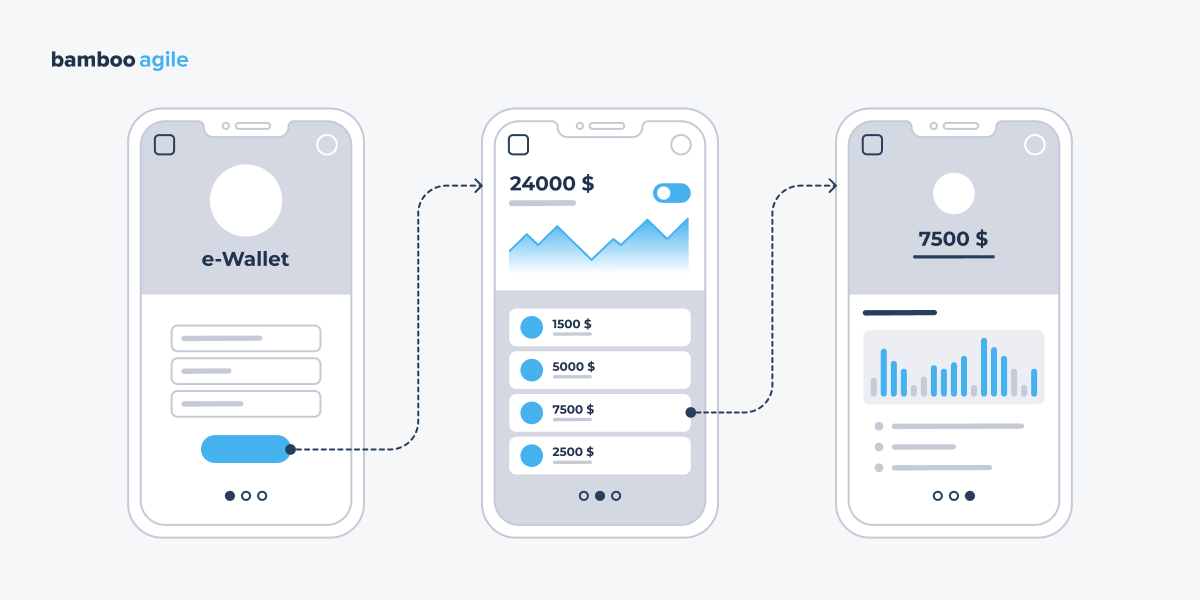
Design your e-Wallet and make a prototype
Designing your e-Wallet is a crucial step in the development process. You need to ensure that the user interface is easy to use and navigate even for non tech-savvy customers. Ideally, individual payments and transfers should not take more than a couple of seconds.
You can create a prototype of your app and see how the UI fares in action, as well as gather feedback from a focus group. Then your design and dev teams can implement changes based on the very first customer impressions before diving into full-on wallet app development.
Design the failure states as carefully as the happy path: declined payments, pending transfers, partial refunds. Users judge a wallet by how it behaves when something goes wrong.
Develop your e-Wallet
Once you have designed your e-Wallet and created a prototype, it is time to kick off development. Consider making an MVP – a minimum viable product. MVP development is the practice of quickly building a product with a minimal feature set, which can be expanded after release. It is a great tactic for reducing time to market and securing your initial user base.
Whether you are working on the software in-house or outsourcing development to an offshore team, you must maintain constant communication with the devs. Hold regular, preferably daily meetings with the team. Provide feedback and ideas, as well as updates and documentation. The team will provide valuable input and ideas in return, which will ultimately result in a stronger, more thought-out product.
An MVP can be minimal in features while still being exact about money.
Test
Testing your e-Wallet is essential to ensure that it is working correctly and meeting the needs of your users. Perform both functional and non-functional testing and ensure that the app is well protected and free of bugs.
Add reconciliation tests that deliberately break things: duplicate requests, timeouts mid-transfer, a provider returning success after you have already timed out. These scenarios produce the balance errors you find in production, and ordinary functional testing misses them.
Budget for a penetration test and, if you are in card scope, a PCI DSS assessment. Both have lead times measured in weeks.
Launch and promote your e-Wallet
The final step in creating a digital wallet is to launch and promote the app. To that end, you need to submit it to the relevant app marketplaces, such as the App Store and Google Play. While Google Play has very few publishing guidelines, Apple is much more strict. So ensure that your app meets all the necessary requirements before submission.
Once your wallet is launched, it’s high time to promote it to your target audience. You can do this through various marketing channels, such as social media, email marketing, content creators, and paid advertising.
Remember that you are not done once the app is all set and running. You have to continue to monitor and update the software to ensure that it meets the needs of your users and stays ahead of the competition long-term.
Launch is where the operational work starts, and it does not stop.
Compliance and licensing: what you actually need
The standards that shape the build
Compliance and licensing cover two different questions. The standards decide how you build and operate the wallet, while the license decides whether you are allowed to hold customer money at all. The standards reach further into the build, covering how you store card data, what you collect at sign-up, and how long you keep it. The table below lists the ones that come up most often, when each applies, and what it changes in practice.
Standard
Applies when
What it changes
PCI DSS v4.0.1
You touch card data in any form
Network segmentation, key management, annual assessment. Tokenizing early keeps your scope small
PSD2, and PSD3/PSR from late 2027
You provide payment services in the EU
Strong customer authentication, open banking APIs, fraud liability
GDPR
You hold personal data of EU residents
Data minimization, retention limits, and the right to erasure set against an immutable ledger
AMLD and local AML rules
You hold or move customer funds
KYC at onboarding, sanctions and PEP screening, ongoing transaction monitoring, suspicious activity reporting
MiCA
You offer crypto services to EU users
Authorization as a crypto-asset service provider, custody and disclosure obligations
DORA
You are a regulated EU financial entity
ICT risk management, incident reporting, resilience testing, oversight of your critical providers
EMVCo tokenization and 3-D Secure
You accept cards
Token service provider integration, authentication flows at checkout
ISO 27001 and SOC 2
Optional, though enterprise clients ask
Documented controls and an audit cycle. Easier to build in
Four ways to be licensed
The licensing route moves your budget and your timeline more than any technical choice. The table below sets out the four routes, what each one involves, and the trade-off that comes with it.
Route
What it means
Trade-off
Technology provider
You build the software; a licensed client operates the wallet
Fastest and cheapest. You never hold funds, and you never own the customer relationship
Agent or distributor
You operate under someone else’s authorization
Months to market instead of years. Your principal sets the rules and can change them
BIN sponsorship
A sponsor bank issues your cards; you run the product
Card issuing without a license of your own. Sponsor dependency, revenue share, and their risk appetite becomes yours
Your own EMI or PI authorization
You hold the license
Full control and the best economics at scale. Capital requirements, a long application, ongoing reporting, and re-authorization ahead under PSD3
Authorization takes longer than most teams expect, and much of the work lands on engineers: safeguarding arrangements, regulatory reporting, audit trails. If your launch date is fixed, start on an agent or sponsorship route and apply for your own license in parallel.
None of this is legal advice. Confirm your position with regulatory counsel in the markets you are entering.
What changes for EU wallets in 2026–2027
If you are building for European users, two regulatory changes land inside your project’s lifetime. Both are cheaper to design for now than to retrofit in 2027.
The e-money license is being replaced
Most wallet businesses in the EU operate as electronic money institutions. Under PSD3 and the accompanying Payment Services Regulation, the separate e-money regime disappears: e-money institutions become a sub-category of payment institutions and will need re-authorization under the new rules.
A provisional political agreement was reached in November 2025, the final compromise texts went to national representatives in April 2026, formal adoption is expected during 2026, and application for firms is expected by late 2027.
Several changes in the package reach into the product itself, which puts them on an engineering backlog as well as a compliance one.
Payee name and IBAN matching, with a warning to the user when the two disagree.
Authorized push payment fraud treated as an unauthorized transfer, meaning full reimbursement of the payer. This is a liability change as much as a compliance one.
Risk- and behavior-based transaction monitoring, and arrangements for sharing fraud information.
Stricter API performance and uptime requirements for open banking interfaces.
Written agreements with technical service providers that supply strong customer authentication.
“Digital wallet” now also means an identity wallet
Under Regulation (EU) 2024/1183, in force since 20 May 2024, every EU member state must make at least one EU Digital Identity Wallet available to its citizens. That deadline falls in late December 2026. Relying parties legally required to use strong user authentication must accept it by late December 2027, and very large online platforms must recognize it on request.
For a consumer wallet this is an onboarding decision with a date attached. If EUDI acceptance becomes mandatory for your service, the identity layer you choose now determines how much you rebuild in 2027. It also opens something useful: verified attributes delivered from a government wallet can cut a KYC flow from minutes to seconds.
The dates, in one place
Two regulatory tracks run in parallel, which is what makes them easy to miss. The table below puts both sets of dates in one place, with what each one means for a build already under way.
When
What
What it means for your build
20 May 2024
eIDAS 2.0 (Regulation (EU) 2024/1183) in force
The EUDI framework is law; implementing acts follow
November 2025
Provisional political agreement on PSD3 and the PSR
The direction is settled; the detail is not
During 2026
PSD3 and PSR expected to be formally adopted
Confirm your licensing route against the final text
Late December 2026
Member states must offer an EU Digital Identity Wallet
Decide whether your onboarding will accept it
Late 2027
PSD3 and PSR expected to apply to firms
Re-authorization work; APP fraud liability live
Late December 2027
Relying parties must accept the EUDI Wallet
Integration deadline, where it applies to you
The PSD3 and PSR dates are expected as default, and the EBA’s technical standards are still to come.
The ledger
Under every wallet sits a record of what each user owns and what has moved where. That record is the ledger. Users never see it, and they notice immediately when it is wrong.
Use double-entry
The tempting shortcut is a balance field on the user record that you add to and subtract from. It works until two requests arrive at once, a provider times out, or someone asks why a number changed, and then it fails in ways you cannot reconstruct.
Double-entry records every movement twice, as a debit on one account and a credit on another, with the two always summing to zero. The balance is then derived from the entries. It costs more work up front and it lets you answer the question “why is this number what it is.”
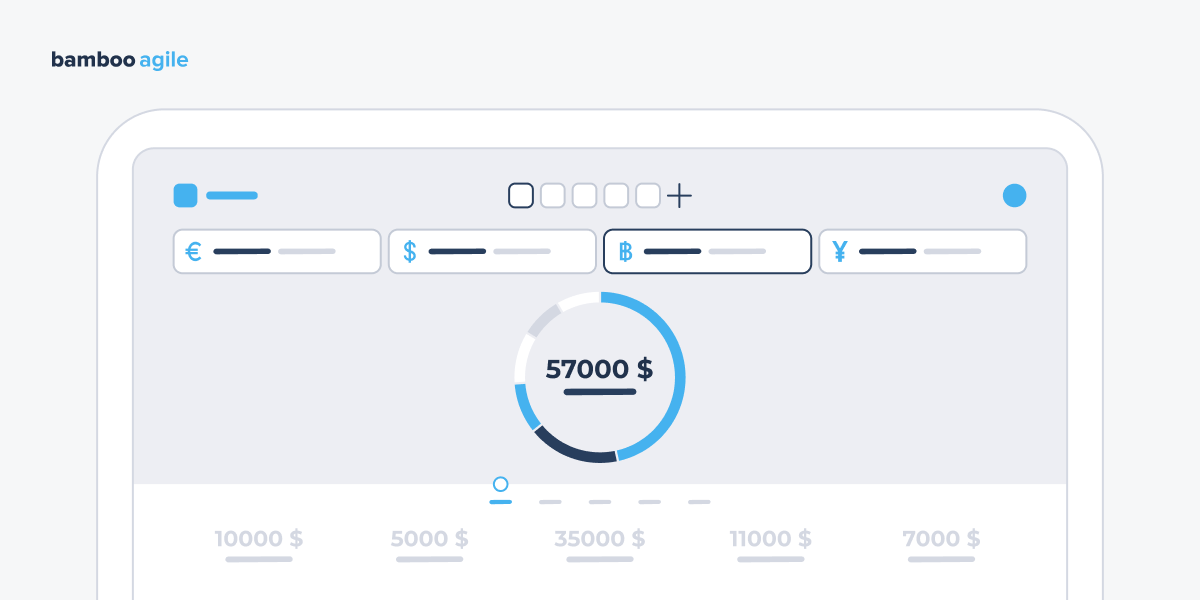
A wallet needs more than one balance
Showing the wrong balance is a common and expensive bug. A user who sees an available balance that still includes a provider’s settlement hold will spend money that is not there, and you cover the difference. Three balances cover most of what a wallet needs.
Posted – money that has settled.
Pending – authorized but not yet settled.
Available – what the user can spend right now, which is posted minus holds.
Three things to design in from the start
Three design decisions are cheap to make at the beginning and painful to add once you hold real balances.
Idempotency. Every money-moving request carries a unique key, so a retried request cannot post twice. Retries will happen; mobile networks guarantee it.
Immutability. Corrections are made by posting a reversing entry, never by editing or deleting an existing one. Regulators and auditors will ask, and so will your support team.
Reconciliation. Match your ledger against every provider’s statement on a schedule, automatically, with a defined process for breaks.
Alexey Shinkarev, Engineering Manager at Bamboo Agile
“Teams usually arrive with the screens designed and the ledger undecided. We do it the other way round: chart of accounts and reconciliation first, then the interface. It is far cheaper than finding a balance discrepancy after launch”
You can also buy this layer. Ledger-as-a-service providers handle double-entry, balance types, and reconciliation primitives, which shortens the build and adds a dependency you cannot easily remove later.
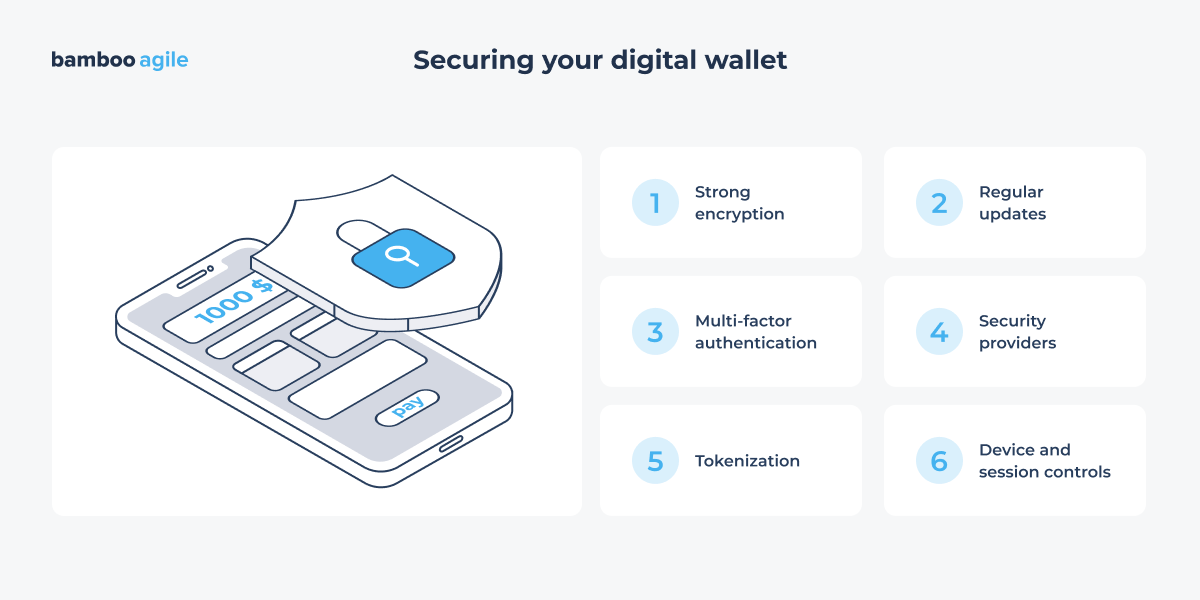
Securing your digital wallet
Since fintech applications deal with sensitive financial information, it is crucial for developers to prioritize data protection. Here is how to make a digital wallet that is hard to attack:
1. Strong encryption
One of the most critical security measures for financial apps is strong encryption. Encryption protects sensitive information by converting it into a code that can only be read by someone with the correct decryption key. To protect user data, developers employ strong encryption protocols such as AES-256 or RSA. Keys belong in a managed key store or an HSM, never in application code or configuration files.
2. Multi-factor authentication
To add an extra layer of protection, developers can implement multi-factor authentication (MFA) in the app. MFA requires users to provide two or more forms of identification, such as a password and a fingerprint scan, to access their account. This helps prevent unauthorized access to the user’s account even if their password is compromised. In the EU, strong customer authentication is a legal requirement under PSD2, and PSD3 keeps it.
3. Tokenization
Replace card numbers with tokens as early in the flow as you can. Done properly, your systems never store a real card number, which shrinks your PCI DSS scope and limits what an attacker can take.
4. Regular updates
You should regularly update and patch the e-Wallet solution to address any potential vulnerabilities. Do not forget to conduct regular security audits and testing to identify potential loopholes. Budget for an annual penetration test, and for DORA-style resilience testing if you are a regulated entity in the EU.
5. Partnering with reputable security providers
If you want to enhance the app’s protection even further, you can partner with trusted security providers (e.g. Bluefin, Forter, Onfido). These provide fraud detection, network security, and identity verification services.
6. Device and session controls
Attackers target the phone as readily as the server. Three controls cover most of what they try: device binding, so an account is tied to a known device; certificate pinning, so traffic cannot be intercepted; and root or jailbreak detection, with a defined policy for what the app does when it finds one.
Want to learn more about digital wallet security? Read this article.
What AI changes, and what it does not
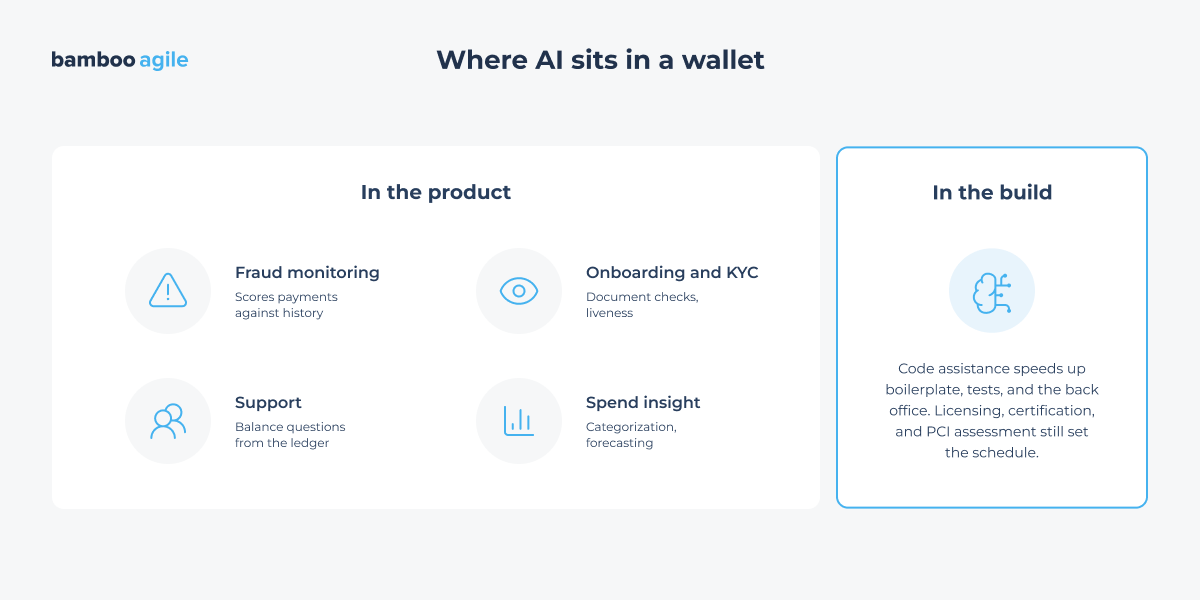
AI has changed wallet projects in two separate places, and the two often get confused. Inside the product, it decides which transactions get stopped and how fast someone gets onboarded. Inside the project, it changes how quickly certain code gets written. The first is now close to table stakes. The second moves your timeline less than vendors suggest.
In the product
Four uses are standard in wallets shipping today, and the first of them is now a regulatory expectation as much as a product one.
Fraud and transaction monitoring. Behavior-based models score transactions in real time against a user’s own history. Under PSD3 and the PSR, risk- and behavior-based monitoring moves from good practice to a requirement, which makes this the one AI component you cannot defer.
Onboarding and KYC. Document checks, liveness detection, and anomaly scoring compress a verification that used to take minutes. The constraint is regulatory: you still need an auditable decision and a human review path for the cases the model declines.
Support. First-line handling of the questions that dominate wallet support, most of them some version of “where is my money.” A model answering from the ledger resolves these faster than a human reading three screens.
Spend insight. Categorization, forecasting, and nudges. Useful for retention, and the least regulated of the four, so it is usually the one to build last.
A caution that applies to all four: a model that declines a payment or an application is making a decision a regulator may ask you to explain. Keep the inputs, the score, and the outcome, and keep a route for a person to overturn it.
In the build
Code assistance does shorten parts of a wallet build, and the parts it shortens are not the parts that set the schedule. Boilerplate goes faster: admin back office screens, CRUD, integration scaffolding, test coverage, documentation. Ledger logic, reconciliation, and settlement edge cases go no faster, because the review they need is the same whoever wrote them.
The schedule is set elsewhere. Licensing, provider certification, PCI assessment, and scheme approval take the same number of weeks they always did, and in most wallet projects they are the critical path. That is why an AI-accelerated wallet build arrives earlier by weeks.
Two practical consequences. If a vendor quotes a dramatically shorter timeline on the strength of AI tooling, ask which regulatory step they have removed. And if AI-assisted code goes into a system under DORA, your ICT risk documentation needs to say how it is reviewed, by whom, and against what.
What it costs to build a wallet
Published figures for a wallet build run from around $40,000 for a thin MVP to well past $200,000 for a licensed, multi-rail product. The table below shows the seven variables that account for most of that range, starting with the one that moves the number furthest.
Driver
Low end
High end
Licensing route
Technology provider or agent, with no authorization work
Your own EMI or PI license: capital, application, safeguarding, reporting
Payment rails
One funding method, one currency
Cards plus SEPA plus instant payments plus local schemes, multi-currency
Ledger
A provider’s ledger-as-a-service
Custom double-entry ledger with reconciliation tooling
KYC and markets
One jurisdiction, one vendor
Several jurisdictions, vendor waterfall, ongoing monitoring
Card issuing
None
BIN sponsorship, scheme certification, card lifecycle management
Compliance scope
Out of PCI scope through tokenization
In scope, with assessment and segmentation work
Platforms
One cross-platform app
Native iOS and Android, plus web and an admin back office
Assuming a team that has built a wallet before, the rough durations run as follows.
Closed-loop or embedded wallet on a provider’s rails: 3–5 months.
Compliance-ready MVP with KYC and one funding rail: 4–8 months.
Open-loop wallet with card issuing under sponsorship: 8–14 months.
Wallet on your own license, built from scratch: 18–24 months and up, most of it outside engineering.
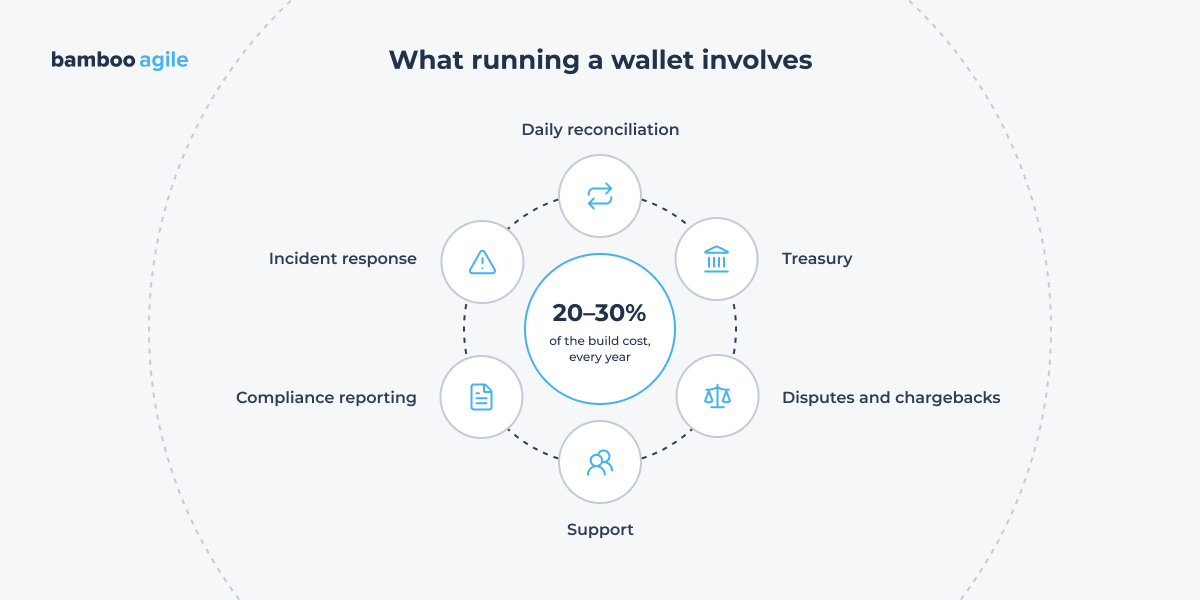
One cost most plans omit is running the wallet once it is live. Budget separately for reconciliation and treasury operations, dispute and chargeback handling, support staffing, compliance reporting, vendor fees, and the annual audit and penetration test.
Who you need on the team
A compliance-ready wallet MVP is usually built by eight to twelve people, with the weight on the backend, because the ledger and the integrations are where the difficulty lives. The table below gives a rough split of the roles and what each one is there to do.
Role
How many
Why they are there
Product manager
1
Owns scope, which argues with compliance constantly
Backend engineers
3–4
Ledger, payment orchestration, integrations. Your most senior people belong here
Mobile engineers
2
One per platform, or one strong cross-platform developer
Frontend engineer
1
The admin back office, which is a product in its own right
QA engineer
1–2
Including someone who tests failure paths
DevOps / SRE
1
Environments, secrets, monitoring, audit logging
UX designer
1
Onboarding and failure states carry most of the value
Compliance lead
1, often fractional
KYC policy, reporting, the regulator relationship. Too much for an engineer’s spare hours
Two patterns worth knowing. Teams routinely under-resource compliance and the back office, then spend a year of engineering capacity on manual support work. And the team changes shape after launch instead of shrinking: fewer feature engineers, more operations, and at least one person whose actual job is reconciliation.
Turn your digital wallet idea into a working product with support from Bamboo Agile.
A wallet does not stop needing attention once it ships. The work it generates is steady, mostly daily, and almost never included in a development estimate. The first year involves the following.
Daily reconciliation. Match your ledger against every provider’s statement, automatically, with a defined process for investigating breaks. Someone owns this each morning.
Treasury. Keep enough float in the right accounts and currencies to settle what users expect, without stranding capital you need elsewhere.
Disputes and chargebacks. Evidence gathering, deadlines set by the schemes, and reporting. Under PSD3, authorized push payment fraud becomes reimbursable, which raises the stakes.
Support. Wallet support volume tracks transaction volume more closely than user count. Most tickets ask where someone’s money went, and a good back office answers that in one screen.
Compliance reporting. Regular submissions, sanctions list updates, suspicious activity reports, and an annual audit cycle.
Incident response. A payments outage needs a runbook, a communications plan, and, where DORA applies, regulatory reporting inside defined windows.
A reasonable planning assumption is that ongoing operations cost 20–30% of the original build each year, before transaction fees.
Replacing a wallet you already have
Plenty of wallet projects start with a system already in production. The balances are the hard part, because they belong to real people and must not change by a cent.
That work means reconciling the old system to a known-good state, running both ledgers in parallel long enough to prove they agree, migrating users in cohorts, keeping a rollback path that avoids restoring a database over live balances, and preserving transaction history, which users and regulators both ask for.
Plan for a quiet period with both systems live. Parallel running under real traffic is the only way to prove the new ledger matches the old one.
Case study: the e-Wallet we built for a national telecom operator
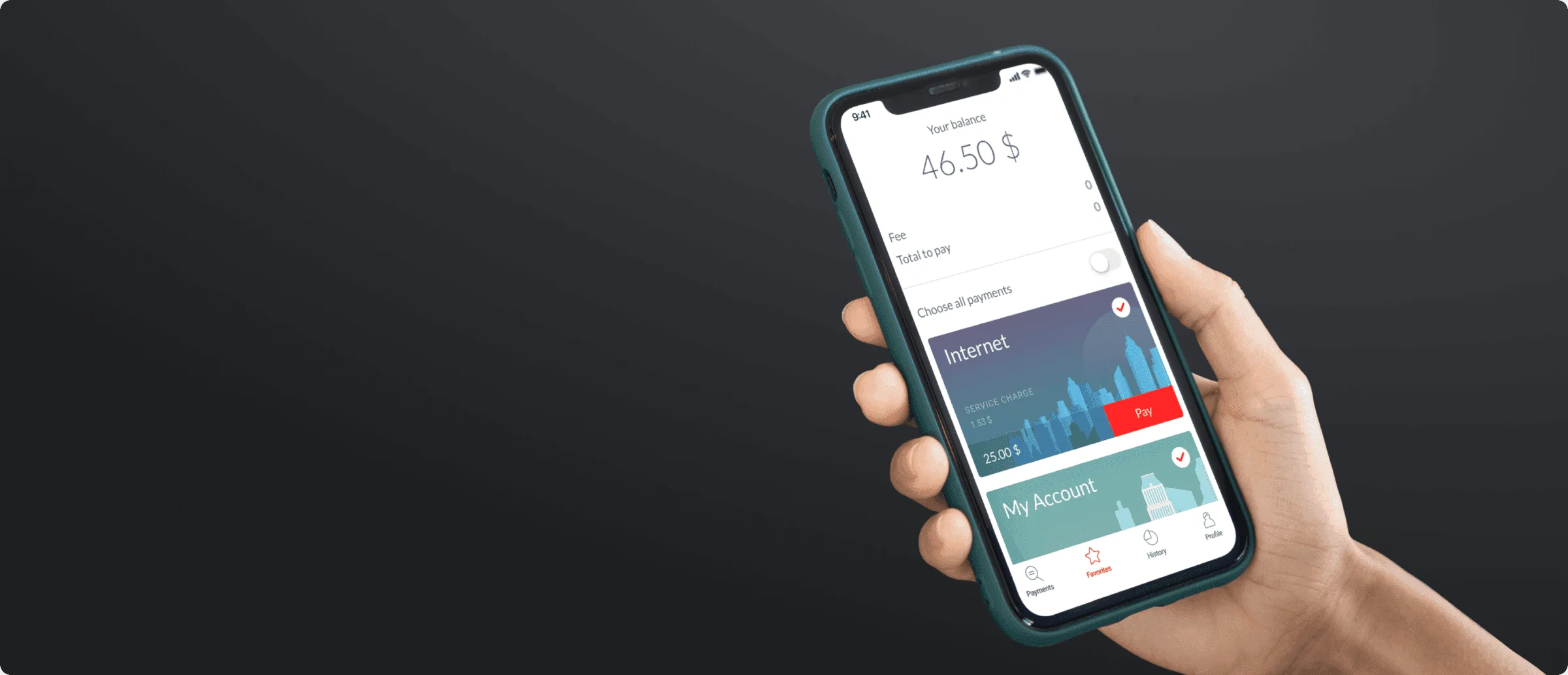
A major telecom operator in a CIS market wanted its subscribers to pay from their phones. Every transaction had to be cleared through the country’s National Information and Settlement System, which ruled out sitting on a card processor: the wallet had to speak to the operator’s billing, the settlement system, and the card management systems of several banks at once.
In conclusion, digital wallets have become a very popular payment method, providing a convenient and safe way for individuals to perform transactions online and in-person. While there are certain challenges to building and maintaining a wallet application, many successful industry examples prove it is a worthy endeavor.
If you are considering developing a custom e-Wallet application, partner with an experienced vendor. Bamboo Agile can provide a team of experts with a rich background in fintech software development to help your project thrive. Contact us today to get a free consultation with our specialists.
FAQ
What is the difference between a digital wallet and a mobile wallet?
A mobile wallet is a digital wallet that happens to run on a phone. “Digital wallet” covers the whole category, including desktop and hardware wallets and wallet features embedded in other products. In practice, most people use the terms interchangeably, and new builds are mobile-first.
Can we launch across several EU countries on one license?
Generally yes. An EMI or PI authorization obtained in one EU member state can be passported into others, which is why the choice of home regulator matters more than teams expect: supervisory style, processing times, and local reporting all differ. Some obligations stay local, so confirm the specifics with counsel in each market.
Do we need PCI DSS if we never store card numbers?
Usually yes, at a reduced scope. Tokenizing early cuts the systems in assessment, and it does not remove you from the standard: if card data passes through any part of your infrastructure, even briefly, that part is in scope. Your acquirer or sponsor will tell you which assessment level applies.
What happens to user balances if we shut the wallet down?
You need a wind-down plan before launch, and regulators increasingly ask for one at authorization. It covers how balances are returned, over what period, how users are notified, and who funds the exercise. Safeguarded funds sit apart from your operating money for this reason.
What happens if a payment provider fails mid-transfer?
Your ledger has to be able to answer for money that has left one place and not arrived at another. In practice that means every request carries an idempotency key, every pending state has a timeout and a defined resolution, and reconciliation catches whatever the timeouts miss.
What are successful examples of custom e-Wallet apps?
Apple Pay and Google Pay are the obvious device wallets. PayPal, Revolut, and Cash App show what a full financial product built around a wallet looks like, and Alipay and WeChat Pay show the super-app endpoint.
Rada has built her career in high-growth EdTech, Automotive, and IoT startups, guiding complex technologies from concept to market. She uses her firsthand experience in product strategy and business development to help B2B organizations de-risk their investments and build scalable products.
We use cookies to analyze user behavior and improve the website for you. Check our Privacy Policy for more information.
Functional
Always active
The technical storage or access is strictly necessary for the legitimate purpose of enabling the use of a specific service explicitly requested by the subscriber or user, or for the sole purpose of carrying out the transmission of a communication over an electronic communications network.
Preferences
The technical storage or access is necessary for the legitimate purpose of storing preferences that are not requested by the subscriber or user.
Statistics
The technical storage or access that is used exclusively for statistical purposes.The technical storage or access that is used exclusively for anonymous statistical purposes. Without a subpoena, voluntary compliance on the part of your Internet Service Provider, or additional records from a third party, information stored or retrieved for this purpose alone cannot usually be used to identify you.
Marketing
The technical storage or access is required to create user profiles to send advertising, or to track the user on a website or across several websites for similar marketing purposes.