Bamboo Agile | Bespoke software development company
Bamboo Agile is an Estonia-based custom software development company that crafts bespoke solutions for telecom, education, healthcare, finances, other sectors.
Telecom operators have outsourced parts of their software stack for years – billing platforms, OSS/BSS integrations, network management tools, customer-facing apps, and more. But if there is a thing that has changed in 2026, it is the price tag attached to picking the wrong partner.
Part of the reason is a broader techco trend. Operators increasingly want engineering in-house rather than with an outside team, since it now counts as a core skill. Moreover, security adds pressure too.
What does this mean for telecom software outsourcing? Handing a build to an external team still beats stretching an in-house squad across every OSS upgrade or every app release. But the calculus around who gets that work changed. Before, the costs used to carry the most weight, but now it is security and data handling practices that take center stage.
In this piece, Bamboo Agile analyzes the current state of outsourcing in telecom. We look inside the insourcing vs. outsourcing debate and share what it takes to find the right tech partner for secure services.
Yauheni Dzemyachenka built his 20-plus-year career on database and telecommunications systems, then moved into large enterprise applications with Java, C++, and web technologies, including work on the Ericsson MM7 SDK. At Bamboo Agile, Yauheni handles project estimation and delivery planning.
Operators are software companies now, but they still outsource
Talk to any telecom CTO in 2026, and the word “techco” comes up within the first five minutes. Omdiafound that more than 60% of operators now build development capability in-house, and another 30% are weighing the move. Scott Petty, CTO at Vodafone Group, echoed the sentiment, saying: “We need to insource. We need to have our own engineering talent… if we’re going to manage these ecosystems of technologies and capabilities.”
McKinseydescribes the same pattern – budgets are moving away from external delivery and toward engineering talent that sits on the payroll. Moreover, Orangebuilds its own cloud-native network software and co-runs the open-source Sylva project alongside Deutsche Telekom, Telefónica, Vodafone, and Ericsson.
But if the whole industry moves toward owning its code, why does every major operator still sign large contracts with telecom software services vendors? Because insourcing and outsourcing solve different problems, and most operators run both at once.
Here are a few examples that prove outsourcing is not going away:
Vodafone‘s own techco push runs on engineering delivered with Accenture and AWS, which shipped 2,300 products for the operator while retiring legacy systems in parallel.
Vodafone went further still and moved its 31,000-person VOIS unit into a commercial venture with Accenture rather than keeping the whole function internal.
T-Mobilehired Netcracker to handle digital BSS/OSS work rather than building it from scratch.
If we look at what these operators keep close and what they hand off, there is a pattern. Product strategy, core platform architecture, and anything tied to differentiation stay in-house. Heavy lifting on legacy systems, large-scale BSS/OSS builds, and specialized engineering capacity go to a partner. Insourcing gives operators control over the roadmap, while telecom software outsourcing gives them speed and depth on projects too large or too specialized for an internal team to staff alone.
Insourcing vs. outsourcing at a glance
Insourcing
Outsourcing
Best for
Product strategy, core platform architecture, and differentiation
Legacy systems, large BSS/OSS builds, and specialized capacity
Insourcing is not a new trend. Telecom operators started doing it years ago, but never from zero. I mean, building everything in-house always struck me as an odd choice given how much software already exists on the market with configuration options and modules ready to go. Usually it works like this: a company buys a platform with an SDK provided and brings in a team to extend the modules themselves. That gives it control over the logic that matters without the cost of writing a whole system from scratch.
Why the stakes of hiring the right partner are high
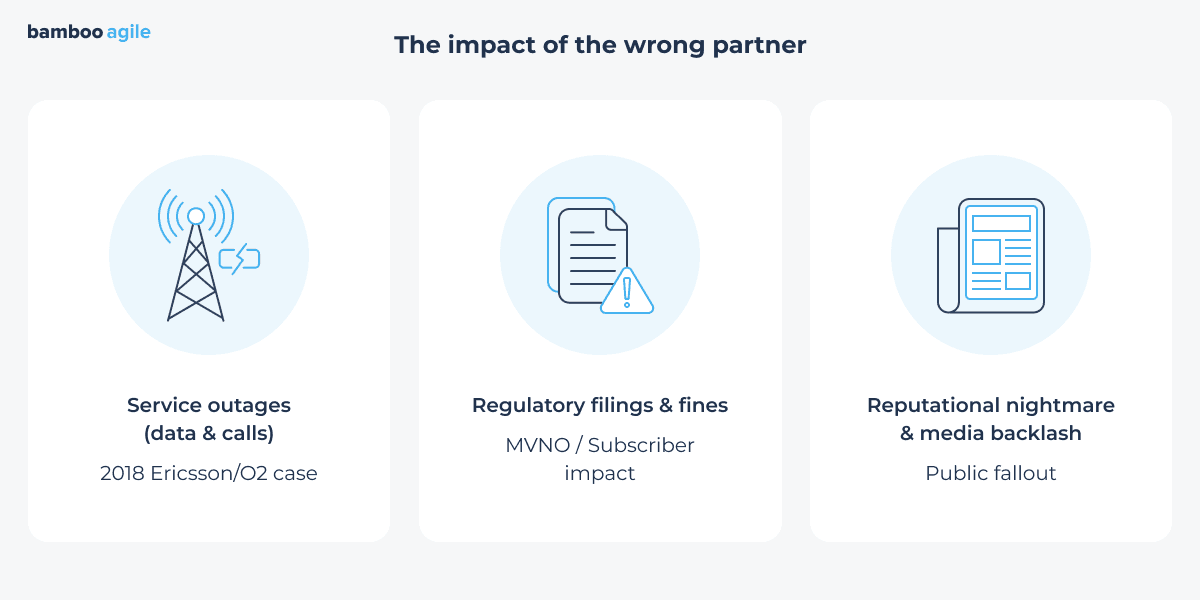
A telecom network runs on software written by someone outside the building. If you choose the wrong partner, the damage goes beyond a missed deadline. It appears as an outage or a regulatory filing – or a scathing headline in the media that causes a reputational nightmare.
Software supplied by a partner can take down more than one operator at a time, too. In December 2018, a single expired software certificate inside Ericsson‘s core network equipment caused mobile data and call outages for O2 in the UK and SoftBank in Japan. This also affected the MVNOs riding on their networks, such as Tesco Mobile and Sky Mobile. In the UK alone, the outage cut off close to 32 million subscribers.
None of this means that if you keep everything in-house, it automatically guarantees safety. Rogers Communications ran its own core network maintenance in July 2022, and a routine update still triggered a nationwide collapse. The fallout reached past mobile and home internet. Over 12 million customers lost service. In addition, the outage disrupted Interac e-Transfer and other electronic payment systems that businesses across Canada depend on daily.
So, you should see the real question behind the in-house-versus-partner decision differently. Not which side of the org chart carries less exposure, but which side brings tighter change control and faster incident response.
Looking for the right kind of telecom software partner?
Bamboo Agile builds and maintains telecom software for operators who will not settle for less.
Quality is what is really on the line here, and in telecom software services that means money – the stakes look a lot like what you would see in banking. The safest things to hand off completely are the ones that are far from a customer’s balance, like mailings, notifications, distribution, that kind of enterprise-side work. As for billing systems, most operators buy off the shelf rather than build. Support is different – that has to stay yours.
When it comes to deciding what to outsource and what to keep in-house, the old core versus non-core split does not hold up anymore. You can ask a different question, though – does the job need scale, speed, or a skill set your recruiters cannot fill in a couple of quarters? If yes, a partner earns a seat at the table.
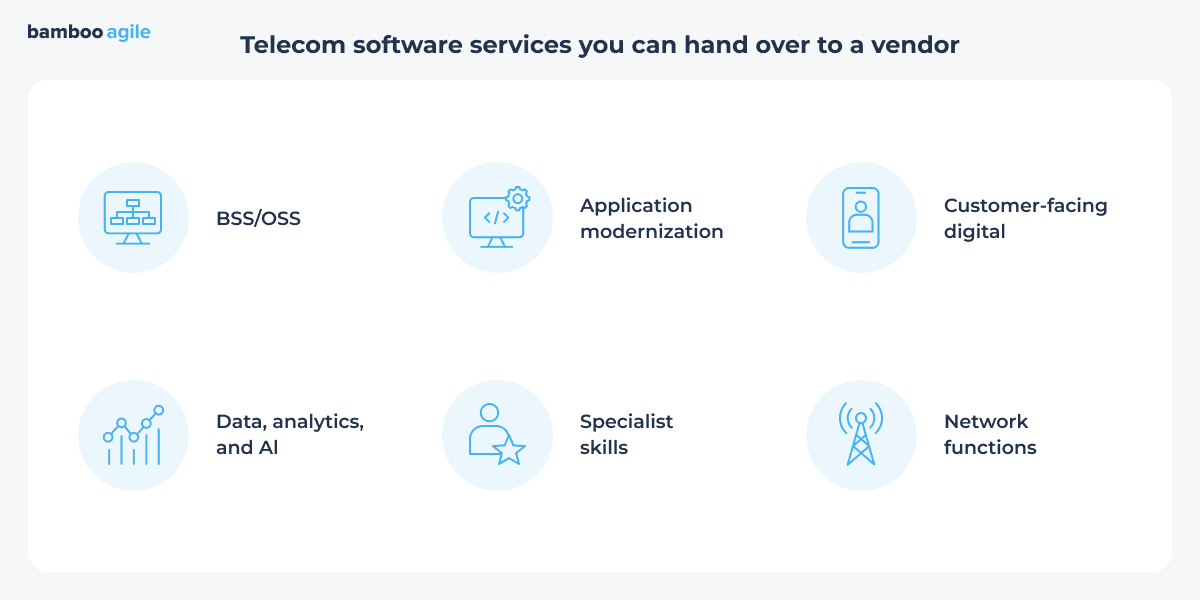
BSS/OSS – billing, charging, CRM, order management (OM), service assurance, network monitoring – takes the largest share of telecom software outsourcing spend. Most operators built this stack over two decades, and few internal teams can run it and rebuild it at once. Here, typical projects may include moving from a monolithic billing engine to microservices or a new OM layer for 5G plans, as well as a service-assurance overhaul that adds real-time fault detection.
Application modernization – moving legacy platforms to cloud-native infrastructure – is time-boxed work. A permanent hire for such a project rarely makes financial sense, but a contract usually does. Experienced vendors now also study how AI can make legacy modernization and migration easier. Telecom carries a large amount of legacy systems, but for some outdated technologies a contractor is hard to find, and the cost to work through it alone is too high for most in-house teams.
Customer-facing digital work (apps, portals, chatbots) moves at a pace consumer-software partners match better than teams stretched across network priorities. Additionally, an outside agency often brings stronger UX and design skills, plus a fresh view on features that helps a product stand apart from competitors. Prototypes and proof-of-concept builds for these projects go to a contractor more often, too, since a company skips building a full internal team when a project’s future stays uncertain.
Data, analytics, and AI – dashboards, AIOps, gen-AI agents – usually come from joint builds while internal data science teams grow into the role. A typical setup pairs an outside team building the model architecture with in-house engineers who own data governance and connect the output to existing systems. Over time, the internal data science team absorbs the pipeline and retrains models on its own, and the vendor moves to more specialized problems.
Specialist skills – 5G-standalone, cloud-native, security, IoT in telecom, or load and regression testing ahead of a network launch – stay open for months. Telecom operators often bring in contract staff for a launch to close these gaps, then let them go once things settle.
Network functions like 5G core operations, Open RAN, and virtualized functions sit in managed services. These systems run around the clock and touch hardware and software from multiple vendors, so an operator needs a partner for the full life – from capacity planning to deployment. Ericsson’s Open RAN integration work with AT&T, built on open O-RAN interfaces, shows what that partnership looks like at carrier scale.
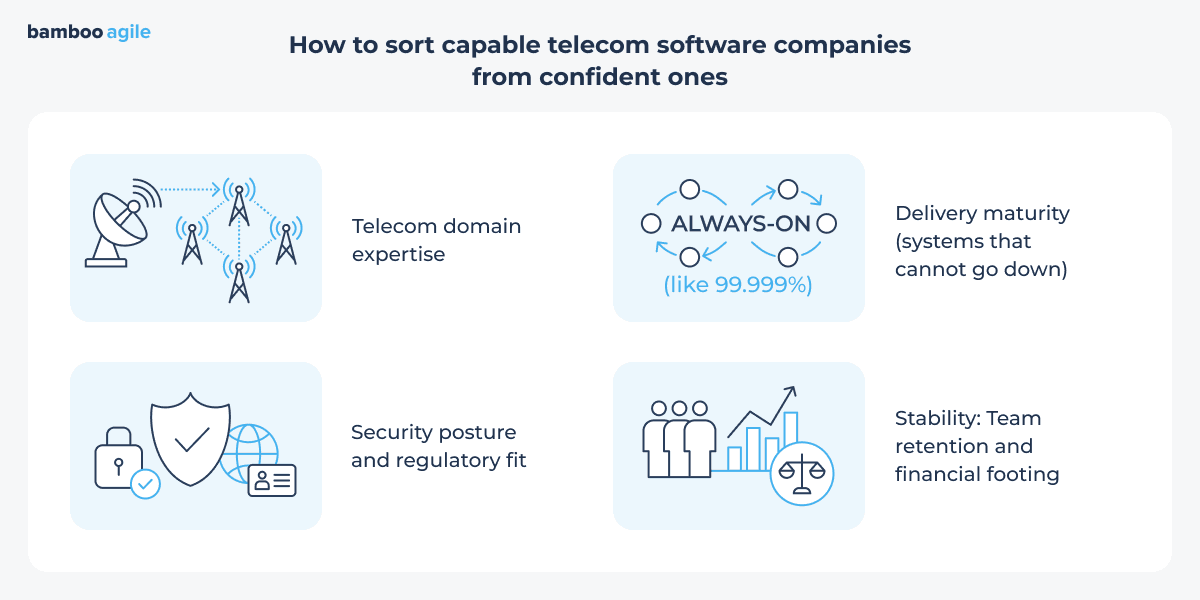
How to sort capable telecom software companies from confident ones
On paper, vendors look pretty much the same – case studies, client logos, a slide promising 24/7 support. The gap between a company that can run your OSS/BSS stack and one that just talks well about it shows up later, usually during an outage or an audit.
Here is what separates the two before you sign anything.
Telecom domain expertise
Ask your potential vendor to walk through a past billing system migration. If a team has real background, they will talk about CDR reconciliation or rating-engine cutovers. In contrast, a generalist will mention agile methodology and move on. Check for familiarity with 3GPP standards, TM Forum APIs, and platforms like Amdocs or Netcracker. In the end, call two former telecom clients directly.
Delivery maturity for systems that cannot go down
Look for staged rollouts and tested rollback plans. A mature partner will also have documented incident response runbooks and can show you a postmortem from a past project, redacted if needed.
Security posture and regulatory fit
ISO 27001 and SOC 2 Type II reports both matter, but so does reading the scope statement, since a certificate that covers the vendor’s HR system does not say much about the environment where your customer data actually lives. Ask for the current audit report, and check the certification date against renewal cycles.
Stability – team retention and financial footing
A vendor can pass every technical and security check and still fail you a year in if the engineers who know your system leave, or the company itself runs into financial trouble mid-contract. Telecom projects run long, so staff turnover matters as much as the architecture diagram.
I’d look at past projects first – who they actually worked with, by name. Get them talking about what they built, then ask for references and press those references on what the experience was really like. And certificates – ISO, SOC 2, whatever applies – I still want to see the document, not just hear about it.
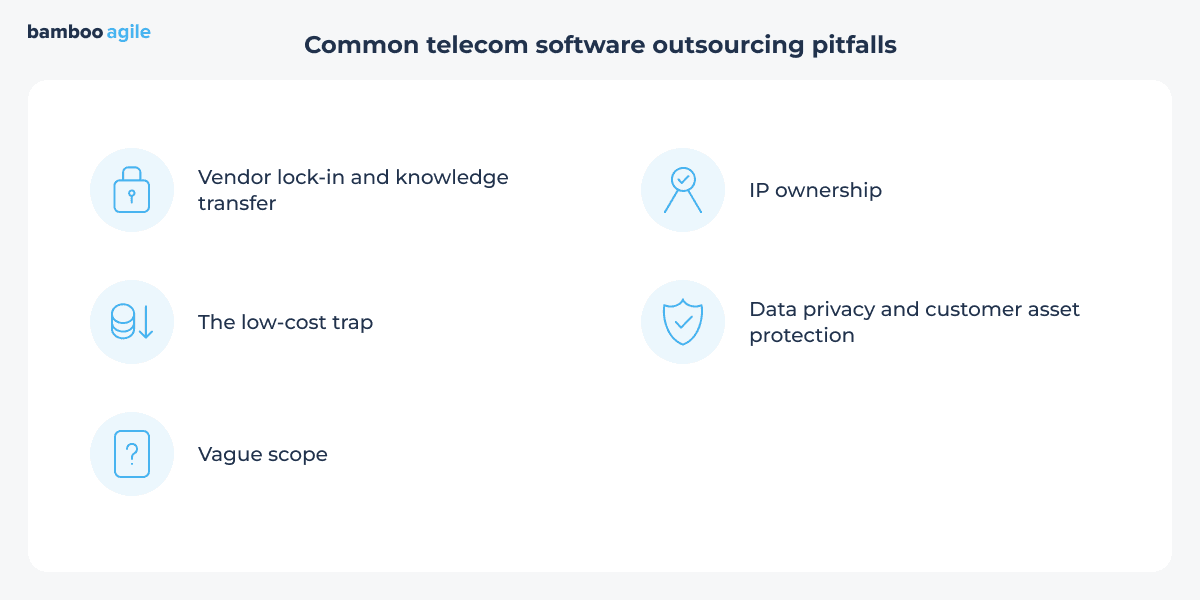
Common telecom software outsourcing pitfalls and how to avoid them
Vendor lock-in and knowledge transfer
Many operators sign with a partner, then discover the partner holds all the operational knowledge behind their telecom systems integration work. Contracts should require documentation in your own systems and code escrow. They should also name transition rights before the first sprint starts.
The low-cost trap
Cheap teams often bring junior staff and high turnover, and telecom as an industry punishes both. The rework that follows eats the original savings within a year or so. What you can do is compare the total cost of ownership across several years and see if the savings hold or disappear.
Vague scope
Loose statements of work end up in scope creep and billing disputes. If you are looking for transparency, define deliverables and acceptance criteria before signing – especially where the work involves legacy OSS/BSS platforms. Spell out the change-request process too, and revisit terms at each milestone.
IP ownership
In telecom software outsourcing, some vendor templates retain rights to code or reusable components. Insist on a work-for-hire clause that transfers ownership upon payment. Also, check that pre-existing vendor IP used in your product carries a written license.
Data privacy and customer asset protection
Telcos hold sensitive data, such as call records and location history, as well as billing details. To gain access to the data, attackers often target vendors as the weak link. This should serve as a reminder that exposure often starts outside your own walls, particularly during telecom software development work that opens deep access to outside teams.
No integration is ever completely free of surprises. In my experience, we had a subscription billing project where a flaw in the verification method caused customers to be charged twice for the same service. But what matters is what happened next. Our team flagged the issue to the operator immediately and restored every affected account by hand. We worked alongside the billing team until the last charge was reversed. A vendor who pretends bugs do not happen is a bigger risk than the bug itself.
A quick checklist before you commit
Separate what stays in-house and what goes to a vendor
Ask for named references and call them directly
Verify security certifications yourself to make sure they cover your sector
Test your vendor’s delivery maturity by asking for a documented rollback plan
Check financial and team stability – retention is important for long-running contracts
Build in knowledge transfer from the start
Compare costs across several years to calculate the total cost of ownership
Lock down scope and change control
Settle IP ownership in writing
Set data-handling terms before access is granted.
Telecom software services by Bamboo Agile
Bamboo Agile started inside the telecom industry back in 2002, building VAS platforms for mobile operators. That background still shows up in how we scope projects and where our teams focus. We have now worked with 60+ MNOs worldwide, including A1 Group, Orange, and Telia. Our telecom work spans billing systems, subscriber self-service portals, VAS platforms, legacy modernization, and telecom system integration built on SMPP, IVR, VoIP, and SIP. A closer look at our case studies shows how these projects held up under real subscriber volumes.
Weighing an in-house build against a partner with telecom mileage on the board? Get in touch with our team and walk through your project before you decide.
FAQ
Should telecom operators outsource BSS/OSS or keep it in-house?
Most operators split the difference. Core billing logic and customer data models tend to stay in-house, where institutional knowledge runs deep. Integration work, legacy migrations, and specialized development – these parts often go to partners who have already solved these problems elsewhere.
Who owns the IP an outsourcing vendor creates?
By default, many jurisdictions grant the vendor ownership of anything its developers build, unless the contract says otherwise. So, do not assume you get the rights automatically. You need an explicit assignment clause that covers code and documentation, as well as architecture. Ask for IP transfer on payment, not project completion, and get it in writing before the work starts.
Darya has over 10 years of experience in the IT sector and specializes in producing clear, research-driven content for technology and business audiences.
At Bamboo Agile, she authored numerous articles covering emerging technologies, digital innovation, and industry-specific solutions, helping readers navigate complex industry developments. Darya collaborated closely with subject-matter experts to ensure accuracy and reliability of her works.
We use cookies to analyze user behavior and improve the website for you. Check our Privacy Policy for more information.
Functional
Always active
The technical storage or access is strictly necessary for the legitimate purpose of enabling the use of a specific service explicitly requested by the subscriber or user, or for the sole purpose of carrying out the transmission of a communication over an electronic communications network.
Preferences
The technical storage or access is necessary for the legitimate purpose of storing preferences that are not requested by the subscriber or user.
Statistics
The technical storage or access that is used exclusively for statistical purposes.The technical storage or access that is used exclusively for anonymous statistical purposes. Without a subpoena, voluntary compliance on the part of your Internet Service Provider, or additional records from a third party, information stored or retrieved for this purpose alone cannot usually be used to identify you.
Marketing
The technical storage or access is required to create user profiles to send advertising, or to track the user on a website or across several websites for similar marketing purposes.