
When you need a web product built, rebuilt, or scaled, hiring an in-house team may look slow and expensive.
Salary costs are the most obvious among other expenses. A web project needs several specialists, such as frontend, backend, DevOps, and QA. But it is rare that each of them is needed on a full‑time basis. Besides, if the project changes direction or ends, those people are still on your payroll. In many European countries, letting them go means notice periods and severance pay.
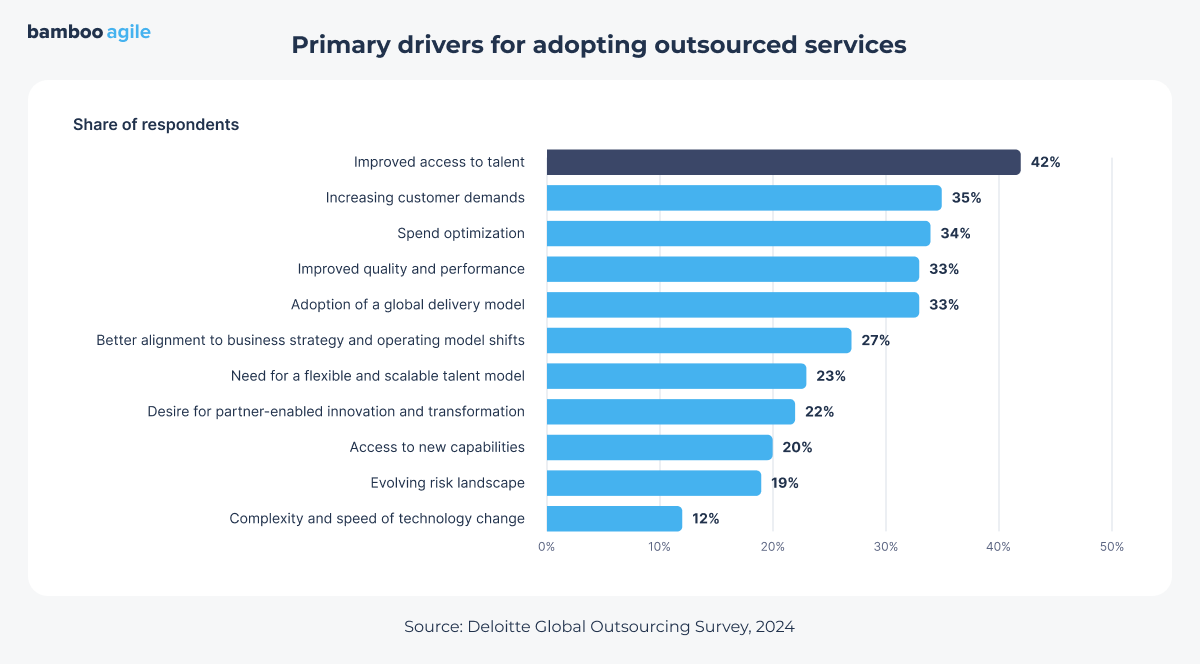
However, the reasons for outsourcing software development are not limited to budget savings. Deloitte’s 2024 Global Outsourcing Survey found that access to talent is now the number-one driver of outsourcing decisions. It also reports that 40% of respondents expect their outsourcing to increase.
The talent market has shifted even further with the rise of AI. According to ManpowerGroup’s 2026 Global Talent Shortage research, AI Model & Application Development (20%) and AI Literacy (19%) now lead the global ranking of hard-to-find skills. Companies that cannot hire such people locally increasingly look for partners who already have them, for example, AI-native engineers who use AI tools as a natural part of their development workflow.
In other words, companies turn to outsourcing not only to cut costs, but to get specialists they cannot find on the local market or do not need full-time. That does not make it the right choice for every project, though.
Drawing on 20+ years of experience in software development, including web projects, we have put together the following points: when outsourcing pays off, when an in-house or hybrid team works better, and how to set up the work with a web development outsourcing company if you go ahead.
What is web development outsourcing?
Web development outsourcing is the process of attracting an external company to design, build, or maintain a website or web application instead of hiring in-house employees. The vendor provides the specialists and may run the delivery process. And you keep ownership of the product and the decisions about what it should do.
Different kinds of companies turn to outsourcing, but their reasons are not the same:
- Startups need to launch an MVP before the funding runs out, and they cannot afford to build a full team first.
- Small and medium-sized businesses often have no developers at all, so a corporate site or an online store has to come from outside.
- Enterprises usually have IT departments. However, they still turn to vendors for extra capacity on a specific project, especially when it comes to short- or mid-term engagement like PoCs or MVPs, or for skills the internal team lacks.
- Digital and marketing agencies might use white-label partners. The vendor builds the product, and the agency delivers it to its own client.
In each case, an organization decided that creating a web product in‑house was not the best use of its time and budget.
So, what do companies typically hand over to external teams when they outsource web development services? Let’s figure it out in the next two sections.
Web development services you can outsource
Custom web application development
Customer portals, partner dashboards, and internal self-service systems usually follow a company’s own processes, and ready-made software fits them poorly. When you outsource web app development, you can hand over the whole build or only the frontend or backend part, if your team already handles the other one.
e-Commerce development
An e-Commerce project may include building a new online store or adding changes to an existing one, such as new payment and delivery options, a larger catalog, or integration with an ERP or CRM. For example, retailers can outsource e-Commerce web development before seasonal sales, when deadlines are fixed.
Corporate websites and CMS development
A corporate site needs a clear structure, fast pages, and a CMS your marketing team can edit without calling a developer. After all, a site that only developers can change soon goes stale.
If you outsource web design together with the build, the team designs the structure, builds the templates, handles CMS development, and connects forms and analytics.
Legacy web application modernization and replatforming
Legacy modernization means updating an old application so it stays secure and maintainable. That can be a refactor, a move to a new platform, a CMS change or the split of a monolith into smaller services. Such projects are large but temporary, which makes them a poor reason to hire permanently.
AI feature integration for web products
The AI functions most commonly requested in web products include natural language search, support chats based on product documentation, and automatic content tagging. Outsourced teams usually integrate them into an existing product and connect them to the company’s data.
Why companies outsource web development
Companies outsource web development services for many reasons. Below are the main ones, explained.
What an in-house web team actually costs, line by line
Hiring an in-house team means paying for capacity. You pay for the people every month of the year, regardless of whether the backlog is full or empty.
As a rule, the people a typical web project needs are a backend developer, a frontend developer, and a project manager. In Stack Overflow’s 2025 Developer Survey, the median annual compensation before taxes in Germany was $87,011 for a backend developer, $79,637 for a frontend developer, and $110,214 for a project manager. In the UK, the backend median was $108,913, and in France – $71,929 (the figures are self-reported). Moreover, the employer’s social contributions are added, the amount of which depends on the country.
In addition, each person needs a laptop, a desk, and a secure remote setup. Licences for code hosting, CI/CD, and monitoring are usually charged per seat. Recruiting costs include posting job advertisements or an agency fee, recruiter time, and the hours your own engineers spend interviewing candidates. If someone leaves in the first year, you pay for all of it again. And you as well pay for holidays and sick leaves.
When you outsource, the budget structure is different. A vendor charges for the work, by the hour, by the month, or by the project. In a 2026 Techreviewer survey of 127 software development companies, 37.8% charged $30 to $49 per hour, 22.05% charged $20 to $29, and 22% charged $50 to $99.
It is true that a vendor’s hourly rate is higher than the hourly equivalent of a salary, because it covers the service provider’s own overhead and margin. Nevertheless, the savings comes from the hours you do not buy. Therefore, if your project needs a team for six months, you pay for six months. An employee can cost you twelve, plus the notice period after that.
This also shows when the argument turns against outsourcing. If you need the same people every week of the year and the product is central to your business, the in-house cost per hour of real work can be lower. The in-house vs. outsourcing vs. hybrid model comparison below shows where each model fits.
| In-house | Outsourcing | Hybrid | |
|---|---|---|---|
| Cost | Fixed: salaries, contributions, equipment, licences, and recruitment | Variable: you pay for the agreed scope or time | Fixed for the core team, variable for extra capacity |
| Speed to start | Months, because of recruitment | Weeks, if the vendor has people available | Core team in place, capacity added quickly |
| Control | Highest | Depends on the contract and on how you manage the vendor | High over product and architecture |
| Scalability | Slow; every change means hiring or laying off | Fast, up and down | Fast for peaks, stable at the core |
| Knowledge retention | Stays in the company unless people leave | Stays with the vendor unless documentation and handover are agreed | Core knowledge in-house, the rest documented |
| Risk | Hiring mistakes, turnover, and cost of ending contracts | Vendor dependency, communication gaps | Coordination between two teams |
Severance and notice periods you keep paying after a layoff
Ending the contracts of the people who worked on it is slower, and the rules differ from country to country. Let’s look at three European examples that show the range.
- Norway. A dismissal must be objectively justified, and necessary downsizing counts as a valid reason. The legal notice period is one month for under five years of service, two months after five, and three after ten, rising to six months for older employees. A dismissed employee who disputes the decision can stay in the post during negotiations or a court case. Severance is not required by the Working Environment Act, but it often comes through settlements or collective agreements.
- Germany. Under § 622 of the Civil Code, employer notice starts at four weeks and rises to one month after two years of service, two months after five, and up to seven months after twenty. Severance is not automatic, but half a monthly salary per year of service is the usual starting point. For a developer with five years at the company, that means two months of notice plus about two and a half monthly salaries.
- France. The mandatory severance pay is paid in addition to the notice period. The legal minimum is a quarter of a month’s salary per year of service for the first ten years and a third after that, for employees with at least eight months of service. A collective agreement can raise it.
A vendor contract works differently. You agree the notice period yourself, and 30 days is a common term. You pay for the work delivered in that time, and nothing after it.
Hiring timeline against project timeline
A project plan usually assumes the team starts soon after the budget is approved, but the hiring market has its own clock.
Gem’s 2025 Recruiting Benchmarks Report analyzed hiring data from 2021 to 2024, covering more than 140 million applications and 1.3 million hires. Across all roles, the average time to hire was 41 days. Engineering roles took 53 days, and IT and infosec roles took 58. These hires also needed an average of 39 interviews each, and only 76% of engineering offers were accepted, which is the lowest rate of any department in the report.
Furthermore, those numbers do not include the weeks needed to agree the budget and write the vacancy, or the notice period the candidate owes the current employer.
But to be fair, a slow hire is not a bad hire. If your deadline is flexible, waiting for the right person for a long-term team makes sense. Timing becomes a problem when the date is fixed, such as a Q4 campaign, a regulatory deadline, or a funding milestone.
Roles a project needs but cannot justify as full-time hires
Beyond developers and a project manager, a web project may depend on four other specialists. Each works at 10 to 30 percent of a full-time load, in short and intense periods.
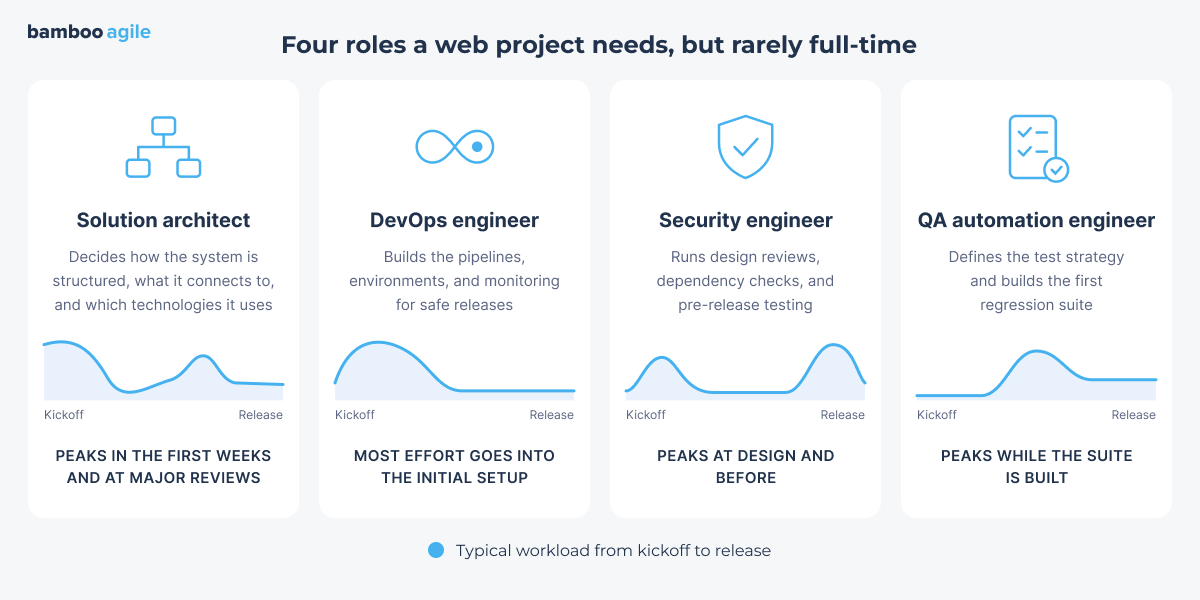
- The solution architect decides how the system is structured, which services it connects to, and which technologies it uses. The load peaks in the first weeks and at major reviews. If the role is missing, early shortcuts turn into expensive rework later.
- A DevOps engineer builds the pipelines, environments, and monitoring that let the team release safely. Most of the effort goes into the initial setup, and ongoing upkeep takes far less.
- A security engineer is responsible for design reviews, dependency checks, and testing before product release. It is the hardest one to leave empty as well as hard to fill. ISC2’s 2025 workforce study surveyed 16,029 practitioners and found that 88% had suffered at least one significant cybersecurity consequence because of a skills shortage.
- Finally, a QA automation engineer runs regression tests that protect every release after the first. In the Capgemini’s World Quality Report 2024-25, 57% of respondents named the lack of a comprehensive test automation strategy as a barrier. A specialist who defines the strategy and builds the first test suite removes that barrier, and the team can maintain the suite afterwards.
Nevertheless, when one of these roles approaches a full workload week after week, a hire makes sense. A high-traffic platform with daily deployments, for example, usually needs its own DevOps engineer.
Peak load without hiring and firing
An online store can earn a large share of its season in a few days. In the 2025 US holiday season, Cyber Week produced $44.2 billion in online sales, 17.1% of the season’s total. Cyber Monday alone reached $14.25 billion, and shoppers spent $16 million a minute between 8 and 10 pm.
Meanwhile, the developers’ busiest weeks are before the sale as checkout changes, performance tunes, load tests, and the code freeze must be finished well ahead of the first discount.
Hiring employees for such a cycle is not easy. As we mentioned earlier, it takes about 53 days to find engineers, so recruitment should start in the spring. Instead, you can form an outsourced web development team for a specific season. Hire additional developers and testers for the period from August to October, and then reduce their number. There is one condition to keep in mind: the contractor will need several weeks to study your catalog and release schedule.
Pilot and proof-of-concept projects
A pilot checks whether an idea works before a company invests in it fully, so ending the project after the pilot is one of the expected outcomes. At the start, nobody knows which way it will go, how long the work will take or which skills it will need.
A pilot is also built differently from a finished product. The team has to move fast, simplify where it can, and still make sure the parts being tested work well enough to give a reliable answer. Vendors that do PoC development regularly know where those shortcuts are safe. The pilot can be set up as a separate project with one question to answer and a date for the result, while the in-house team continues with planned releases.
Migration and replatforming work you would never hire for permanently
A CMS switch, a content migration or the split of a monolith has a defined result and an end date. Afterwards the people who did it have little left to do, which makes the work a poor fit for a permanent post.
The risk is in the details. Google’s own guidance on site moves tells owners to expect temporary ranking fluctuations while Google recrawls and reindexes the site. How deep and prolonged the decline will be depends on the preparation: a full inventory of URLs, a redirect for every old address, checks on a staging site, and close monitoring after launch. Specialists who have done this many times know where moves go wrong, while your own team may face one in several years.
A monolith split has the same shape. It needs senior architecture work for a limited period, followed by ordinary maintenance that your own developers can handle. As a rule, the vendor leads the migration, and your team takes over operation, so agree on documentation and handover at the start.
A well-established delivery process
Every vendor team has habits on how code is reviewed, how tests run, how a change reaches production, where decisions are written down, etc. It may take months for in-house employees to form them from scratch.
Five points show whether a web development outsourcing company’s routine is real:
- CI/CD pipeline that runs tests on every change
- peer review before merging
- an agreed level of test coverage
- current documentation
- separate development, staging, and production environments
Ask to see them in a live repository.
That said, a process counts only if people follow it, and some vendors describe one in the pitch and work differently day to day. If your own developers already work well, ask whether the vendor can adopt your routine instead.
Summary: why companies outsource web development and what they gain
Taken together, the points above come down to one thing: a web project needs a wide mix of skills, but its workload is uneven. Companies outsource web development because this way they pay for the capacity they actually use. And this brings them several benefits:
- Costs that follow the work. You pay for the agreed scope or time, not for twelve months of salaries, equipment, and licences.
- A faster start. A vendor can often begin within weeks, while hiring an engineer takes about 53 days on average, before the candidate’s notice period.
- Specialists you cannot justify full-time. A solution architect, DevOps, security, and QA automation engineer join for the weeks when their work matters most.
- Capacity that scales up and down. Seasonal peaks, pilots, and migrations get a dedicated team, and it is released when the work is done.
- Established delivery practices. CI/CD, code review, and documentation come with the team, so you do not spend months building them.
Outsourcing is not always the cheaper option, though. If you need the same people every week and the product is central to your business, an in-house or hybrid team may cost less per hour of real work.
Common objections when you outsource web development projects, and what solves them
People usually have some reasonable doubts when it comes to signing an outsourcing contract. Some concern the vendor: who will own the code, and whether its quality will hold up. Others concern your own side, such as whether you can describe the project well enough and who will manage the relationship day to day. That second group deserves attention, because of, as Deloitte describes it, weak internal management as a common cause of outsourcing problems.
Let’s take a look at five objections that are raised most often (and how to manage them).
You do not have a project specification yet
Start with a paid discovery phase, in which a business analyst on the vendor’s side works with you to write down what the product must do. This way, scope creep is handled before the build begins. Apparently, nowadays, an AI tool can draft the first requirements in a few hours, but a person still has to check the draft.
You want to keep ownership of the code
Ownership is settled on paper. The contract assigns all intellectual property to you, and the repository is in your organization’s account from the first day. As an extra protective measure, an escrow copy of the source code protects you if the vendor shuts down. And the contract step explains how IP ownership and vendor lock-in are covered.
You have nobody to manage the vendor
You do not need a full-time hire for this: the vendor’s delivery manager handles the daily coordination. Also, if you need a hand in technical decisions, expert vendors offer to hire a CTO as a service to reduce key-person dependency.
Oversight still pays back, though, because in Deloitte’s survey 61% of organizations with a mature vendor management function cut third-party spend by 20% or more.
You can’t assess the code you’re paying for
First, ask for access to the repository from the very beginning and write a test coverage target into the agreement. For larger projects, add an independent audit at milestones, a sensible extra check when 62.4% of developers name technical debt as their top frustration.
A freelancer fits better than an agency due to budget constraints
To be fair, this objection really makes sense as with a narrow scope and a tight budget it might be better to hire a full-stack freelancer. In some cases an agency’s overhead would cost more than it gives. On the other hand, once the project needs several skills, or has to go on while one person is ill or away, a team is the safer choice.
Web development outsourcing rates by region
Rates depend on the vendor’s location more than on anything else, and the gap between regions can be several times over. The table shows typical hourly rates for a senior developer at an outsourcing company in 2026.
| Region | Senior developer, USD per hour |
|---|---|
| North America | $100–150+ |
| Western Europe and the UK | $80–150 |
| Baltics (Estonia, Latvia, Lithuania) | $45–80 |
| Eastern Europe | $45–85 |
| Latin America | $50–85 |
| South and Southeast Asia | $25–60 |
Published rate tables often differ because some show a vendor’s average rate across all seniority levels, while others show senior rates only. When you compare offers, ask each vendor for a rate per role.
Nearshore web development
A nearshore vendor works from a nearby country with the same or a similar time zone. For a company in Germany, France, or the Nordics, this usually means Eastern Europe or the Baltics, where the working day overlaps almost fully with yours.
Estonia is one hour ahead of Central European Time and shares a time zone with Finland, so a team in Tallinn and a client in Berlin or Helsinki work the same hours. Calls can be scheduled at short notice, and the team can visit your office or host you within a half-a-day’s travel. Vendors in EU countries, including the Baltic states, process personal data under the GDPR, so no extra safeguards for transfers outside the European Economic Area are needed. Rates are lower than in Western Europe, though higher than in Asia.
Offshore web development
An offshore web development vendor is located far away, usually in South or Southeast Asia, or in Latin America for European clients. Rates in South and Southeast Asia are the lowest in the table, and the talent pool is large, which helps when you need to hire offshore web developers in large numbers quickly. The time difference means the shared working window may be only a few hours, so the work depends on clear written requirements, detailed documentation, and an agreed time for daily calls. If the vendor will handle personal data of people in the EU, the contract needs transfer safeguards, such as standard contractual clauses.
How to outsource web development step by step
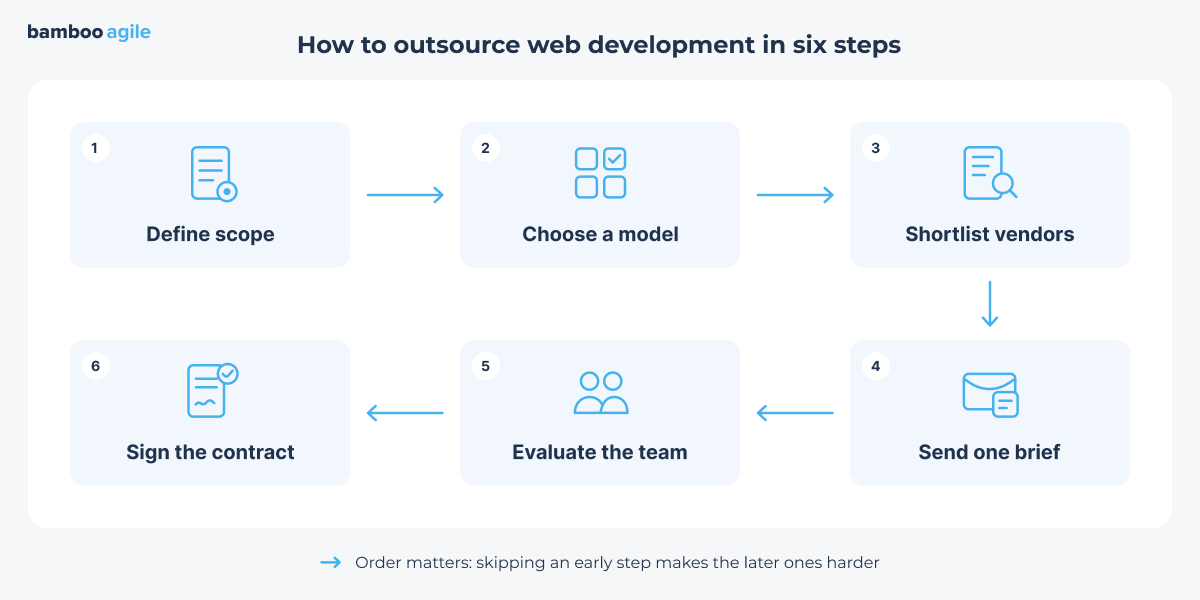
The process has six steps, and the order matters. Skipping the early ones makes the later ones harder, because the choice of contract and vendor depends on what you want to achieve.
Step 1. Define scope and success criteria
First, write down what the product must do, for whom, and by when, and how you will know it worked. A one-page brief is enough to start and should include:
- business goal
- main user groups
- must-have and nice-to-have features
- deadline
- budget range.
Besides that, set success criteria you can measure, such as a conversion rate, a page load time, or the number of active users after launch.
If the scope is still unclear even for you, during the paid discovery phase, the vendor’s team can produce the brief for you.
Step 2. Choose an engagement model
There are four models which differ in who carries the risk.
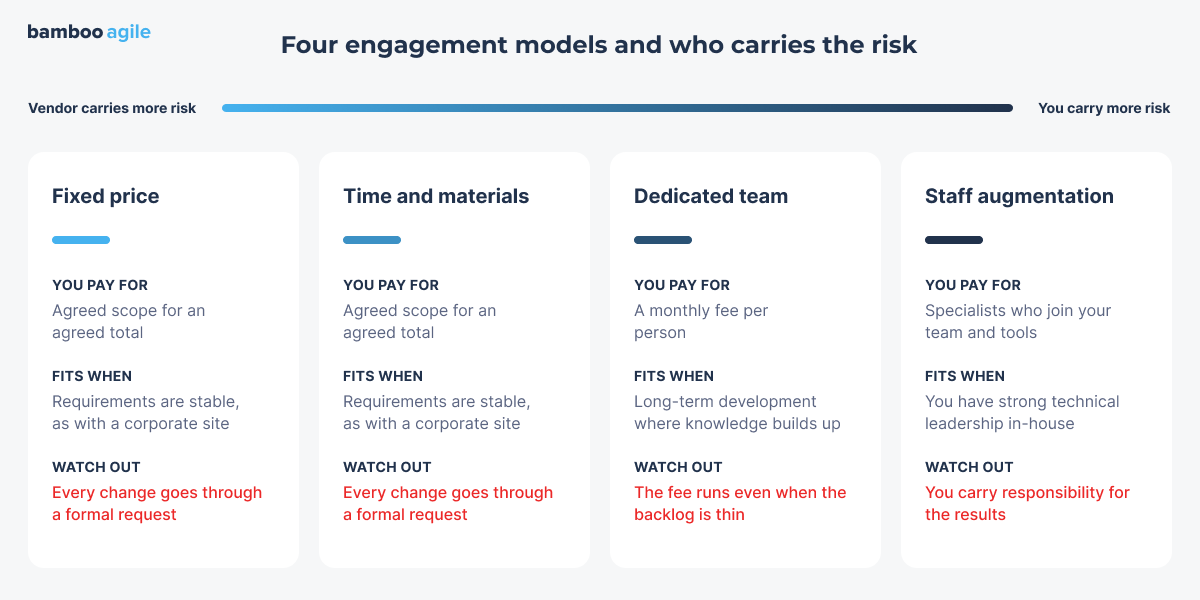
- Fixed price. The vendor commits to a defined scope for an agreed total. This works when requirements are stable, as with a corporate site or a well-described feature. Any change goes through a formal request, which protects your budget and slows down adaptation.
- Time and materials. You pay for the hours worked, usually with a monthly cap or forecast. The model absorbs shifting requirements, so it fits a product that is still taking shape. The budget stays under control only if you receive regular reports and set the priorities yourself.
- Dedicated team. A group of specialists works on your product alone, and you pay a monthly fee per person. Knowledge accumulates over time, so this option is ideal for long‑term development. The fee runs whether the backlog is full or thin, so it needs a steady flow of work.
- Staff augmentation. Individual specialists join your team, take tasks from your managers and work in your tools. You get the most control and the least vendor overhead, but you also carry responsibility for the results. It assumes strong technical leadership on your side.
Step 3. Shortlist web development outsourcing companies
First, decide where to look. Recommendations from colleagues matter most because they can tell you how a web development outsourcing company they turned to behaves when a project goes wrong. Review platforms such as Clutch add client reviews, and the portfolios of agencies show who has already built products like yours.
Next, narrow the field with four checks: relevant projects, team size, overlap of working hours with your side, and references you can call. A vendor with ten developers and one with two hundred suit different projects, so match the size to your scope.
Finally, keep the list short. Three to five companies give you enough to compare, as a longer list only adds calls without adding insight.
Step 4. Prepare and share an RFP or a brief
Write one brief and send the same document to every shortlisted vendor, so the proposals can be compared. It should cover the business context, the scope with priorities, the success criteria from Step 1, the technical constraints (existing systems, integrations, hosting), deadline, and more. You may include the budget range, so that it saves both sides from proposals that miss the mark.
Next, tell the vendors what you want back. This could be, for example, their approach, the team they would assign, an estimate with its assumptions, and the main risks they see. Give them a date for questions and a date for proposals. Finally, sign an NDA before sharing anything sensitive.
Step 5. Evaluate the team
Proposals show what a vendor promises, but not always what you will get. Meet the people who would work on your project, and compare each candidate on the same four points:
- Technical fit. Experience with your stack, code review and testing habits, CI/CD, security practices, and documentation.
- Web app portfolio. Live products of similar size and complexity, with references you can check.
- Use of AI in delivery. Which tools the team uses, how AI-written code is reviewed, and whether your code and data stay out of third-party model training.
- Team and process. The mix of senior and junior people, staff turnover, the reporting rhythm, and the language level of the people you will talk to daily.
Note that the AI question needs a direct answer. In Stack Overflow’s 2025 survey, 84% of developers use or plan to use AI tools, yet 46% distrust the accuracy of the output, against 33% who trust it. What matters, then, is how a team checks what the tools produce.
Finally, you can start with running a short paid pilot, such as a small feature or a discovery sprint. A few weeks of real work tell you more than any presentation.
Step 6. Sign the contract
Each risk in an outsourcing project has a contract term that covers it:
- Scope creep. A change-request procedure, with an estimate approved before extra work starts.
- Key-person dependency. Named key roles, an overlap period when someone is replaced, and shared documentation.
- Code quality and technical debt. Code review rules, an agreed test coverage level, and the right to an independent audit.
- Time-zone gaps. A minimum overlap of working hours and response times for urgent issues.
- Vendor lock-in. Repositories and accounts in your name, plus documented environments, so another team can take over.
- IP ownership. Assignment of all rights to your company, covering code, designs, and documentation.
- GDPR and data residency. A data processing agreement, a named place for data storage, safeguards for transfers outside the European Economic Area, and access control for production data.
- Project handover. A set handover period with documentation, knowledge-transfer sessions, and the transfer of all access.
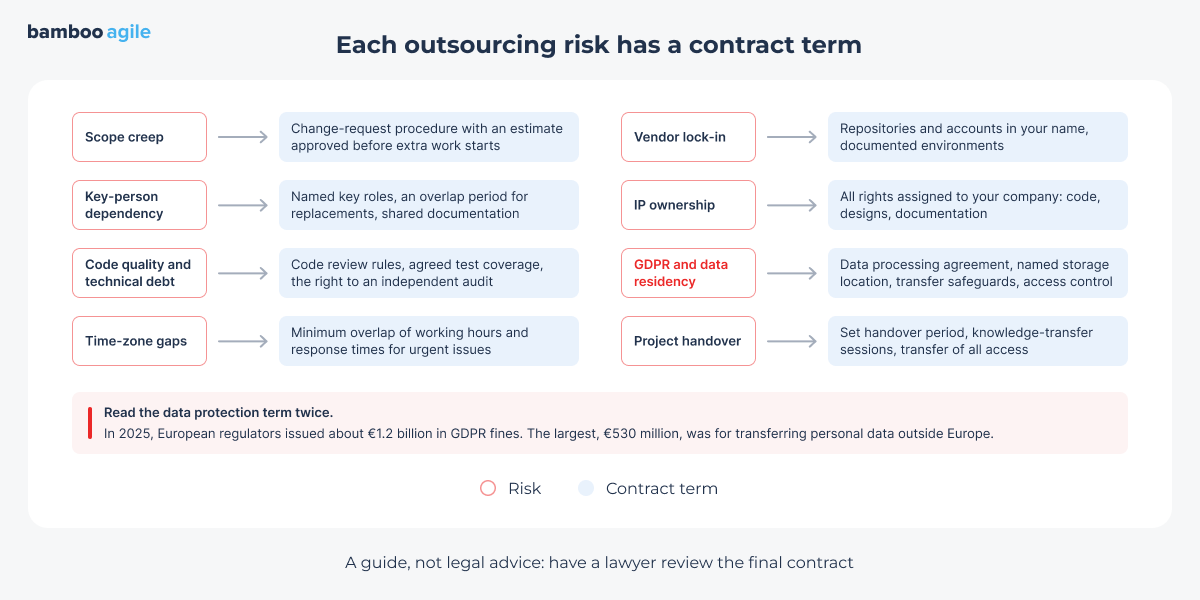
The data protection term is the one to read twice. In 2025, European regulators issued GDPR fines of about €1.2 billion, close to the 2024 total. The largest single fine, €530 million, was imposed for breaking the rules on transferring personal data outside Europe, a risk that applies whenever a vendor works from another country.
That said, this list is a guide and not legal advice, so have a lawyer review the final text.
Our case studies in web development outsourcing
Two projects from Bamboo Agile’s own work show how the arguments above look in real projects.
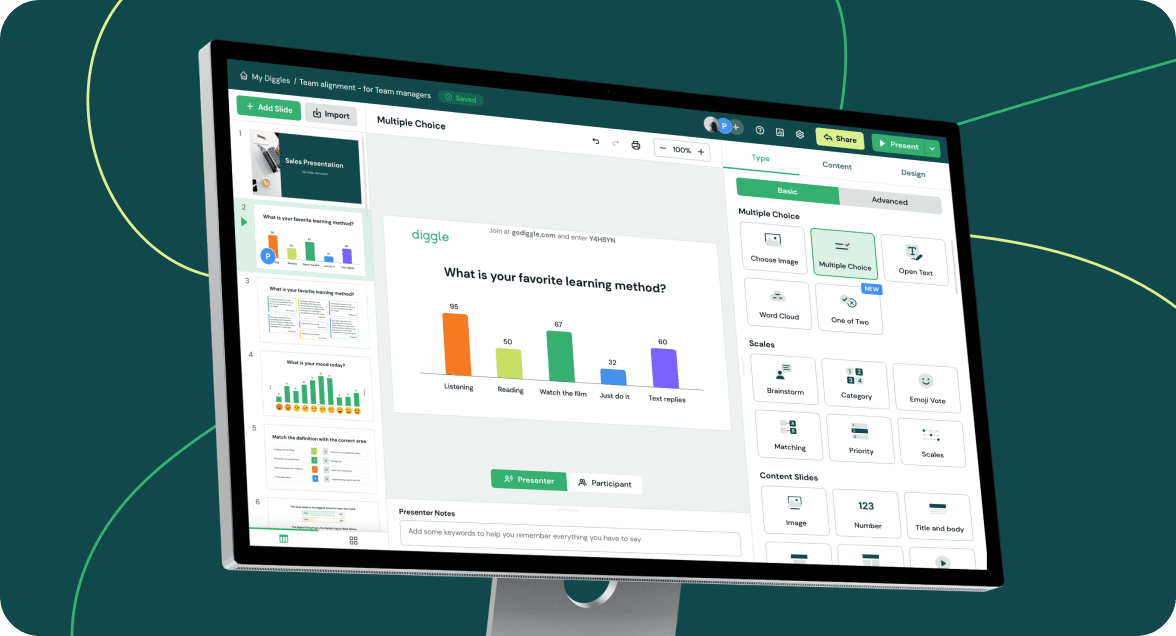
Diggle
The client behind Diggle is a Norwegian company whose core business is consulting in the areas of organizational development, change management, and corporate training. The platform was a side tool for that training work, so software development sat outside what the company does.
In this project, an in-house team made little sense for several reasons:
- Developers were not part of the company’s expertise
- A team in Norway is expensive
- The client was not sure what the future of the project would be.
- Ending contracts with developers after a lay-off would have cost a lot, because of the social guarantees employees have in Norway.
So, instead, Specifique Norge AS hired Bamboo Agile’s engineers at a good rate. The team size ranged from 1 to 8 developers during different phases of product development Based on the difference in Norwegian and Estonian developer rates, the approximate savings ranged $75,000–145,000 per month for a full team of eight.
The collaboration lasted four years, from a free beta version to releasing a full commercial product.
QTI player for tests
MasteryPrep, an US-based EdTech company, has the product as its core business, supervised by its internal development team. Still, the company hired dedicated senior developers from Bamboo Agile to increase their capacities and work on several modules in parallel.

An external team meant the client could close one track and scale down without touching its own staff. The rates also worked in its favor, since the client is based in the US. Compared to typical US senior developer rates of $100–150/hour, the estimated savings started from $7,700 per developer per month.
The cases differ a lot, yet the logic is the same. Both clients minimized the costs and risks by attracting an outside team for the certain scope.
Outsource web development to Bamboo Agile
We have figured out that it makes sense to outsource web development projects if you need skills that are hard to find locally or aren’t needed full-time, or when the work has an end date or an uncertain outcome. For a core product with a steady workload, an in-house team usually costs less over time. Many companies combine the two: they keep the core team and bring in outside specialists for specific tasks.
Bamboo Agile has worked with clients in each of these situations: startups without a technical team, mid-sized companies that need a web product outside their core business, and enterprises that add our developers to their own teams for extra capacity or specific skills.
Our web development services include:
- Custom web application development: customer portals, self-service systems, SaaS platforms, e-Commerce platforms, and internal corporate systems, built end to end or as separate frontend or backend work
- API engineering and integration: connecting web applications to ERPs, CRMs, payment gateways, and legacy systems
- Legacy web application modernization: moving monolithic systems to microservices and the cloud
- Software project rescue: code audits and a plan to finish a stalled or unstable web project
- Web application support: monitoring, security patches, and performance tuning after launch
We work on a fixed-price basis, as a dedicated development team, or on time and materials, so the model can match the scope of your project.
If you are not sure which option suits it, send us a short description, and we will suggest a first step, whether or not it involves outsourcing.