IoT budgets are growing, but not the way they used to. Enterprise IoT spending rose just 10% in 2024, the slowest pace in over a decade, before picking back up a little to 13% growth in 2025, according to IoT Analytics’ State of Enterprise IoT 2026 report. That slowdown is forcing CIOs to get pickier about where the money goes. In this situation execution quality is what can separate the winners from everyone else.
Partially, that gap comes down to device-level engineering. Eseye’s 2025 State of IoT report, based on a survey of 1,200 senior IoT decision-makers in the UK and US, found that:
- 76% of businesses agree a ‘hardware blind spot’ is undermining their projects
- 66% say their devices fail to connect regularly, or always, because of a hardware issue
- only 2% of IoT deployments hit the connectivity reliability needed to support AI workloads
- 34% of businesses say poor connectivity is already holding back their AI plans.
None of this means IoT is a bad idea, though. However, it rewards teams who have already solved the hard parts, the hardware selection, the firmware, the connectivity, the platform, many times before. And that is the argument for at least considering outsourcing IoT development before you commit engineers to building from zero.
This guide covers what IoT outsourcing actually involves, what it tends to cost in 2026, the main engagement models on offer, and how to tell a vendor who can only ship a pilot from one who can keep a fleet of devices running for years.
What does outsourcing IoT development mean?
To outsource IoT development means to bring in an outside team to design, build, and often run part or all of a connected product, instead of staffing that work internally from scratch.
How much gets outsourced depends on the company. Some hand over a single layer, say firmware or a cloud dashboard, and keep everything else in-house. Others outsource the whole stack: from device hardware and firmware and connectivity to the security work that holds it all together. A lot of these deals also cover what happens after launch – things like device provisioning or over-the-air updates – since an IoT product’s hardest work usually starts once it ships.
Many large and well-known companies, especially in energy, actively use the services of third-party vendors. When Siemens Energy, for instance, needed to standardize manufacturing data across factories running a mix of legacy and modern equipment, they teamed up with AWS and AWS partner Domatica to build Connected Factory, a platform that unified data collection across its factories and later absorbed data from more than 10 industrial standards.

Here is also an example of IoT in telecom: Deutsche Telekom and T-Mobile set out to build T-IoT, a global connectivity platform meant to let enterprise customers manage IoT SIMs, billing, and provisioning across 188 destinations and 383 networks from one place. They did not build the underlying platform entirely in-house. By contrast, they turned to Compax with the task to build the cloud-native BSS/OSS system behind it.
Apparently, neither company outsourced because it was short on engineers. Both did it because a specialized partner already had the tooling, patterns, or platform-scale infrastructure to fix a specific problem faster than an internal build ever could.
Benefits of outsourcing IoT development
Once a company decides IoT is worth building, there is a question: why outsource IoT development to an outside team at all? The reasons are as follows.
Access to specialized expertise
Specialized expertise needed can include firmware engineers, RF specialists, cloud architects, etc. They are hardly sitting on the bench in-house waiting for an IoT project. So, you will have to hire for skills that are already scarce.
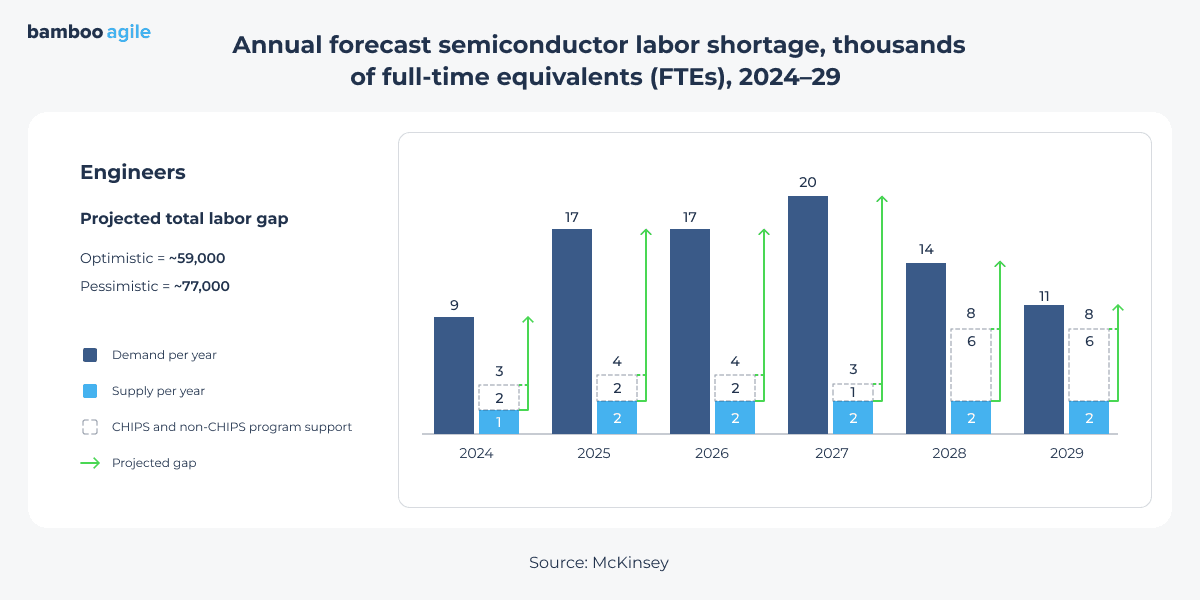
Electronica, an international trade fair for the electronics industry, reported that 65% of 200 leading embedded systems companies surveyed are struggling to fill vacancies. Moreover, McKinsey’s 2024 analysis found the U.S. semiconductor industry alone (a field closely tied to embedded and IoT hardware), could face a gap of 59,000 to 146,000 engineers and technicians by 2029.
An outsourcing partner already has that talent on staff, so a company gets access to it immediately instead of running a months-long search that might not even succeed.

When a company comes up with an idea for an IoT product, a few scenarios are possible.
The company has expertise in both hardware and software. Great, you can go ahead and build the product in-house. But that case is fairly rare.
The team has the expertise and technology base to build the hardware part, and say they can even handle the embedded software for the device itself, the control box. What’s left is the IoT hub, or monitoring center, the mobile app, and any specialized apps for statistics and analytics, and those are exactly the specialists that come from an outside team.
The company has the expertise and resources to build the software. So what do you do about the hardware specialists it doesn’t have? Right, bring in a partner who does.
There is one more case: the product’s already built, but the client is in a location with no office and no local team, no specialists on the ground at all. What do you do? Right, outsource the support to people who are already there.
Yauheni Dzemyachenka, Head of Product Delivery at Bamboo Agile
Faster time to market
A team that has already shipped similar products moves faster, because it is not learning the hardware quirks and integration pitfalls for the first time. There is a real-world example.
When Traeger Grills’ IoT vendor shut down its platform, the company had three months to migrate 111,000 connected grills and 700,000 mobile accounts, or the app controlling customers’ actual grills would stop working. They turned to OST, an AWS Select IoT Consulting Partner, to help them replatform IoT-connected grills. As a result, the project hit the deadline with zero downtime.
A migration of that size in three months only happens when someone has already done it and knows where the problems hide.
The same logic holds on the hardware side, where finding a reliable manufacturing partner is its own project, one most companies would rather not repeat from scratch:
I also want to talk about the hardware side. We have our own technical base for building device prototypes, pilots, and MVPs. But that’s dozens of units, not hundreds, and definitely not thousands. For larger batches, we work with manufacturing partners abroad. And even there, there’s a catch. We went through a long process choosing a factory. Not every factory is great. We went through four different options before we found the one that gave us what we needed: a defect rate under 5%, a factory representative always reachable 24/7 with an almost instant response time, and its own logistics agents in many locations worldwide who handle delivery and customs clearance, taking almost that entire headache off the client’s plate.
What went wrong with the previous four factories: defect rates as high as 25%, deviations from the spec, slow response times, and so on. If you do not want to go through that same search for a manufacturer yourself, then you might want to outsource the hardware side of your product.
Yauheni Dzemyachenka, Head of Product Delivery at Bamboo Agile
Lower total cost of ownership
There are such systems as device provisioning, fleet monitoring dashboards, or OTA update pipelines, that company has to keep staffing, patching, and scaling for as long as the product is alive. As a rule, that ongoing cost does not show up in the initial budget estimate.
A good outsourcing partner has usually already built that infrastructure once and now runs it for many clients at the same time. The savings, in other words, are not just a cheaper hourly rate. They come from not having to construct and maintain something from scratch that someone else has already built, tested, and hardened.
Flexible scaling
A pilot project can connect several hundred devices, and a full IoT implementation can reach tens of thousands within one quarter. No internal hiring plan can withstand such a leap, and no one wants to fire half of the team after the implementation is complete.
On the contrary, a partner’s team can grow due to a large-scale implementation, and then shrink without anyone else’s work, depending on the project calendar. This seems to be a common occurrence. According to the ISG index for the 2nd quarter of 2025, outsourcing of engineering, research and development grew by 35% year-on-year.
Should you build your IoT project in-house or outsource? Take the quiz
The right approach to whether you outsource IoT development or build in-house depends on what your team already has. Hardware expertise, firmware skills, cloud experience, project complexity, and available resources can all affect the decision.
In-house vs. outsourced vs. hybrid IoT development
There are really only three ways to staff an IoT project, and most companies default to whichever one they are already set up for rather than the one that actually fits the project.
In-house means your own engineers own the whole stack – hardware, firmware, cloud, and the application layer. You have full control of the roadmap and intellectual property, and nobody has to explain your product to an outside team. The cost, however, is speed and depth.
Fully outsourced model is when a partner brings the whole stack, hardware selection through cloud, and often keeps running it after launch. That is fast to start and covers gaps a company can’t fill on its own.
Hybrid is somewhere between the two, and in practice it is the most common setup for large enterprises running IoT at scale. The company keeps whatever gives it the most competitive advantage in-house and hands off the more specialized or repeatable pieces.
I think this model works well in a few situations.
One is when the client wants to build up their own expertise in this area, they can put their people right alongside the outsourcing team.
Another is when the client already has some groundwork of their own in place. And then there’s support: at least the first line is often on the client’s side.
Yauheni Dzemyachenka, Head of Product Delivery at Bamboo Agile
A typical version of a hybrid setup looks like this:
- The in-house team owns the system architecture and the data model, since that is where the product’s real IP lives and where internal knowledge of the business matters most.
- Firmware development and the cloud backend, on the other hand, go to an outside team, since those are the parts that require deep, narrow expertise (RTOS internals, connectivity protocols, secure boot, fleet management infrastructure) that a specialized partner has already built more than once.
- The in-house team still reviews and approves the architecture decisions, so the company never loses visibility into how the product actually works.
That split matters because it is usually not an all-or-nothing decision. A company does not have to choose between owning everything and owning nothing. It can decide, layer by layer, where in-house knowledge is worth protecting and where outside expertise gets the product to market faster.
| Criteria | In-house | Outsourced | Hybrid |
|---|---|---|---|
| Control | Full, direct control over process and decisions | Limited, dependent on vendor management | High on strategy/architecture, shared on execution |
| Cost | High – salaries, training, and infrastructure | Lower – project or milestone-based, no overhead | Moderate – balances fixed and flexible costs |
| Speed to start | Slow – hiring, onboarding, and training | Fast – ready-to-go team with existing tools | Moderate – internal team ramps while vendor starts immediately |
| Expertise breadth | Limited to who you hire | Cross-industry, cross-project experience | Internal domain knowledge + external specialist skills |
| Scalability | Difficult to scale quickly | Easy to scale up or down with demand | Flexible – core team stable, specialists added as needed |
| IP and security control | Full internal ownership | Requires contractual safeguards | Core IP stays internal, peripheral work outsourced |
| Best for | Core, long-term differentiating products | Non-core components, tight timelines, and limited budget | Complex projects needing both control and specialist skill |
The cost of outsourcing IoT development in 2026
The cost of an IoT project depends on more than the developer’s hourly rate. Hardware work, embedded development, cloud architecture, connectivity, security, and testing can all require different specialists. The development team’s location also has a direct effect on the budget.
Regional hourly rates: EU, Americas, and Asia compared
Hourly rates outsourcing IoT development vary considerably between regions. North American teams usually sit at the higher end of the market, while many Asian markets offer lower rates. European teams tend to fall between the two, although there are significant differences from one country to another.
The Baltics are worth a closer look for outsourcing IoT development. Countries such as Estonia or Lithuania have strong digital infrastructure and mature technology sectors, while English is widely used in professional and technical work. This can make communication easier without moving to the higher rates common in some Western European and North American markets.
| Region | Hourly rate (USD / EUR) | Notable strengths |
|---|---|---|
| Eastern Europe (Poland, Romania, Ukraine) and Baltics (Estonia, Latvia, Lithuania) | $35-$70 / €32-€65 | Strong software/IoT engineering talent, EU membership and regulatory alignment (GDPR, CRA), high English proficiency |
| Western Europe | $75-$140 / €70-€130 | Maximum regulatory and cultural alignment, strong for regulated industries |
| India | $18-$45 / €17-€42 | Largest talent pool, strong cloud IoT and SaaS integration layers |
| Southeast Asia (Vietnam, Philippines, Indonesia) | $22-$50 / €20-€46 | Cost-competitive, scaling rapidly in embedded systems |
| Latin America | $30-$60 / €28-€56 | Minimal time zone gap with the US, growing embedded talent |
| USA / Canada | $110-$200 / €102-€185 | Regulatory fluency for US-market products, full US time zone alignment |
Cost by engagement type: PoC, MVP, and full IoT platform
The project stage has an even bigger effect on the total budget. A proof of concept may need only a small team and a limited number of devices. An MVP usually adds production-ready firmware, backend services, user interfaces, and more extensive testing. A full IoT platform can involve device management, cloud infrastructure, analytics, security, integrations, and long-term support.
| Engagement type | Typical cost range (USD / EUR) | Duration estimate |
|---|---|---|
| Proof of Concept (PoC) | $15,000-$55,000 / €14,000-€51,000 | 4-12 weeks |
| Minimum Viable Product (MVP) | $55,000-$175,000 / €51,000-€162,000 | 3-6 months |
| Full IoT platform (firmware + cloud + apps) | $175,000-$1,000,000+ / €162,000-€880,000+ | 9-24 months |
| Ongoing maintenance and support retainer | $5,000-$25,000 / €4,600-€23,000 per month | Ongoing |
These figures are benchmarks. The final estimate depends on the number and type of devices, connectivity requirements, cloud architecture, integrations, security requirements, and the amount of hardware development involved.
Offshoring vs nearshoring
Nearshore and offshore approaches to outsourcing IoT development solve slightly different problems. Offshore teams can offer access to a larger global talent pool and lower development rates. On the other hand, nearshore teams usually cost more, but the smaller time-zone gap makes day-to-day work easier.
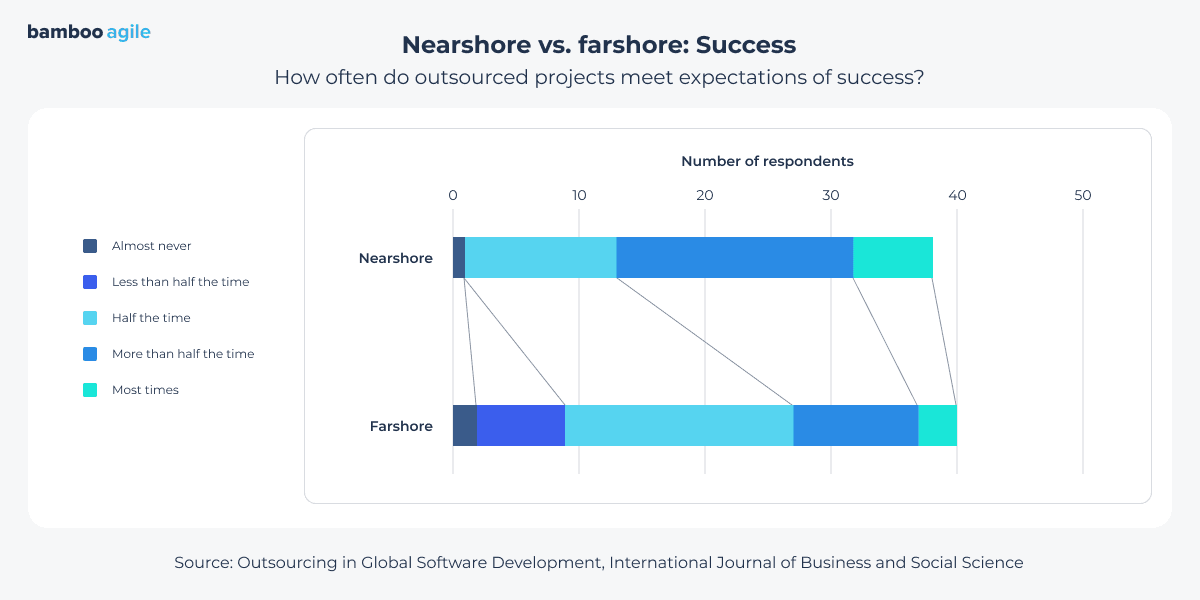
A recent study of software development outsourcing published in the International Journal of Business and Social Science found that nearshore teams had better results than far-offshore teams in overall project success, quality, schedule performance, communication, and project-management effort. The researchers based their findings on 80 customer surveys and six interviews and concluded that nearshore is particularly suitable for projects with a high need for communication.
Why does that distinction matter in IoT? A connected product can involve hardware, firmware, connectivity, cloud infrastructure, and physical testing at the same time. A change in one layer can affect several others, so some projects benefit from having engineers and product teams available during the same working day.
What it means for European companies
For a European client, nearshore usually means the Baltics or Eastern Europe. Asia is the more typical offshore option.
The Baltics are not interchangeable, though, and the region as a whole punches well above its weight. Despite a combined population of just over six million people, Estonia, Latvia, and Lithuania are home to 17 unicorns and roughly 33,000 startups. Those startups raised €607 million in 2025 alone, up 20% year over year. Lithuania has carved out its own niche in fintech and software specifically, home to engineering teams for companies like Revolut, Nasdaq, and Vinted.
Within that regional picture, Estonia stands out as a particularly digital economy. The European Commission’s 2025 Digital Decade report says that 52.6% of Estonian businesses used cloud services, compared with 38.7% across the EU. Business use of AI also rose from 5.19% in 2023 to 13.89% in 2024. Estonia also had an estimated 10 edge nodes in 2024.
The country’s engineering talent base is another relevant factor. In the European Commission’s 2024 report, ICT specialists accounted for 6.7% of employment in Estonia, compared with 4.8% across the EU.
English proficiency level provides useful context as well. Estonia scored 561 in the 2025 EF English Proficiency Index, compared with a global average of 488. Tallinn, in particular, scored 582.
For a European IoT project, these factors can make Estonia attractive. The time difference with most European markets is small, travel is relatively straightforward, and the country already has a strong digital environment.
Offshore development in Asia can be more appropriate when the project is easier to divide into independent work packages. A mature IoT platform with established architecture, documented interfaces, and stable requirements needs less real-time coordination than a product that is still going through hardware and firmware iterations.
What it means for US companies
For a US client, the usual nearshore region is Latin America. Europe and Asia are geographically offshore, but do not create the same working conditions.
Latin America has the obvious advantage of time-zone alignment with the US. That makes it a strong option when the development team needs to work closely with the US product organization throughout the day.
Europe introduces a larger time difference, but it is still manageable. A US East Coast client and a European engineering team can have several hours of overlap during the workday. A US West Coast client has less overlap, although the team can agree on a fixed period for meetings, technical reviews, and urgent questions.
That makes a European partner a reasonable option for a US company when technical expertise matters as much as proximity. This can be particularly relevant for an IoT product intended for the European market, where the development team may need familiarity with European connectivity ecosystems, industrial customers, or regulatory requirements.
The time-zone difference therefore becomes one factor rather than a deal-breaker.
IoT outsourcing engagement models
How you pay for outsourcing IoT development shapes the relationship as much as who you hire. Below are the four most common models, what each one costs, and where each one actually fits.
Dedicated development team
You pay a recurring fee, usually monthly, for a team of engineers who work exclusively on your product, often embedded in your processes like an extension of your own staff. This model fits long-running IoT products where the roadmap keeps expanding after launch.
The main benefits are:
- Team continuity, since the same engineers stay on the product and build institutional knowledge
- Predictable monthly budgeting as the fee does not swing with hours logged
- Direct involvement in daily standups and planning, closer to managing an internal team.
Staff augmentation
Here, rather than fully outsource IoT development services, you pay an hourly or monthly rate to add specific specialists into your existing internal team. You keep full control of the roadmap and process and the outside engineer just fills a skill gap you do not have in-house.
Advantages of this model include:
- Closing a narrow skill gap fast, without restructuring your whole team or process
- Keeping architectural decisions and IP ownership entirely internal
- Scaling the headcount up or down as a specific need appears or disappears.
Time and materials
You pay for actual hours and resources used, tracked and billed as the work happens, with the scope allowed to shift as you learn more.
Among its pros are:
- Changing direction mid-project without renegotiating a contract every time
- Paying only for work actually done
- Starting development before every requirement is fully locked down.
Fixed price for project-based outsourcing
You agree on one price for a clearly defined deliverable up front, like a specific firmware module or a mobile app with a locked spec.
What this setup is reasonable:
- Budgeting with a hard number instead of an estimate that can drift
- Handing off a self-contained piece of work with a clear finish line
- Holding the vendor accountable to a specific, agreed-upon outcome.
What can you outsource in an IoT project?
Some parts of an IoT project are common candidates for outsourcing IoT development. These are usually areas that require specialist skills, physical testing facilities, or experience.
Proof of concept and MVP development
A proof of concept helps answer a basic question, which is does the idea work in practice? At this stage, you may have only a few sensors, a simple device prototype, and a basic dashboard. There is usually little value in building a full production system before you know that the core concept works.
An external team can help build this first version and test the main technical assumptions. They can also point out issues that are easy to miss at the start, such as unsuitable hardware, poor connectivity, or power requirements that make the original design impractical.
There is another advantage here. A small proof of concept gives you a relatively low-risk way to assess an external team before you give it responsibility for a production system.
Embedded firmware development
Firmware controls what happens inside the device. It manages sensors, power use, communication, memory, and other hardware functions. Because the code runs so close to the hardware, mistakes can be difficult to diagnose and expensive to fix once devices are already in the field.
This is also a specialist area. A strong firmware engineer needs practical experience with microcontrollers, real-time operating systems, communication protocols, and low-level debugging. Those skills do not always exist within a company’s general software team.
Connectivity implementation
An IoT device needs a reliable way to communicate with the rest of the system. Depending on the use case, that might mean cellular, Wi-Fi, Bluetooth, LoRaWAN, or satellite connectivity.
The choice affects much more than network coverage. Power consumption, hardware cost, data volume, certification requirements, SIM management, and the physical environment all play a role. A solution that works well in a lab may perform very differently inside a warehouse, underground, or across a large outdoor site.

People underestimate how hard reliable data transmission actually is until they’re outside a controlled environment. Wi-Fi works great in an office, NB-IoT coverage is solid within city limits, but put a sensor on a real factory floor, out in a rural area, or down in a mine, and you’re dealing with metal structures, interference, distance, and batteries draining faster than expected. Projects fail when it turns out the sensor doesn’t hold a reliable connection and keeps dropping out.
Dmitry Fostiy, Head of IoT and Hardware Engineering at Bamboo Agile
A connectivity specialist can help with both the technical choice and the practical implementation. It is worth solving these questions early because a connectivity problem discovered during a pilot can force changes to the hardware itself.
Cloud infrastructure and platform development
The cloud platform sits between the devices and the people or systems that use their data. It receives device messages, stores them, processes events, manages device state, and exposes the data to applications and dashboards.
IoT platforms also have some requirements that differ from ordinary web applications. Devices may connect intermittently, send large numbers of small messages, reconnect in batches, or remain offline for long periods. The architecture therefore needs to account for device identity, message delivery, data retention, fleet growth, and failure recovery from the start.
An external team with direct IoT platform experience can be useful here, especially when the internal development team has strong web or enterprise software skills but limited experience with connected devices.
Data management and analytics
IoT projects often use time-series databases and data pipelines that differ from the systems used for typical business transactions. An external data team can build this layer and prepare the information for dashboards, reports, alerts, or further analysis.
That can also leave the internal team free to focus on the business questions behind the data. For example, which readings indicate a maintenance problem? What counts as an abnormal operating condition? Which measurements actually matter to the customer?
Machine learning integration
An IoT solution may need to run inference on a low-power device, deal with incomplete data, or update a model as equipment and operating conditions change. These constraints require a different approach from a typical cloud-based ML project.
If the internal team has little IoT or ML experience, an external specialist can help with the initial model, data pipeline, and deployment approach. It is still important to define who will own the models and data once the system moves into production.
Security engineering
Security deserves attention from the first hardware prototype. IoT devices can be physically accessible, may remain in service for years, and often have fewer opportunities for software updates than phones or laptops.
A lot of projects start out using raw, unprotected protocols and open passwords, just to get something working. Then the company realizes an unsecured sensor could be an entry point into the corporate network, and the whole project gets frozen.
Dmitry Fostiy, Head of IoT and Hardware Engineering at Bamboo Agile
An external security team can cover such areas as firmware security reviews, penetration testing, secure boot, device authentication, key management, and a software bill of materials (SBOM).
Independent testing can also provide a useful second perspective. Internal developers know how a system was designed, but an external security team is more likely to approach it from the perspective of someone trying to break it.
Quality assurance and hardware-in-the-loop testing
IoT QA must cover both software and physical devices. A system may work perfectly under normal conditions and still fail when a battery loses capacity, a sensor reaches an extreme temperature, or a network connection disappears for several hours.
Hardware-in-the-loop testing can reproduce some of these conditions before deployment. Many software teams do not have in-house equipment or specialist processes required for this type of testing.
Post-launch maintenance and device lifecycle management
IoT products need ongoing support after launch. Devices require firmware updates, health monitoring, troubleshooting, and, eventually, a plan for hardware retirement.
Companies often outsource IoT development work when they lack the resources for continuous fleet monitoring and support. An external team can handle routine maintenance and the internal team focuses on the product.
Common challenges of outsourcing IoT development (and how to solve them)
Security vulnerabilities in outsourced code
When you outsource IoT development, handing a partner access to your codebase also gives them access to your attack surface. Verizon’s 2025 Data Breach Investigations Report, based on more than 22,000 security incidents worldwide, found that third-party involvement in breaches doubled year over year, from 15% to 30%.
Part of the risk comes from how deeply an outsourced product ends up wired into a client’s own systems, not just running alongside them:
Code vulnerabilities are something you have to be really careful about, and the reason is that the product’s software usually ends up integrated into the client’s own infrastructure. That integration is a challenge in its own right, actually, since every client’s environment comes with its own requirements. We’ve had a client insist we use their database server, MS SQL, even though our product runs on PostgreSQL by default, and that took real effort to make work. Another required the mobile app to be distributed exclusively through their own MDM environment. Every one of those we’ve worked through without major issues, but each one also meant more surface area to secure.
Yauheni Dzemyachenka, Head of Product Delivery at Bamboo Agile
Bamboo Agile builds security into the architecture from the start rather than testing for it afterward. We work under ISO/IEC 27001 information security standards, with encryption, secure boot, and encrypted OTA updates part of the initial design. That will not remove the risk entirely, no partner can promise that. However, it means that security decisions get made before a device ships, so there is no reverse-engineering once something’s already gone wrong.
Quality assurance gaps
IoT products fail in a specific way. Hardware and software have to be tested together, under real conditions like heat, vibration, or a dropped signal. Skipping that step under deadline pressure is tempting, since a simulator will happily report that everything passed.
But for our team hardware-in-the-loop testing is not an optional extra. We check devices against the real conditions they will face in the field before anything reaches a customer.
Time zone and communication friction
This one gets dismissed as a minor inconvenience more often than it should.
Harvard Business School research published in Organization Science in 2024 found that a single extra hour of time difference between colleagues cuts real-time communication by 11%, and shrinks the daily window for live collaboration by 19%.
Thus, being based in Estonia gives Bamboo Agile solid overlap with both US and European business hours. This is especially important in IoT, since a firmware bug found overnight can sit untouched for a full day if nobody’s awake to see it.
Intellectual property exposure
Deep technical access cuts both ways. Insulet found that out the hard way when several engineers who understood the details behind its Omnipod insulin pump later worked with a competing device maker, EOFlow, on a strikingly similar product. A jury initially awarded Insulet $452 million in damages, later reduced to $59.4 million (though a federal appeals court overturned the verdict in May 2026, ruling that Insulet had simply waited too long to sue after first learning about the alleged theft, not that the misappropriation never happened).
At Bamboo Agile, we define IP ownership in the contract before the engagement begins. The agreement specifies that the work created for the client belongs to the client, including the relevant source code, documentation, and project deliverables. We also distinguish client-owned work from pre-existing and third-party components, so there is a clear record of what the client can use and own after the project ends.
Vendor lock-in
A client should not have to depend on its development partner to access or operate its own product. Therefore, we keep the key technical assets accessible to the client throughout the engagement. This includes source code, documentation, and infrastructure configuration.
Moreover, such an approach makes a future handover easier. If the client decides to bring development in-house or move the project to another team, the new team has the materials it needs to take over without rebuilding the product from scratch.
Knowledge transfer at project completion
A project that ends without a proper handoff leaves a company owning a product it does not fully understand. This tends to surface months later, when a bug appears and nobody internally knows why a particular design decision was made, because the reasoning lived in a Slack channel that no longer exists.
Our team documents architecture changes, important technical decisions, and setup details throughout the project. This gives the client something useful to work with after the handoff.
Physical logistics and on-site support
Software-only outsourcing ends the moment code ships. IoT doesn’t work that way, since a physical device still has to arrive, get installed, and occasionally get looked at by someone standing in front of it, not just diagnosed over a network connection.
With IoT, it’s not enough to just deliver software by installing it in some cloud or publishing it in app stores. You have to handle the delivery and installation of the hardware too. And there’s support, at least the first line – someone has to physically show up and look at what happened if remote diagnostics didn’t work for some reason.
Yauheni Dzemyachenka, Head of Product Delivery at Bamboo Agile
How to choose an IoT development partner
Questions to ask before signing a contract
A good sales pitch and a good engineering team are not always the same thing, and the gap between them tends to show up only after the contract is signed. Here is what to ask, and what each answer actually tells you.
- Can you show examples of your last IoT projects? You want to know whether they have shipped real products still running in the field.
- Which microcontrollers, connectivity protocols, and cloud platforms have you worked with in production? This tells you whether their experience actually matches your stack.
- What is the largest device fleet you’ve supported after launch? The answer shows whether they have dealt with fleet-scale problems, like OTA failures or provisioning problems, or only ever built small pilots.
- What does post-launch support and maintenance look like once the initial build is delivered? Here you are checking whether you will be left maintaining a product you don’t fully understand once the build phase ends.
- How do you handle hardware-in-the-loop testing? Can you describe your test environment? A specific answer suggests bugs get caught before shipping; a vague one suggests they get caught on real devices in your customers’ hands.
- How do you handle security by default, secure boot, encrypted OTA updates, and a software bill of materials? The answer shows whether security is built in from the start or treated as an optional extra.
- What does the knowledge transfer process look like if we end the engagement or bring development back in-house? This tells you whether you will be able to leave cleanly, or end up stuck depending on them indefinitely.
Red flags that should disqualify a vendor
Some warning signs are only obvious once you know to look for them. Catching them before a contract is signed is far cheaper than catching them six months into a build. Here they are:
- The portfolio contains no connected-device projects. Web and mobile app experience does not transfer to firmware, connectivity, and hardware-software integration the way a sales deck might suggest. If every case study is a website or a CRM tool, that is not an IoT portfolio.
- No security certifications and no documented security process. If a vendor cannot point to something like ISO 27001, SOC 2, or at minimum a written process for secure boot and vulnerability handling, security is not a discipline for them.
- Post-launch support is not discussed. If a proposal talks entirely about the build and goes quiet on what happens after devices ship, that is a strong sign the vendor sees the relationship ending at launch, right when a device fleet actually starts generating problems.
- A detailed proposal arrives within 24 hours of a complex technical brief. A thorough, specific proposal for a nontrivial IoT project takes real analysis. A fast, polished response to a complicated brief usually means a templated pitch got reused.
- Pricing is dramatically lower than every other quote for the same scope. IoT engineering talent is scarce and not cheap anywhere. A quote well below the market usually means corners get cut somewhere, often in testing or security, since those are the easiest things to skip without it showing up immediately.
- They push back on independent security testing or code audits. A vendor confident in their work has no reason to resist a third-party review. Resistance here is one of the clearest signals something wouldn’t hold up to scrutiny.
Why outsource IoT development to Bamboo Agile
Everything in this guide points to the same conclusion – the decision to outsource IoT development pays off when a project is not built entirely from a standing start. Bamboo Agile is an ISO-27001 certified company that has been building telecom and connectivity solutions since 2002. For our clients this means the team has been through more than one generation of connectivity standards, cloud platforms, and device form factors.
The service lineup is built around the actual stages an IoT product goes through, rather than one generic ‘we do IoT’ offering:
- IoT consulting for companies still shaping the idea, covering strategy planning, business case development, and technology selection before any code gets written, which matters given how many IoT projects in this guide’s earlier sections stalled at the proof-of-concept stage from unclear scope rather than bad engineering.
- IoT software development covers the layers a connected product actually needs: firmware for microcontrollers and edge devices, backend data pipelines for ingestion and processing at scale, and the APIs, dashboards, and mobile apps stakeholders use to monitor everything.
- Enterprise IoT for large organizations running IoT across many sites, adding the program-level work, C-level strategy workshops, multi-year roadmaps, ROI modeling tied to real operational data, that a single project team usually is not positioned to handle.
- Industrial IoT for manufacturing and industrial clients specifically, focused on production-ready systems for asset health monitoring, predictive maintenance, and MES/ERP integration, with security built into the architecture from the first deployment rather than added once the system is live.
Across these services, Bamboo Agile covers the full IoT stack end to end, including:
- Circuit diagram and PCB design, plus embedded firmware for microcontrollers and edge devices
- Connectivity across BLE, LoRaWAN, NB-IoT, Zigbee, and cellular
- Cloud platforms including AWS IoT Core, Azure IoT Hub, and Google Cloud IoT, with dashboards and mobile apps layered on top
That range, from a single firmware module to a full-stack platform with years of post-launch support, covers most of what a growing IoT product will need along the way. So if you are considering outsourcing, reach out to us for a free initial consultation, and we will discuss your case.